


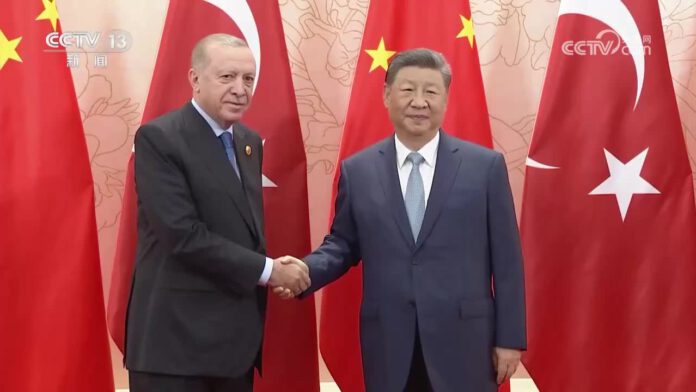
Turkey occupies a pivotal position along the Belt and Road Initiative (BRI) and remains one of the most influential powers in the Middle East. Since China and Turkey established a strategic cooperative relationship in 2010, bilateral ties have undergone a steady, if sometimes uneven, transformation. As 2025 marks the 15th anniversary of that upgrade, the trajectory of the relationship reveals both structural resilience and persistent constraints.
Over the past decade and a half, China–Turkey relations have evolved through several distinct phases. The early period following the 2010 strategic upgrade was characterized by cautious engagement. While Beijing actively promoted cooperation, enthusiasm in Ankara was comparatively restrained, partly due to limited understanding of China and lingering policy misperceptions.
This dynamic shifted after the failed coup attempt in Turkey in July 2016. At a moment when many Western governments publicly criticized Ankara’s domestic response, China adopted a more supportive tone. High-level exchanges soon followed, including President Recep Tayyip Erdoğan’s participation in the 2016 G20 Hangzhou Summit and the 2017 Belt and Road Forum in Beijing. These moves signaled Turkey’s recognition that deeper engagement with China could diversify its foreign policy options.
The period beginning in 2019 introduced new strains. Public comments by Turkish officials on China’s policies in Xinjiang created diplomatic friction and briefly disrupted bilateral momentum. However, Erdoğan’s visit to China later that year helped stabilize ties, and cooperation during the COVID-19 pandemic, including Turkey’s use of Chinese vaccines, restored a measure of mutual trust.
By mid-2024, renewed high-level visits, including Turkey’s foreign minister traveling to Xinjiang, suggested that both sides were seeking to consolidate the relationship on a more pragmatic footing. Turkey’s formal application in 2024 to join the BRICS cooperation mechanism, making it the first NATO member to do so, underscored Ankara’s desire to broaden its strategic partnerships beyond the Western alliance system.
Economically, the relationship has deepened but remains structurally imbalanced. China is now Turkey’s second-largest trading partner globally and its largest in Asia, as well as Turkey’s primary source of imports. Bilateral trade reached approximately $42.9 billion in 2024. Chinese firms have expanded their footprint in Turkey through infrastructure projects and acquisitions, including stakes in ports, banking, railways and energy facilities. Flagship BRI-linked projects such as the Ankara–Istanbul high-speed railway and the Hunutlu power plant have raised the visibility of Chinese investment. Financial cooperation has also advanced, with the renewal and expansion of a bilateral currency swap agreement in 2025.
Yet the composition of trade reflects persistent asymmetry. Turkey’s exports to China remain concentrated in raw materials, while it imports higher value-added manufactured goods and machinery. Moreover, Turkey’s domestic economic challenges—high inflation, external debt pressures and fiscal strain—inject uncertainty into long-term planning. For Chinese investors, Turkey’s economic resilience is often noted, but concerns about macroeconomic volatility and the so-called “middle-income trap” cannot be ignored.
Politically, institutional mechanisms have strengthened. The intergovernmental cooperation committee established in 2015 provides a structured framework for dialogue across political, economic and cultural domains. High-level meetings between leaders and foreign ministers have become more frequent, reinforcing strategic communication. Turkish leaders have reiterated support for the one-China principle and opposition to terrorism targeting China, positions that Beijing views as central to political trust.
However, counterterrorism remains a sensitive issue. For China, it is tied directly to sovereignty and internal stability; for Turkey, it intersects with its own complex security environment, including tensions with Kurdish groups and shifting dynamics in Syria and the broader region. Whether the two sides can translate rhetorical alignment into deeper operational cooperation will shape the ceiling of the relationship.
Cultural and people-to-people exchanges have expanded but lag behind economic and diplomatic ties. Tourism flows have increased, sister-city partnerships have multiplied, and academic institutions in both countries have established research centers and language programs.
Confucius Institutes operate in Turkey, while Turkish cultural institutions maintain a presence in China. Nevertheless, mutual understanding remains limited. In Turkey, China studies face resource constraints and are often filtered through Western academic frameworks. In China, Turkish studies is growing but still comparatively niche. The result is a gap between strategic ambition and societal familiarity.
Looking ahead, the potential for further development is evident but not automatic. Turkey’s domestic political landscape adds urgency to economic cooperation. Following setbacks in local elections in 2024, Erdoğan and the ruling Justice and Development Party face mounting pressure to deliver tangible economic improvements before the next national elections. Deeper Chinese investment, expanded market access for Turkish goods and enhanced industrial cooperation could offer Ankara economic breathing space while serving Beijing’s connectivity ambitions.
At the same time, expanding subnational diplomacy may prove crucial. Many of Turkey’s largest cities are governed by opposition parties, suggesting that diversified engagement beyond central authorities could broaden the foundation of bilateral ties. Limited but symbolic military exchanges, such as past participation in joint exercises, could also reinforce strategic dialogue, though such steps would require careful calibration given Turkey’s NATO membership.
Ultimately, China–Turkey relations sit at the intersection of opportunity and constraint. Both countries seek greater strategic autonomy in an era of shifting global power balances. Turkey aims to position itself as an energy and geopolitical hub linking Asia and Europe; China views Turkey as a critical corridor in westward connectivity. Their ambitions converge in principle, yet structural economic imbalances, geopolitical sensitivities and limited societal familiarity complicate the path forward.
As the two countries approach the 55th anniversary of diplomatic relations in 2026, the question is not whether cooperation will continue, but whether it can move from pragmatic alignment to deeper strategic synergy. In a world marked by fragmentation and realignment, a more mature China–Turkey partnership would carry implications not only for bilateral ties, but also for the broader Eurasian order.
Source: world affairs, mfa gov cn, mesi shisu