


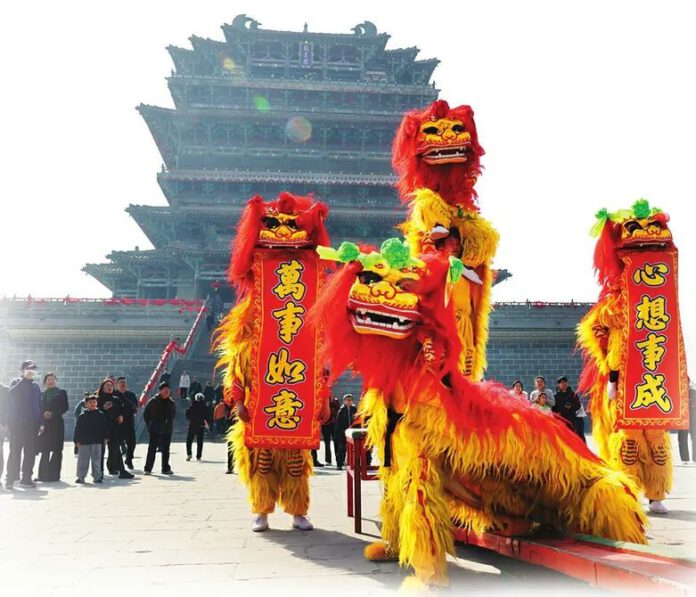
Spring Festival, or Chinese New Year, is the most important festival for the Chinese people, marking a time for praying for blessings, warding off misfortune, and welcoming the new year.
In the ancient land of Shanxi, the customs surrounding the celebration are particularly long-standing and rich. In the lunar calendar, the first day of the first month is called New Year. Traditionally, after the Laba Festival, people in Taiyuan start preparing for the New Year, with the atmosphere growing more festive each day.
On the twenty-third day, the Kitchen God is honored, and the twenty-fourth marks a thorough house cleaning day. From this point, preparations reach a peak. Taiyuan locals used to follow the saying: “25th, grind tofu; 26th, finish work; 27th, go to the market; 28th, paste decorations; 29th, buy liquors; 30th, make dumplings.” Every day is full of tasks until the afternoon of New Year’s Eve, when the outdoor cleaning is finished, new clothes are prepared, dumplings are made, and offerings such as incense and lamps for welcoming deities are arranged.
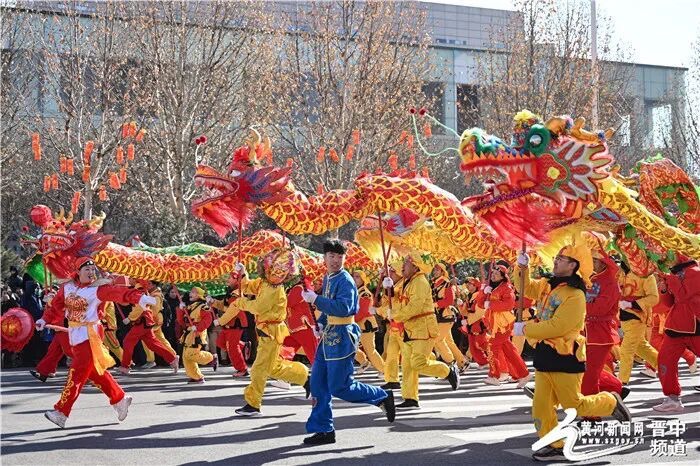
On New Year’s Eve, families stay up all night, a practice called “Ao Sui.” At the rooster crow, incense is burned, lamps are lit, offerings are placed, fireworks are set off, deities welcomed, and ancestors worshipped, followed by family greetings. Children kowtow to elders, who in turn give red envelopes for good luck. Traditionally, breakfast is finished before sunrise, and people set out to visit relatives and friends, exchanging greetings like “Happy New Year,” “Wishing you wealth,” or “A year of happiness.”
Merchants pay special respect to the God of Wealth during the New Year. Before the late Qing dynasty, worship was held on the fifteenth day of the third lunar month and the twenty-second day of the seventh month. After the Republican era, it became customary to offer incense and food at the God of Wealth altar only during the New Year before visiting business associates.
The fifth day, “Po Wu,” was traditionally a day to stay home; the sixth was suitable for travel and marked the reopening of businesses. The seventh day, “Renri,” celebrated human beings’ birthdays, with favorable weather believed to ensure prosperity. On the eighth day, stars are worshipped at dusk, with seven lamps lit to honor the Big Dipper and bring good fortune. The tenth day, “Shi Bu Dong,” commemorates the day mice are said to marry. From the thirteenth to the sixteenth, the Lantern Festival brings bright lights and lively folk performances. The twentieth is “Xiao Tian Cang,” and the twenty-fifth “Lao Tian Cang,” when market officials are worshipped, and firecrackers are set off. Only after the Tian Cang festival does the New Year excitement fully wind down.
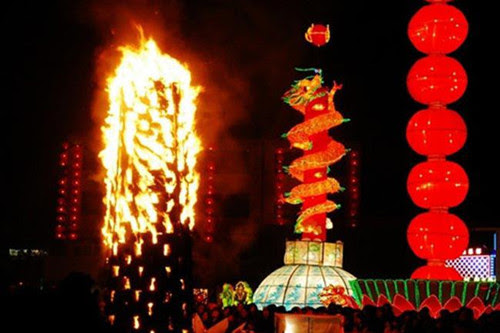
The Shanxi “Wang Huo” tradition during the New Year symbolizes the renewal of fire at the turning of the year. Historical records from the Ming dynasty by Lu Shen describe households setting up large furnaces with stones and coal, burning through the night in a practice called “Bu Tian,” recalling the legendary repairs of the sky by Nüwa. Shanxi’s abundant coal resources shaped the tradition, with different regions preparing fire differently: in northern Shanxi, large coal blocks form the fire tower; central and southern Shanxi use wood, cypress branches, and straw; southeastern Shanxi shapes mud sculptures filled with coal, often in forms like zodiac animals or lions. In rural areas, fire towers are lit on New Year’s Eve, doors are decorated with cypress, and children eat boiled pumpkin, symbolizing a fresh start. Offerings of millet are made to ancestors, and the fifth day marks yard cleaning.
From hanging prayer bells on Mianshan Mountain to visiting the Great Pagoda Tree in Hongtong, from worshipping at Jiezhou Guandi Temple to witnessing the carp leap over the Yellow River dragon gate, each ritual embodies hopes for the new year and reflects Shanxi’s rich cultural heritage.
Mianshan, famous as the retreat of Jie Zitui and birthplace of the Cold Food Festival, is a sacred site for blessing. During the New Year, people hang prayer bells along the cliffs, the wind causing them to chime, carrying wishes for the year ahead.
The Great Pagoda Tree in Hongtong, immortalized in the folk song “Ask me where my ancestors are, in Hongtong under the Great Pagoda Tree,” draws descendants from all over to seek their roots.
Jiezhou Guandi Temple, the largest and best-preserved temple dedicated to Guan Yu, sees throngs of worshippers during the New Year, praying for safety, prosperity, and success, while Guan Yu’s spirit of loyalty and courage inspires generations.
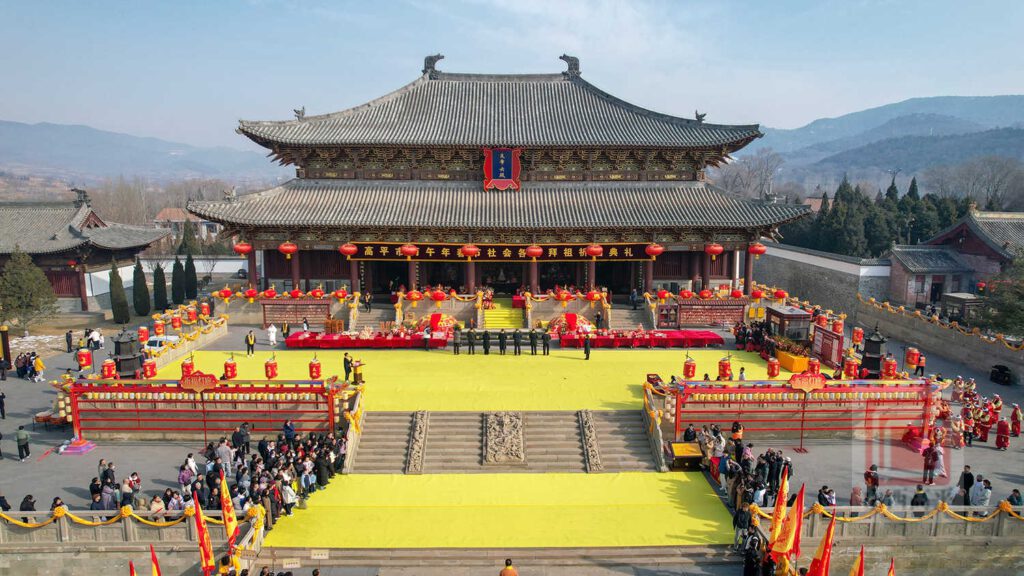
In Gao Ping City, the Yan Emperor Mausoleum hosts grand ancestor-worship ceremonies on New Year’s Day, drawing tens of thousands of visitors who follow ancient rites of drumming, offerings, and bows to honor the cultural progenitor Yan Emperor, wishing for a year of favorable weather, family well-being, and national prosperity. As a global site for ancestral veneration, the Yan Emperor Mausoleum has organized cross-strait folk worship ceremonies for over a decade, enhancing international recognition and boosting local cultural tourism.
Shanxi’s New Year customs, with their deep cultural roots, diverse forms, and vibrant atmosphere, allow all who partake to experience the enduring traditions and hopes of a new year.
Source: sn news, sxgp gov, chinesefolklore, jinsui, gmw, sxwbs