



Ten years ago, Kingdee pioneered the concept of cloud transformation in China. Back in 2014, when digitalization was just beginning for Chinese enterprises, Kingdee decisively shifted from a traditional software company to a cloud service provider. This transformation positioned Kingdee as one of the first management software companies in China to successfully upgrade its business model and laid the foundation for the wave of digital transformation that would follow across Chinese enterprises.
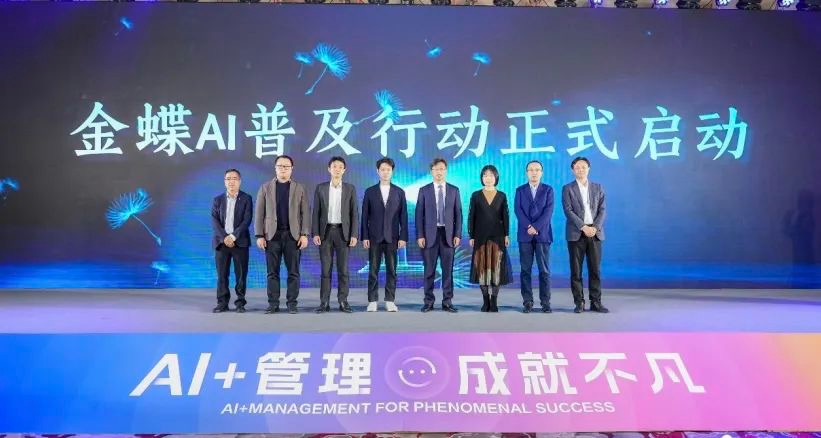
In 2025, Kingdee took another bold step forward. In November, the company announced the rebranding of Kingdee Cloud to Kingdee AI, with Chairman and CEO Xu Shaochun unveiling that AI transformation goes beyond technological upgrades—it requires a systematic reshaping of operations, products, business models, ecosystems, organizational structures, talent, and leadership.
As part of this transition, Kingdee also launched “Little K,” the first enterprise-level AI-native super platform in China, creating a new paradigm for AI-driven enterprise management. Xu underscored that the AI era is not a short-term technology race but a long-term marathon testing an organization’s resilience and strategic endurance. By embracing intelligent transformation with a long-term perspective, Kingdee aims to empower enterprises and elevate Chinese management practices on the global stage.
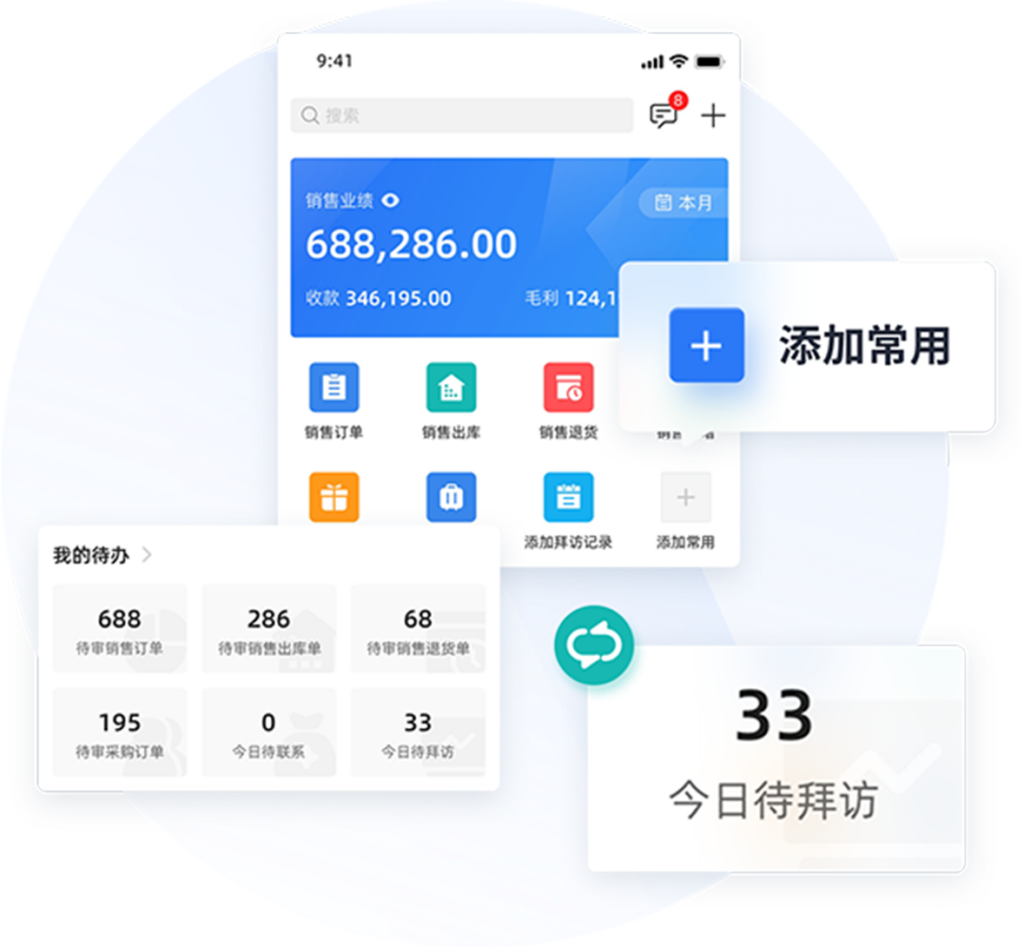
Not only Kingdee, but other ERP providers have also recently upgraded their brands and placed big bets on AI, aiming to seize an early advantage in the wave of industrial intelligence.
This transformation is not just about the development of individual companies—it also affects the large base of clients still reliant on traditional business models and has implications for the global competitiveness of Chinese management practices. Can Chinese software replace SAP, the world’s leading enterprise application provider? How can Chinese companies escape the service-heavy model and achieve exponential growth through productization? In the wave of overseas expansion, how can Chinese enterprises leverage their talent advantage to enter international markets?
Chen Guo, a digitalization expert and founder and chief evangelist of China’s enterprise knowledge open plan (KPro), shared his insights on the AI-driven transformation of enterprise software, the evolving market landscape, and opportunities for Chinese companies to expand globally, highlighting the key path for the IT industry to shift from service-oriented models to product-driven growth.
Kingdee’s transformation affects not only itself but also many clients relying on its traditional business. How do you view this?
Kingdee has already completed the shift of its traditional ERP business from 1990s-era technology to cloud-native architecture. The AI transformation of ERP can take different forms, and one common approach is “AI enhancement,” where AI is integrated into existing products. This allows ERP systems to achieve an initial level of AI capability, which reflects the current industry trend.
ERP has two core functions: running end-to-end business processes like procurement, sales, and production, and recording transactions to generate financial reports, known as “record to report.” Both of these processes can be transformed by AI. Intelligent agents can handle routine workflows, while AI that understands accounting rules can automatically record transactions.
Domestic software may even move faster than foreign competitors because ERP serves the manufacturing sector, and China is the world’s largest manufacturing hub, offering abundant real-world business scenarios. At the application level, despite perceived gaps in large AI model capabilities, domestic ERP software and international products like SAP are essentially on the same starting line.
ERP standardizes organizational operations. After the internet and cloud eras, AI brings new challenges and opportunities—what’s your view?
Traditionally, ERP assumed that if people followed fixed rules, accounting could be automated: first the business activity happens, then bookkeeping is completed according to standards.
However, as we discussed before, Western enterprise software doesn’t always fit seamlessly in China. For example, over the past 20 years, Chinese internet companies have grown rapidly, but their business processes are often poorly standardized. New businesses emerge constantly, rules are unclear, and IT teams spend a lot of effort defining processes. Much of China’s growth has relied on human effort—people solving problems manually—rather than highly automated systems. In the past, low labor costs masked these low-standardization, low-automation issues, but as living standards rise, the gaps become more visible.
AI introduces a new variable. In complex business scenarios, humans can describe processes in natural language, and AI can interpret them, organize logic, execute tasks, and generate structured, standards-compliant accounting information—all under human supervision, or “human-in-the-loop.” While this is still largely a vision today, the potential for AI to automate previously labor-intensive work is steadily increasing.
What are the specific directions and roadmap for applying AI in enterprises?
The direction of the industry is already clear. The ideal scenario for AI in enterprises is a so-called “unmanned company” or a system of autonomous multi-agents, where humans simply state a requirement and AI understands, reasons, and executes the tasks. Realistically, such a scenario is unlikely before 2050. What we can more reasonably foresee is the state of enterprise AI by around 2035, in the next 10 to 15 years.
During this period, mainstream AI will play two core roles, forming a human-AI hybrid model. The first is “understanding and orchestration”: AI interprets the requirements of decision-makers, breaks them into executable tasks, decides which tasks the intelligent agents handle versus humans, and coordinates the workflow between both. The second is “execution”: tasks are carried out by AI agents or humans, with humans supervising AI performance.
This human-AI hybrid model is what we see as an achievable future. Many companies, however, often focus on visions 20 or 30 years out, which are far ahead of what can realistically be implemented today.
Can Chinese software potentially replace SAP in the future or significantly improve on it?
Domestic software can fully replace SAP. Last year, I visited Kingdee’s SAP replacement projects and spoke with major clients like Weichai and Yunnan Tobacco. These clients had been using SAP and have now successfully switched to domestic software, often finding it easier to use. Recently, a large state-owned electrical equipment enterprise in Northwest China also replaced a decade-old SAP system with UFIDA software, showing that domestic replacements are accelerating.
Challenges remain. SAP is a standard product with relatively low implementation risk, benefiting enterprises, software vendors, and implementers alike. Many domestic projects, while successful, generate little profit for software or implementation companies, and clients often see the solution as mostly their own design, limiting the management value added.
China has the capability to build SAP-like products, but many projects still rely heavily on manual effort—a key challenge for the domestic IT industry.
With AI dominated by China and the U.S., what opportunities exist for Chinese enterprise software to go global?
Earlier this year, I spoke with several leading Chinese enterprise software companies about going global. They agreed that Chinese firms still lack experience in international operations, and cultural differences make it hard to build products as universally applicable as SAP. Currently, the main target markets are Southeast Asia, the Middle East, and Japan, with little presence in Africa or South America. Most companies also report that a single product cannot yet serve all markets effectively.
Chinese software companies are taking two main approaches. One is “China for local,” bringing domestic tools like Tencent Meeting to overseas users. The other is “local for local,” providing solutions tailored to local business needs, such as finance and sales. The latter has significant potential. For example, a Malaysian real estate group chose Kingdee over Microsoft because local IT talent is limited, and Kingdee provided hands-on support close to their operations, which made the project far more feasible and cost-effective.
A major advantage for Chinese firms going global is the size and efficiency of their IT talent. China has millions of highly skilled programmers, far more than countries like Saudi Arabia, and their productivity is extremely high. For now, leveraging this talent to deliver strong, localized services may be a more practical and immediate entry point than focusing purely on productization.
Source: guancha, sina finance, kingdee, sohu, xinhua