


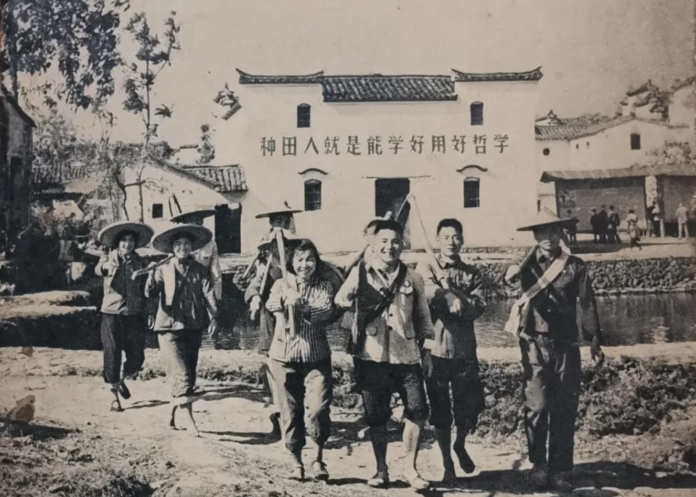
The period from the 1950s to the 1970s was one of the most turbulent and transformative phases in modern Chinese history. It followed the founding of the People’s Republic of China and unfolded in the context of rapid revolutionary change. During these decades, the new state attempted to rebuild society under conditions of economic scarcity and limited industrial foundation, while also carrying out large-scale social, political, and cultural transformation. Among the many movements of this era, the campaign known as “Learn Philosophy, Use Philosophy” became a distinctive phenomenon that reflected broader ideological and social dynamics.
At its core, the movement sought to bring philosophy out of academic circles and into the daily lives of ordinary workers and peasants. Philosophy was not treated as an abstract or purely theoretical discipline, but as a practical tool for solving real-world problems. Questions such as how to increase industrial output, how to organize collective agricultural work, and how to manage relationships in workplaces and communities were all framed as issues that could be better understood through philosophical thinking. Works such as Mao Zedong’s On Practice and On Contradiction became widely circulated texts, used to interpret everyday difficulties and guide action. In this sense, philosophy was transformed into a method of reasoning closely connected to labor and social life.
In its early phase, roughly beginning around 1958, the movement developed in a relatively spontaneous and decentralized manner. Factories, rural communes, and local units organized study groups on their own initiative, often linking philosophical reading directly with production tasks and practical concerns. Learning was flexible, discussion-oriented, and deeply embedded in daily work. Reading materials were diverse, including Marxist classics as well as accessible writings by Chinese philosophers and educators. Philosophy at this stage functioned less as a rigid doctrine and more as a way of thinking through concrete problems.
By the mid-to-late 1960s, particularly during the Cultural Revolution, the movement underwent significant transformation. Philosophical study became more centralized and politically charged. It was increasingly framed in terms of ideological struggle, class consciousness, and participation in social transformation. The emphasis shifted toward using philosophical language to criticize established structures, reshape values, and guide political action. Reading materials also became more concentrated, with stronger focus on selected Marxist-Leninist and Maoist texts. Philosophy was no longer primarily a practical tool for problem-solving, but increasingly a language of political mobilization.
Seen in broader historical terms, the “Learn Philosophy, Use Philosophy” movement reflected an attempt to involve the masses directly in the production of knowledge and the transformation of society. Philosophy was redefined as something that could and should be practiced by everyone, not just intellectuals. It was understood as part of a larger project of building a new socialist society in which ordinary people were not only participants in labor, but also active agents in shaping ideas and guiding social development.
At the same time, as the movement deepened, certain tensions became more visible. The close integration of philosophy with political campaigns sometimes led to simplification of complex theoretical ideas. In some cases, nuanced analysis of social reality was replaced by fixed formulas or slogans, and philosophical inquiry became subordinated to immediate political needs. These developments contributed to periods of intellectual rigidity and practical distortion.
By the late 1970s, as China’s national priorities began to shift, this phase of ideological mobilization gradually came to an end. A renewed emphasis emerged on systematic theoretical study, historical reflection, and engagement with classical Marxist texts in a more academic sense. This shift was widely understood as part of a broader process of reassessing earlier practices and restoring a more balanced relationship between theory and reality.
In historical perspective, the “Learn Philosophy, Use Philosophy” movement represents both an ambitious attempt to democratize philosophical thinking and an experiment in linking ideas directly to mass social practice. It expanded the reach of philosophical concepts into everyday life, while also revealing the difficulties of maintaining theoretical clarity under conditions of rapid political and social mobilization. Understanding this period helps illuminate the complex relationship between ideology, practice, and social change in 20th-century China.
Source: sohu, philosophy china, open times