


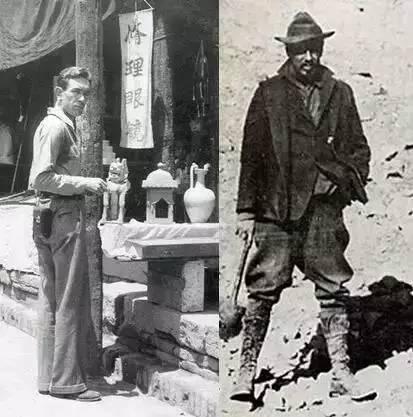
In the 1930s, two American explorers attempted to enter China’s Xinjiang region for scientific expeditions. Both were ultimately denied permission by the Nationalist government in Nanjing. At first glance, these may appear to have been ordinary diplomatic disputes. In reality, they reflected something far deeper: China’s growing determination to reclaim control over its territory, culture, and academic sovereignty after decades of foreign intrusion.
Since the second half of the nineteenth century, as China weakened politically and militarily, Western explorers had poured into the country’s frontier regions. Xinjiang, Tibet, Inner Mongolia, and Dunhuang became major destinations for foreign expeditions sponsored by Britain, Russia, France, Germany, Japan, the United States, and others. Under the banner of “scientific research,” many of these explorers removed enormous quantities of manuscripts, artifacts, fossils, paintings, and religious objects from China.
Dunhuang became one of the clearest examples of this cultural plunder. Explorers such as Aurel Stein, Paul Pelliot, and the American Langdon Warner carried away priceless manuscripts and artworks from the Mogao Caves. Warner, in particular, caused irreversible damage while attempting to strip Buddhist murals from cave walls. By the 1920s, Chinese intellectuals had become increasingly convinced that foreign “scientific expeditions” were often little more than cultural imperialism disguised as scholarship.
A major turning point came in 1927, when Chinese academic organizations negotiated with the Swedish explorer Sven Hedin over the formation of the Sino-Swedish Northwest Scientific Expedition. The resulting agreement, known as the “Nineteen Articles,” established an entirely new principle: foreign expeditions in China would no longer operate freely and independently. Instead, they had to cooperate with Chinese institutions on equal terms. Chinese authorities would supervise photography, publications, and the distribution of collected materials. For the first time, China formally asserted what many scholars later called “academic sovereignty.”
In simple terms, foreign explorers could no longer enter China, collect what they wanted, and leave without oversight.
It was against this background that the American explorer Jack Roberson proposed an expedition to Xinjiang in 1930. Sponsored by the American Museum of Natural History in New York, Roberson planned to photograph local people and landscapes while collecting zoological specimens.
The proposal immediately alarmed officials in Nanjing.
The concerns were not unfounded. Earlier American expeditions had already left a deeply negative impression in China. The American Museum’s Central Asiatic Expeditions, led by Roy Chapman Andrews, had repeatedly clashed with Chinese scholars, and many Chinese intellectuals regarded the Americans as arrogant and dismissive toward Chinese authority. Meanwhile, Langdon Warner’s destruction and removal of Dunhuang artworks remained fresh in public memory.
Photography itself had also become politically sensitive. Foreign photographers frequently focused on scenes that portrayed China as backward, exotic, or uncivilized: bound feet, beggars, opium smokers, and impoverished villages. Such images circulated widely in the West and reinforced humiliating stereotypes about China. Xinjiang, moreover, was a frontier region with military significance. Chinese officials feared that extensive filming and mapping could potentially expose strategic routes, military facilities, or sensitive ethnic conditions.
As a result, the Ministry of Education warned that “even slight negligence could produce serious consequences.”
The government then launched extensive internal discussions involving the Ministry of Foreign Affairs, the Ministry of Education, and the Academia Sinica. Chinese scholars proposed strict conditions for any foreign expedition: a detailed research plan had to be submitted in advance; Chinese personnel had to participate; collected specimens had to be divided with China; unique items could not be taken abroad; and all films and photographs required official review.
Today such requirements may seem ordinary. At the time, however, they represented a dramatic shift in China’s attitude toward foreign scientific activity.
Only a few decades earlier, explorers like Stein and Warner had moved through China with almost complete freedom.
Roberson’s own conduct further irritated Chinese officials. Instead of formally applying through Chinese authorities, he attempted to rely on diplomatic introductions and personal connections. One telegram even stated that any dangers encountered would be “entirely the responsibility of the expedition and unrelated to the Chinese government.”
To Chinese officials, this wording was deeply insulting. How could activities conducted on Chinese territory possibly be “unrelated” to the Chinese government?
In October 1930, the Nationalist government formally rejected Roberson’s request to enter Xinjiang.
Officially, the government claimed that Chinese scientific teams were already conducting research in the region and that no additional foreign expeditions were necessary. But the deeper reasons were far more complicated.
Xinjiang at the time was politically unstable. Following internal upheavals and shifting regional power struggles, the central government’s authority over the province remained weak. At the same time, China was engulfed in the Central Plains War, a massive conflict among rival military factions. Allowing unfamiliar foreign expeditions into Xinjiang under such conditions was seen as an unnecessary risk.
Four years later, another American scholar, the botanist Macmillan, proposed entering Xinjiang through Soviet Central Asia to conduct plant research.
By then, the Nationalist government’s response had become even more systematic and institutionalized.
Rather than immediately rejecting the request, the Academia Sinica outlined a formal set of regulations. Foreign researchers had to apply directly to Chinese authorities, cooperate with Chinese institutions, accept Chinese participation in the expedition, submit collected specimens for inspection, and refrain from exporting any objects connected to China’s historical heritage. Film and photography would also remain tightly regulated.
Even the content of photographs was subject to restrictions. Foreigners were forbidden from filming scenes deemed harmful to China’s national dignity or contrary to the principles of the state.
Behind these regulations lay a growing sensitivity about China’s international image. For decades, Western photographers had shaped global perceptions of China through carefully selected images of poverty and “backwardness.” By the 1930s, Chinese authorities were increasingly determined to control how the nation was represented abroad.
Ultimately, however, Macmillan was also denied entry.
Once again, the unstable situation in Xinjiang played a major role. The region had only recently emerged from violent conflict, and political tensions remained high. Even the Sino-Swedish expeditions supported by the Chinese government had encountered enormous difficulties in Xinjiang, including military interference, confiscation of vehicles, and restrictions on movement. Officials feared that if foreign researchers were harmed during the expedition, it would create an international diplomatic embarrassment.
More fundamentally, China in the 1930s was no longer willing to accept foreign-led expeditions in which Chinese authorities played only a secondary role.
For decades, foreign explorers had treated China as an open field for scientific extraction. But after the May Fourth Movement and the Northern Expedition, rising nationalism transformed Chinese intellectual and political attitudes. Increasingly, scholars and officials insisted that China’s land, cultural heritage, and scientific resources must remain under Chinese control.
The rejection of Roberson and Macmillan therefore represented much more than two failed expeditions. It marked a broader transformation in modern Chinese political consciousness.
China was moving from passive acceptance to active supervision; from foreign domination to demands for equal cooperation; from unrestricted removal of artifacts to legal protection of cultural property; and from unrestricted foreign photography to official regulation of China’s national image.
These changes did not come easily.
In the late Qing and early Republican periods, China had lacked the power to stop foreign expeditions. Priceless manuscripts were carried out of Dunhuang by the crate, frontier regions were secretly mapped, and scientific discoveries made on Chinese soil were published abroad under foreign institutional names.
By the 1930s, however, something had clearly changed.
China remained politically fragmented and militarily weak, especially in its frontier regions. Yet intellectually and symbolically, the country had begun to assert a new principle:
China would no longer serve as a “free hunting ground” for foreign explorers.
Source: zggjls, sina, sxlib, sohu, gmw, kknews