


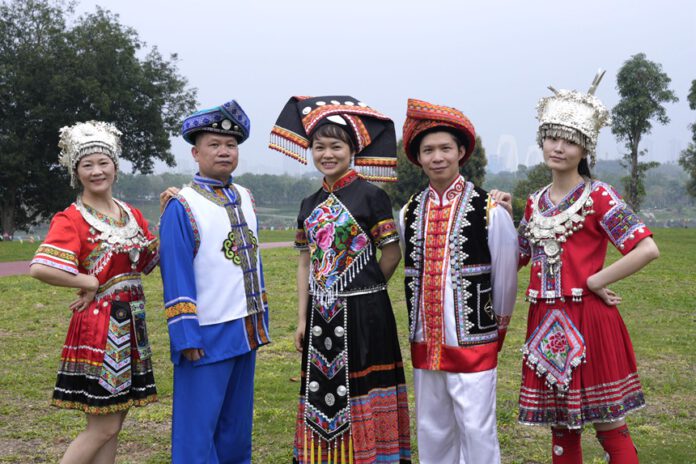
Among China’s 56 recognized ethnic groups, the Zhuang stand as the largest minority, with a population approaching 20 million. By sheer demographic weight, one might expect a strong and widely recognizable cultural presence. Yet in public perception, references to Guangxi, the primary homeland of the Zhuang, more often evoke the landscapes of Guilin, or the Li River, rather than distinctly identifiable Zhuang cultural symbols. This apparent low visibility is not a sign of cultural absence, but rather the result of a long historical process in which the Zhuang have deeply integrated into the broader fabric of Chinese society.
The ancestors of the Zhuang belong to the ancient Baiyue peoples, among the earliest inhabitants of the Lingnan region. As early as the Qin and Han dynasties, waves of migrants from the Central Plains moved southward, bringing agricultural techniques and administrative practices. Lingnan’s warm, humid climate and dense river networks made it especially suitable for wet-rice cultivation. The Zhuang ancestors developed settled communities centered on paddy agriculture, with social organization built around cooperation in irrigation and land use. This agricultural system closely paralleled that of the Han heartland, creating a natural basis for interaction and eventual integration.
Unlike the pastoral societies of the northern steppes or the highland cultures of the west, which were often shaped by mobility and competition for resources, the rice-based societies of the south emphasized stability, continuity, and accumulation. As a result, interactions between incoming Han settlers and local populations in Guangxi tended to take the form of economic exchange and cultural adaptation rather than sustained conflict. Early political experiments, such as the governance of the Nanyue kingdom, adopted policies that respected local customs while encouraging intermarriage and cooperation, setting precedents for inclusive rule.
Although moments of tension did occur, the broader trajectory remained one of accommodation and synthesis. During the Northern Song period, the uprising led by Nong Zhigao briefly disrupted regional stability, yet its aftermath demonstrated a distinctive approach to governance. Rather than relying solely on military suppression, the state expanded education, strengthened institutional ties, and incorporated local elites into the administrative system. Over time, this strategy transformed potential divisions into channels for integration, and large-scale conflict did not reemerge in the region.
The Ming and Qing dynasties further advanced this process through the gradual replacement of hereditary local chieftains with centrally appointed officials, a policy known as “gaitu guiliu.” In Guangxi, this transition was relatively smooth compared to other frontier regions. Former local leaders often retained social influence as landlords or gentry, while ordinary communities continued their agricultural livelihoods with minimal disruption. This stability reflected both flexible governance and a long-standing foundation of mutual accommodation between different groups.
Economic change in the modern era accelerated integration even further. As trade networks expanded, Guangxi became a corridor linking inland China with the southern coast. Commercial activity brought diverse populations into closer contact, fostering shared linguistic and social practices. Many Zhuang people participated actively in regional markets, often adopting widely used languages to facilitate exchange. Urban centers such as Nanning grew into hubs of interaction, where cultural blending became part of everyday life.
Throughout this long process, Zhuang culture did not disappear; rather, it evolved in a more embedded and less overtly distinct form. Shifts in language use, the decline of traditional scripts, and the adoption of broader social norms reflect gradual historical adaptation rather than abrupt change. Compared with some other ethnic groups that maintained strong cultural boundaries through religion or standardized writing systems, the Zhuang followed a more open path, absorbing and contributing to surrounding cultural currents. While this has reduced the sharpness of external cultural markers, it has also supported long-term stability and demographic growth.
In the mid-20th century, official ethnic identification recognized the Zhuang as a distinct group within the modern Chinese nation, providing a clearer framework for cultural and social development. This recognition affirmed their historical role while enabling new efforts in education, cultural preservation, and regional development. Today, the Zhuang continue to navigate the balance between integration and heritage, participating fully in national life while maintaining connections to their historical roots.
Viewed from a broader historical perspective, the Zhuang experience represents a distinctive model of development through integration. It is not a story of passive assimilation or cultural loss, but one of continuous adaptation and mutual shaping over centuries. Their history illustrates how a community can sustain growth, stability, and relevance by engaging deeply with a larger social framework.
What may appear at first as a lack of visibility can instead be understood as a different form of success, one achieved through coexistence, exchange, and long-term resilience. In this sense, the Zhuang have played a quiet yet significant role in the making of a diverse and unified society, offering an enduring example of how cultural integration can contribute to both continuity and change.
Source: neac gov cn, gxzf, sohu, people cn