


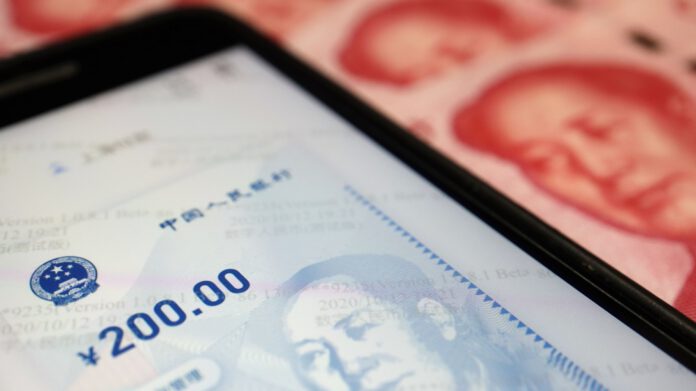
At the beginning of the new year, China’s digital renminbi (e-CNY) has entered a new stage of development, officially transitioning from the era of “digital cash” to that of “digital deposit currency.”
China’s international operation center for the digital RMB announced that the Digital RMB App, a core carrier of the system, has been comprehensively upgraded to Version 2.0. This update represents not only a technical iteration but also a profound shift in institutional design and operational logic, marking a milestone in the evolution of China’s central bank digital currency (CBDC).
Since its public launch in January 2022, the Digital RMB App has undergone 54 updates, consistently refining user experience. The most significant change in Version 2.0 is that, starting January 1, 2026, balances in verified (real-name) digital RMB wallets will accrue interest based on the current deposit rate listed by designated operating institutions.
At present, ten institutions are authorized to operate digital RMB services: Industrial and Commercial Bank of China, Agricultural Bank of China, Bank of China, China Construction Bank, Bank of Communications, Postal Savings Bank of China, China Merchants Bank, Industrial Bank, MYbank (Alipay), and WeBank (WeChat Pay). These institutions have announced that real-name wallet balances will earn interest at their respective demand deposit rates, currently 0.05%, with calculation and settlement rules aligned with traditional demand deposits.
Interest will be settled quarterly on March 20, June 20, September 20, and December 20. Users can check the credited interest through the wallet asset section of the Digital RMB App after each settlement date. If an account is closed before a settlement date, interest will be calculated up to the day prior to closure at the prevailing rate.
Importantly, only real-name wallets—classified as Tier I, II, and III—qualify for interest. Tier IV wallets, which can be opened using only a mobile phone number and are non-verified, are not eligible. This distinction reflects regulatory requirements related to anti-money laundering (AML) compliance and provides a clear legal basis for deposit insurance protection.
The introduction of interest payments signals a fundamental shift in the liability structure of the digital RMB. Previously positioned as “digital cash” (M0) and a direct liability of the People’s Bank of China (PBOC), the e-CNY emphasized payment functionality and a degree of disintermediation. However, in practice, the absence of interest limited user incentives to hold digital RMB, and commercial banks lacked sufficient motivation to actively promote it.
Under the new framework, real-name digital RMB balances will be treated as commercial bank liabilities, included in deposit insurance coverage and incorporated into banks’ required reserve calculations. This realignment creates an incentive-compatible mechanism that integrates digital RMB more fully into the existing financial system.
The policy foundation for this transformation lies in the Action Plan on Further Strengthening the Digital RMB Management and Service System and Related Financial Infrastructure, issued by the PBOC on December 29, 2025. The plan establishes a new measurement framework, management system, and operational mechanism for the next generation of digital RMB. It clarifies that the future digital RMB will be supported technically and supervised by the central bank but will carry the liability attributes of commercial banks. Account-based in structure and compatible with distributed ledger technologies, the digital RMB will circulate within the financial system as a modern digital payment and settlement instrument, fulfilling the core monetary functions of unit of account, store of value, and medium of exchange—including in cross-border contexts.
Analysts suggest that the transition reflects three core considerations. First, risk control: a purely central bank–liability digital cash model could weaken banks’ credit creation functions and affect macroeconomic policy transmission. By converting digital RMB into commercial bank liabilities, it is brought under the umbrella of reserve requirements and deposit insurance, thereby enhancing financial stability. Second, user incentives: interest-bearing balances address a key obstacle to adoption, as users generally prefer assets that generate returns. Third, systemic integration: leveraging existing bank account management systems reduces compliance costs related to AML and know-your-customer (KYC) requirements while enabling seamless integration with traditional financial services.
With the introduction of interest, commercial banks are expected to expand innovation on the asset side of their balance sheets. As digital RMB deposits become equivalent to ordinary deposits, banks can utilize these funds for lending, wealth management products, and other financial services. Industry sources indicate that banks are preparing to allow customers to purchase traditional wealth management products using digital RMB, further embedding it into the broader “payment + finance” ecosystem.
From a macroeconomic perspective, the reform also introduces a potential new policy variable: the digital RMB interest rate. Combined with the traceability of digital transactions, this could enhance the precision of structural monetary policy tools. By incorporating digital RMB into the traditional framework of money creation and regulation, policymakers gain a more direct and technologically advanced channel for influencing liquidity and financial conditions.
Since research began in 2014, China’s digital RMB pilot programs have expanded across retail, catering, tourism, healthcare, education, public services, rural revitalization, and cross-border settlements, placing China at the forefront of global CBDC development. Yet as the economy becomes increasingly digital and intelligent, further improvements in regulatory clarity, legal status, and ecosystem expansion remain necessary. Broader pilot coverage, richer application scenarios, and stronger incentives for merchants and consumers will be key to sustaining momentum.
The shift from digital cash to digital deposit currency represents more than a technical upgrade—it is a structural transformation. By combining payment convenience with deposit functionality and financial integration, Digital RMB 2.0 strengthens incentives for users, empowers commercial banks, and deepens integration with the existing financial system. As reforms continue and use cases expand, the digital RMB is poised to play a more significant role in improving efficiency, lowering transaction costs, supporting financial stability, and advancing the international competitiveness of the renminbi.
Source: Xinhua, 21CBH, China’s state council, Nikkei Asia