


On December 4, Taiwan’s Democratic Progressive Party announced a one-year ban on Xiaohongshu (also known as Red Note), a Chinese social media platform centered on lifestyle content, citing “information security” concerns—a move that sparked strong public opposition.
With more than three million active users in Taiwan and a history of topping the iOS free app rankings, Xiaohongshu’s ban once again drew attention to the broader question of why Chinese internet platforms have become so competitive, both domestically and increasingly overseas. For years, a popular saying in the global tech industry has claimed that the United States focuses on innovation, China on imitation, and Europe on regulation. While this description captures part of the reality of China’s early internet development, it fails to explain a recurring phenomenon: Chinese internet companies often succeed in defeating the Western platforms they originally emulated.
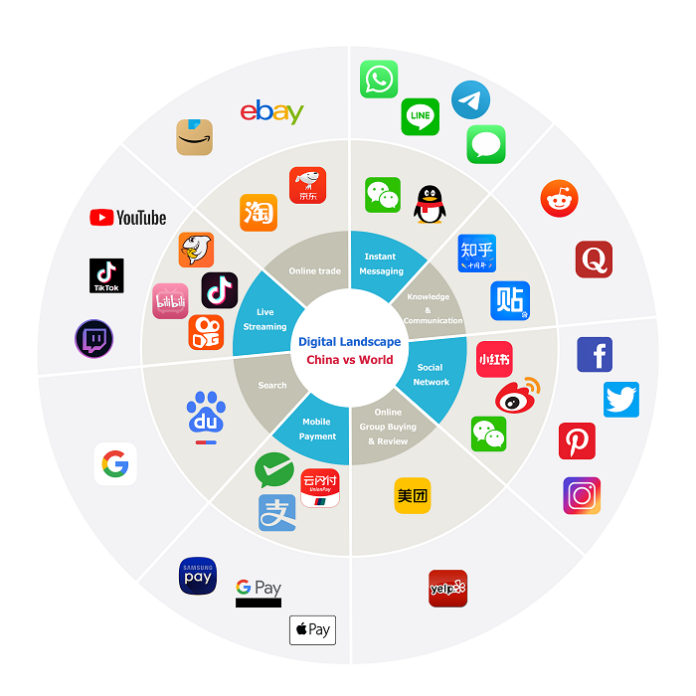
Most major Chinese internet products can indeed trace their origins to Western prototypes. Taobao resembles eBay, Tmall echoes Amazon, Baidu mirrors Google, and early instant messaging tools followed similar paths. Yet in market after market, Chinese firms have outperformed their original models. Scholars have proposed numerous explanations, emphasizing institutional advantages, regulatory environments, or execution efficiency, while often dismissing innovation as a decisive factor. However, this interpretation overlooks a distinctive form of innovation that has been central to China’s internet success: combinatorial or secondary innovation.
Unlike primary innovation, which creates entirely new technologies or business models from scratch, combinatorial innovation recombines existing technologies, services, and market conditions to generate new solutions better suited to specific contexts. Historically, truly original innovations have been rare, while progress has largely come from recombining earlier breakthroughs. When executed effectively, such combinations can outperform the original innovations themselves by integrating multiple strengths into a single product or ecosystem.

The rise of Taobao illustrates this clearly. When Alibaba launched Taobao in 2003, eBay’s Chinese subsidiary, eBay EachNet, dominated the C2C market with over 70 percent share. Taobao initially lagged far behind in capital, technology, and user base. The turning point came with the introduction of Alipay, modeled after PayPal but adapted to China’s financial reality. At the time, low credit card penetration and widespread distrust of online transactions severely constrained e-commerce. Alipay’s escrow mechanism, holding payments until buyers confirmed receipt, solved both payment access and trust issues. This single integration of eBay-style marketplaces with PayPal-style payments—introduced faster and more decisively than eBay itself managed in China—enabled Taobao to rapidly overtake its rival.
A similar pattern emerged in the competition between Baidu and Google. While Google’s exit from China is often attributed solely to regulatory disputes, Baidu had already established a substantial and growing market lead beforehand. Beyond localization, Baidu pursued aggressive combinatorial innovation by integrating features inspired by various global platforms. Products such as Baidu Tieba, Baidu Baike, and Baidu Wenku addressed Chinese users’ specific needs for community discussion, localized knowledge, and document sharing, often launching earlier or scaling faster than Google’s equivalents. These integrations gradually shifted user loyalty toward Baidu, long before Google’s withdrawal.
The most emblematic outcome of combinatorial innovation is the emergence of Chinese “super apps,” with WeChat as the prime example. WeChat began as a simple messaging tool but rapidly absorbed features inspired by global platforms: location-based social networking, content feeds resembling Facebook and Twitter, blogging-style public accounts, digital payments akin to PayPal and Alipay, QR-code-based interactions, and eventually mini-programs that function as lightweight apps within the platform. None of these features were original in isolation, but their integration into a single, seamless ecosystem transformed WeChat into a comprehensive digital infrastructure rather than a standalone app.
Not all Chinese companies pursued super apps; many instead built interconnected app ecosystems under a single corporate umbrella. This approach intensified competition among major platforms such as Alibaba, Tencent, and Baidu, whose product portfolios increasingly overlapped. Unlike their American counterparts, Chinese internet giants rarely respected each other’s core business territories. Each aggressively entered competitors’ domains, accelerating innovation but also intensifying internal competition and compressing profit margins.
In contrast, the U.S. internet industry evolved toward a “monopolistic oligopoly” structure. Dominant firms such as Google, Amazon, and Meta typically avoid direct invasions into one another’s core markets, competing instead in peripheral areas or through partnerships. This restraint reflects legal risks, intellectual property barriers, and unwritten industry norms. While such an arrangement reduces friction and regulatory exposure, it also slows product iteration compared to China’s relentless cross-market rivalry.
China’s highly competitive environment produced two major consequences. First, rapid feature integration and business model experimentation dramatically accelerated innovation cycles. Developments such as livestream e-commerce emerged years earlier and more comprehensively in China than in the United States. Second, extreme competition intensified “involution,” squeezing margins and increasing survival pressure even for industry leaders. These forces collectively pushed Chinese internet firms to seek growth abroad.
Early overseas expansion, particularly into Southeast Asia, largely failed because companies mechanically transplanted domestic models without sufficient localization. Alibaba’s acquisition of Lazada demonstrated how strategies successful in China, such as dual-platform segmentation and large-scale shopping festivals, proved ineffective in markets with different income levels and consumption patterns.
The second wave of globalization, led by companies such as TikTok, Temu, SHEIN, and AliExpress, has been more successful precisely because it combines localization with combinatorial innovation. SHEIN exemplifies this approach by integrating European fast-fashion concepts, Chinese supply chain efficiencies, and platform-driven marketing strategies drawn from Chinese social commerce. This synthesis allowed it to scale rapidly in Western markets and outperform established incumbents.
Despite these successes, risks remain significant. Blindly exporting domestic models can still lead to failure, while aggressive market entry may disrupt entrenched interests in host countries. Moreover, unfamiliarity with foreign legal, political, and cultural environments exposes Chinese firms to regulatory backlash, as seen in controversies surrounding logistics subsidies, data privacy, and national security concerns.
Ultimately, the global competitiveness of Chinese internet firms cannot be reduced to imitation or institutional advantage alone. Their true strength lies in combinatorial innovation—the ability to integrate technologies, business models, and market conditions across borders. Whether this approach can sustain long-term success abroad will depend not only on technological adaptation, but also on a deeper understanding of global governance, public sentiment, and geopolitical realities.
Source: ifeng news, xinhua, whzh, goclickchina, digiant