


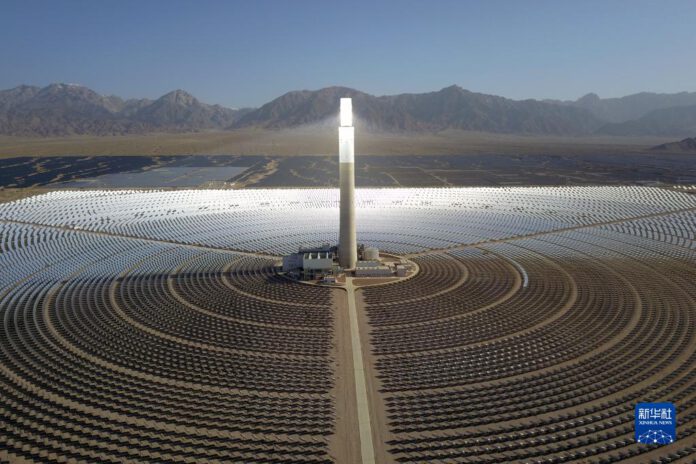
On April 14, data released by China’s General Administration of Customs showed that in the first quarter, China’s exports reached 6.85 trillion yuan, up 11.9% year-on-year. The export structure continued to improve, with mechanical and electrical products accounting for 63.4% of total exports.
Among them, exports of green products such as electric vehicles, lithium batteries, and wind power equipment and components increased significantly by 77.5%, 50.4%, and 45.2% respectively. In addition, the total export value of the photovoltaic industry chain reached 22.17 billion USD in the first quarter, up 27.2% year-on-year; the energy storage industry chain reached 8.11 billion USD, up 71.8%. New energy-related industries are increasingly becoming the core engine of China’s export growth.
Over the past decade, China has heavily invested in the new energy sector. This strategic shift first stems from China’s energy resource endowment of “rich in coal, poor in oil, and lacking in gas,” which makes it necessary to reduce excessive reliance on traditional fossil fuels, especially imported oil and gas, in order to ensure national energy security. Secondly, it also aligns with and supports global climate action, fulfilling commitments to environmental protection and the “dual carbon” goals, and accelerating the transition from fossil fuels to clean technologies and renewable energy.
Western countries have been less consistent in implementing green and low-carbon energy transitions, resulting in relatively slow progress in investment in new energy technologies and equipment in developed economies. In contrast, China has been a firm executor of the energy transition. According to the International Energy Agency, China accounts for over 70% of global electric vehicle manufacturing, about 85% of global battery cell production, and more than 80% of global capacity in photovoltaics, wind power, and energy storage.
With ongoing geopolitical tensions in the Middle East and potential disruptions in the Strait of Hormuz, global energy supply chain risks have led countries to realize the necessity of reducing dependence on fossil fuels. At the same time, rapid growth in global artificial intelligence investment and applications is driving explosive demand for data centers, with the energy consumption of intelligent computing centers rising exponentially. Countries urgently need large-scale investments in power plants and grid infrastructure.
The combination of these two factors is prompting countries heavily dependent on energy imports to increase investment in renewable energy generation, battery energy storage (for storing solar or wind power), and power grids to enhance energy autonomy and electrification levels. China has already provided a mature model in these areas. In 2024, China’s electrification rate was approximately 28.8%, surpassing major developed economies in Europe and the United States; it is expected to reach around 35% by 2030, exceeding the OECD average by 8–10 percentage points.
The key to China’s rising electrification rate lies in two aspects: first, shifting from fossil-fuel-dominated power generation to a modern multi-energy system integrating wind, solar, hydro, nuclear, and storage, thereby strengthening energy independence and sustainability; second, moving beyond simple scale expansion to deeply integrate digital technology with power systems, building not only ultra-high-voltage grids but also flexible “source-grid-load-storage” interactive systems.
At present, Chinese companies have built global technological and manufacturing advantages across the entire industrial chain, including photovoltaics, wind power, nuclear energy, ultra-high-voltage transmission, high-voltage cables, transformers, energy storage batteries, and electric vehicles. In the future, regardless of whether countries develop their own green power systems or expand electricity infrastructure to meet AI-driven demand, it will be difficult to bypass “Made in China.” As a result, China’s new energy exports are expected to maintain strong growth.
China’s advantages in clean energy are systemic and strategic. Faced with today’s global energy crisis and surging AI electricity demand, China is in a highly favorable position, not only likely to expand its international competitiveness further but also capable of shaping the future global energy landscape.
Of course, challenges remain. Some countries aim both to reduce dependence on fossil fuels and to promote domestic manufacturing. In response, Chinese companies are shifting from simple product exports to establishing overseas factories, promoting both capacity export and standard export. Notably, China’s technological and manufacturing advantages in the power sector provide strong leverage, making international engagement more of a two-way balance rather than one-sided dependence on foreign markets.
Source: 21jingji, xinhua, 2500sz, cgtn