


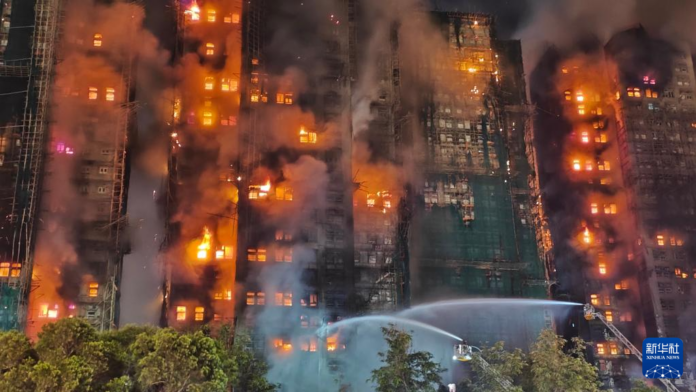
On November 26, 2025, a catastrophic fire broke out at Wang Fuk Court in Hong Kong, engulfing seven residential buildings and resulting in at least 151 deaths, including a firefighter, with over 30 people missing.
It was the city’s second “five-alarm” fire since the 1997 handover and the deadliest since 1948. Initial investigations highlighted construction violations, regulatory lapses, and potential corruption: non-fire-resistant building materials, malfunctioning alarms, unheeded complaints, and developer misconduct were all cited, alongside concerns over the simultaneous construction of multiple buildings without sufficient oversight.
While these factors are significant, the disaster cannot be explained solely by regulatory failure. The fire exposed deep structural and systemic issues in Hong Kong’s urban governance. Regulatory systems, even when professionalized, face enormous pressure in highly modernized and densely populated cities.
The city’s aging, tightly packed buildings and constrained streets create inherent difficulties for fire prevention and emergency response. Economic inequalities exacerbate the problem: lower-income districts often receive less maintenance funding, while rental-heavy communities may lack cohesion or capacity to monitor safety, leaving gaps for corruption and neglect. Policy-making is further skewed toward professional associations and large capital, leaving ordinary residents with limited influence over safety regulations and urban planning.
Hong Kong’s regulatory system relies heavily on professional expertise. Fire departments oversee safety equipment, while the Buildings Department monitors construction and structural compliance. Licensed engineers certify building inspections and accept legal liability, and market mechanisms, such as insurance, reinforce compliance. These arrangements allow oversight without expanding bureaucracy, but the system depends on professional integrity and community engagement, both of which have limits.
The fire also revealed how social and political dynamics shape public perception. Media and social platforms amplified narratives blaming mainland China for materials or labor issues, while mainland observers focused on construction practices such as temporary scaffolding. These discussions often shifted attention from governance and safety to ideological and political debates, leading to personal and systemic attacks.
Hong Kong’s post-colonial governance challenges are central to understanding the disaster. The territory’s administrative system, inherited from colonial rule, struggles to accommodate modern social demands and political participation. Weak authority, polarized politics, and entrenched opposition complicate decision-making and slow urban planning or regulatory reforms. Heightened political participation has sometimes been conflated with “scientific” or “rational” policymaking, although differing interests inevitably yield conflicting assessments of policy effectiveness. In this context, building consensus for development and long-term safety becomes difficult.
Despite these structural and political constraints, the community’s resilience during the fire was notable. Strengthening public safety requires combining an active, competent government with robust social organizations. This entails reforming unsafe regulations, improving enforcement, and balancing competing interests without allowing powerful economic actors to dominate policy.
For mainland observers, the Wang Fuk Court tragedy offers lessons in urban planning and governance. It highlights the risks of densely populated, high-rise developments and the need for strong institutional oversight. Hong Kong’s model, combining legal frameworks with professional and social participation, demonstrates how expertise and community engagement can enhance regulatory effectiveness. Applying similar principles in other urban contexts, alongside inclusive decision-making, could help mitigate the risk of comparable disasters.
Source: GBA Review, hkcna, hkcd, guancha, xinhua