

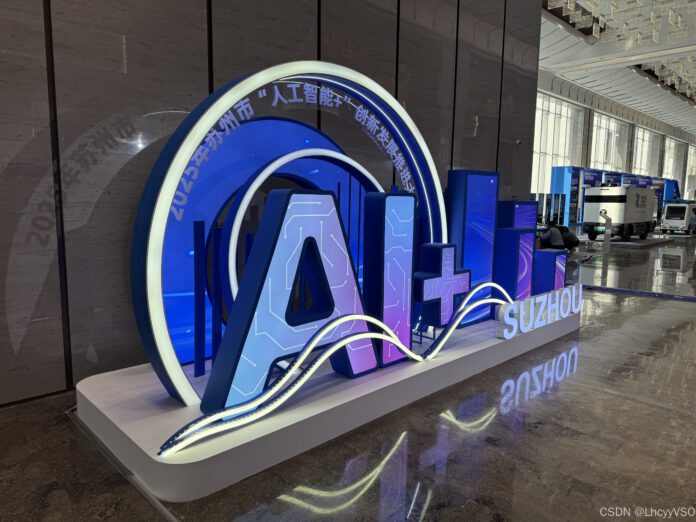
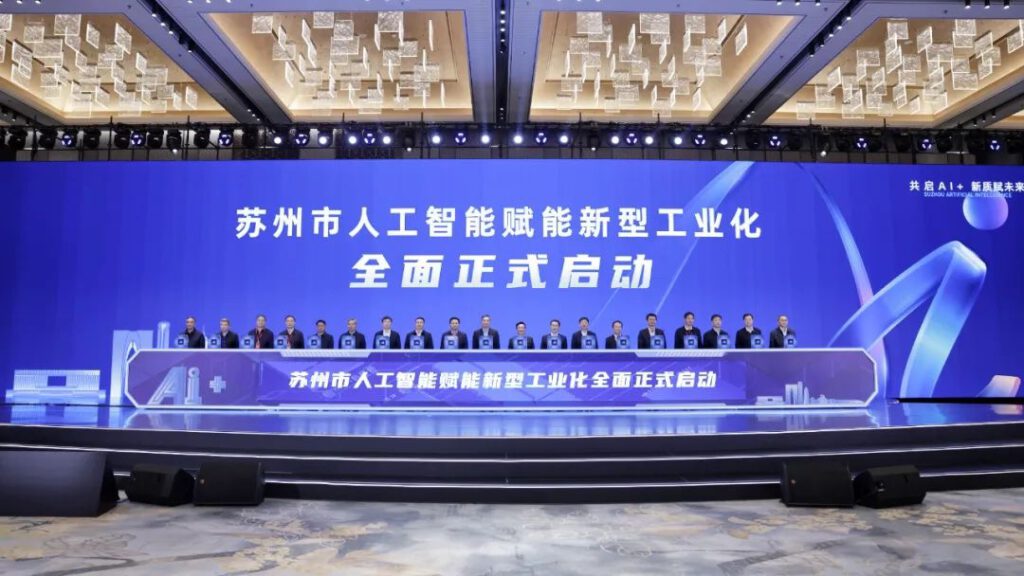
On January 4, 2026, Suzhou convened its Conference on Advancing New-Type Industrialization alongside the “AI + Manufacturing” Innovation and Development Forum, marking a decisive moment in the city’s industrial evolution.
Tracing Suzhou’s recent trajectory reveals a strategy that has consistently moved in step with the times. In 2021, the city emphasized the digital economy and digital transformation. In 2022, it shifted toward building industrial innovation clusters for the digital economy era. By 2023, the focus narrowed to the development of new energy vehicle industry clusters. Beginning in 2024, Suzhou clearly elevated “new-type industrialization” as the central theme of its annual agenda, a focus that was sustained and deepened through 2025.
In 2026, this theme underwent a critical upgrade. “AI + Manufacturing” was explicitly positioned as both the strategic core and the primary execution path for advancing new-type industrialization. At the conference, Suzhou announced that it would take the creation of a National Demonstration Zone for New-Type Industrialization as its main thread for the year, rolling out eight major initiatives comprising 28 concrete actions. Key targets include the dynamic cultivation of 150 industrial large models and the construction of more than 200 high-quality industrial datasets. By the end of the 15th Five-Year Plan period, Suzhou aims to make substantial progress in developing new quality productive forces, establish a modern industrial system, and ultimately build a globally leading “City of Intelligent Manufacturing” by 2035.
From the digital economy to new-type industrialization, and now to the precise focus on “AI + Manufacturing,” each iteration of Suzhou’s industrial strategy reflects a deep understanding of industrial development. Crucially, this understanding consistently translates into targeted empowerment for enterprises rather than abstract ambition.
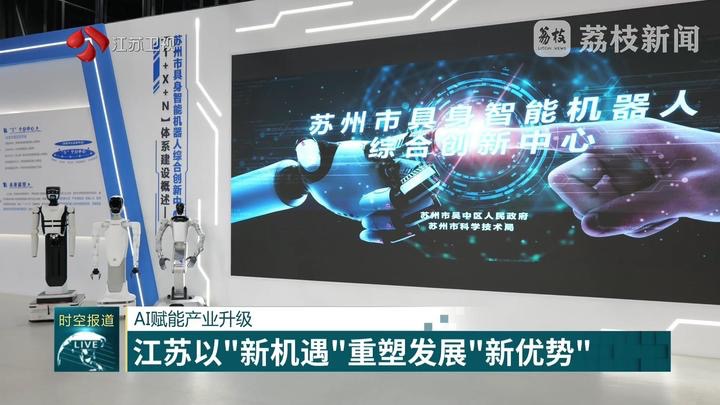
Today, Suzhou stands as one of China’s most comprehensive industrial cities, encompassing 34 major industrial categories, 170 medium categories, and 514 subcategories. It is home to approximately 160,000 industrial enterprises, and in 2024 its above-scale industrial output reached RMB 4.7 trillion.
Globally, a new industrial revolution driven by artificial intelligence is rapidly reshaping economic structures and competitive hierarchies. From large language models and humanoid robots to new energy, low-altitude economies, and synthetic biology, new tracks are emerging at remarkable speed. Technological iteration is accelerating beyond traditional cycles, and industrial systems that cling to legacy models without proactive transformation risk rapid marginalization.
Against this backdrop, Suzhou’s integration of AI into manufacturing is not a pursuit of short-lived hype, but a strategic inevitability. The timing is equally critical: 2026 marks the opening year of the 15th Five-Year Plan and a key window in the next round of global technological and industrial competition, making a strong first step particularly consequential.
In Suzhou, AI is steadily permeating the fine-grained operations of manufacturing enterprises. At an electronics company, for example, an expense reimbursement form involving installment payments now flows automatically through the financial system. Within seconds, the system extracts invoice amounts and contract payment terms, cross-references historical records to calculate the proportion already paid, verifies compliance with payment conditions, and forwards the request to the next approval stage. Today, 99% of such processes are approved automatically, with only 1% of complex cases requiring human intervention. Compared with the past—when financial staff manually searched contracts and reconciled data—approval times have been reduced to under five minutes, delivering a dramatic efficiency gain.
Suzhou’s deep manufacturing base has also created fertile ground for collaborative technology service providers. Many of their orders come directly from local enterprises. One local food manufacturer, for instance, long relied on more than 20 workers for manual sorting at the back end of its production line, creating a persistent efficiency bottleneck. By introducing robotic sorting systems, the company reduced staffing needs to just two people, seamlessly connected imported production lines, and eliminated a critical production constraint.
Such transformation scenarios are now commonplace across Suzhou’s manufacturing landscape. The rise of generative AI has significantly reshaped the city’s industrial and entrepreneurial atmosphere, prompting enterprises to concentrate less on abstract technological potential and more on concrete, scenario-based applications. Smart factories, logistics optimization, and industry-specific AI solutions have become focal points of R&D and commercialization, closely aligned with market demand for practical AI deployment.
The results are visible in the data. From January to November 2025, Suzhou’s above-scale industrial value added grew by 7.6% year-on-year, while total industrial output reached RMB 44.4 trillion, up 3.9%. The city’s six leading industries generated RMB 29.1 trillion in output, growing 4.1%, and the top 100 enterprises recorded a 5.1% increase. High-tech manufacturing output rose 5.5%, contributing 53.2% of total industrial output growth. The rapid expansion of “AI +” applications drove notable increases in the production of optoelectronic devices, integrated circuits, and industrial robots, which grew by 8.8%, 7.8%, and 17.1% respectively.
Behind the vitality of Suzhou’s “AI + Manufacturing” sector lies a first-class business environment and highly targeted policy support. Since 2025, the city has issued policy frameworks such as the Implementation Plan for Building an AI-Empowered Pioneer Zone for New-Type Industrialization and the Action Plan for Accelerating “AI + Manufacturing” Innovation, clearly defining development goals and priority tasks across technology R&D, scenario application, and industrial cultivation.
At the 2026 conference, Suzhou further unveiled eight major actions to advance “AI + Manufacturing.” These include cultivating 150 industrial large models; building more than 200 high-quality industrial datasets; promoting over 100 replicable benchmark application scenarios; creating smart terminal brands and nurturing more than 300 smart terminal products; establishing 10 industry empowerment centers and high-level platforms; expanding computing power capacity to 40,000 PFLOPS with inclusive access; developing more than 20 related standards; and optimizing the industrial ecosystem by attracting 240 leading talents and achieving breakthroughs in more than six domestically produced AI chips.
For entrepreneurs, Suzhou’s support is both comprehensive and concrete. From project selection and landing platforms to team building, financial support, talent subsidies, and investment matchmaking, the city offers end-to-end services—often described as enabling founders to arrive with “just a backpack.”
For enterprises, Suzhou’s advantages are evident in the details. Government-led activities centered on large models and AI are frequent and diverse, spanning industry chain conferences, sector-specific salons, technical workshops, and industry–academia–research matchmaking events, with at least one or two held every week. From industrial manufacturing to healthcare and education, and even cutting-edge fields such as AI for Science, all sectors are actively pushing for real-world implementation. Even traditional enterprises display strong enthusiasm for “AI +” transformation, creating a dense and pragmatic AI innovation atmosphere.
The government’s role extends beyond simply providing platforms. It actively releases demand signals and guides development directions. In Wuzhong District, the core hub for embodied intelligence and robotics, authorities not only publish typical application scenarios but also build supply–demand docking platforms to connect technology providers with end users. Industry discussions consistently center on scenario-based AI deployment: enterprises bring concrete problems, while research institutions and technology firms jointly explore how large models can address real pain points, grounding industrial dialogue firmly in practice.
Suzhou also organizes vertical, industry-specific matchmaking sessions for sectors such as automotive and advanced manufacturing, precisely aggregating upstream and downstream players to surface genuine implementation needs. Government teams proactively research enterprise pain points in AI adoption, coordinate resources, and help remove obstacles to deployment. In this pragmatic exchange environment, companies often find viable pathways for technological fit and scale-up. Enterprises that demonstrate outstanding progress in AI-driven transformation are further rewarded with official recognition and accompanying subsidies, reinforcing incentives for continuous upgrading.
Beyond industrial policy and infrastructure, Suzhou sustains its momentum through a compelling blend of livability and opportunity. Its deep manufacturing roots and dense concentration of leading firms provide abundant career options for graduates and professionals alike. At the same time, the city is renowned for its livable environment, cultural heritage, and orderly urban rhythm. Proximity to Shanghai, moderate population density, and comfortable living spaces allow professional ambition and quality of life to reinforce one another.
On this fertile ground, what grows is not merely a collection of enterprise transformation cases, but a city-level confidence in embracing the industries of the future—and shaping them with intent rather than reaction.
Source: China Daily, ifeng js, caifuhao, cadmm, jswx gov