


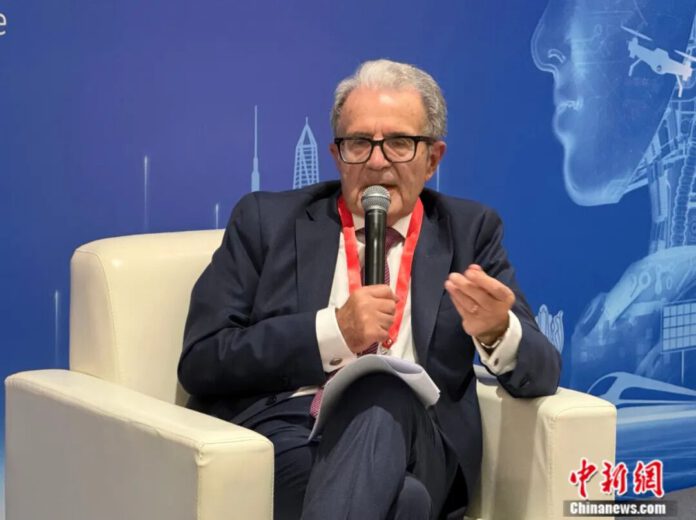
In today’s world, traditional and non-traditional security threats are increasingly intertwined, and global governance faces multiple, overlapping challenges. This year marks the 50th anniversary of the establishment of diplomatic relations between China and the European Union. As two of the world’s largest economies, how China and Europe can deepen cooperation and jointly address global challenges has become a critical question.
During the 2025 Understanding China Conference (Guangzhou), held from November 30 to December 2 in Guangzhou, Romano Prodi, former Prime Minister of Italy and former President of the European Commission, shared his insights on the prospects for China–EU cooperation.
Prodi observed that China’s achievements in recent years have been remarkable. He noted that China has evolved from a country with great potential into a global leader in several emerging industries, particularly in solar energy, batteries, and electric vehicles. This transformation, he emphasized, implies that China now bears greater international responsibility, especially in guiding high-quality global industrial development.
Prodi remarked that hosting the conference in the Guangdong–Hong Kong–Macao Greater Bay Area was highly symbolic, describing the region as a dynamic hub comparable to China’s “Silicon Valley.” He noted the presence of numerous vibrant economic entities in the Greater Bay Area, which collectively drive China’s economic growth. Combined with Hong Kong’s extensive experience in finance and trade agreements, he expressed confidence that the Greater Bay Area will play an increasingly important role in future economic development and shoulder significant responsibilities.
In Prodi’s view, China’s Global Security Initiative carries profound significance. The vision it promotes—common, comprehensive, cooperative, and sustainable security—responds directly to the international community’s urgent need to safeguard peace and confront shared challenges. He also highlighted that China’s forthcoming five-year plan, with its strong emphasis on scientific and technological innovation, will further consolidate China’s advantages in high-tech sectors and open new opportunities for global industrial cooperation.
Addressing the difficulties currently facing international cooperation, Prodi stated candidly that such cooperation has indeed weakened in recent years. One contributing factor, he argued, is the withdrawal of certain countries from international organizations and their departure from multilateralism, actions that have undermined the foundational framework of global cooperation.
To restore vitality to international cooperation, Prodi stressed that the key lies in moving beyond vague commitments and identifying concrete, practical common goals that all countries can participate in. He emphasized that nations bear moral, political, and economic obligations to strengthen cooperation. Under the current complex global circumstances, he argued, China alone cannot restore international cooperation to a healthy path. Instead, he expressed hope that the European Union and China can jointly take the lead in rebuilding global cooperation and preventing further fragmentation of the world. Initiatives such as the Global Security Initiative, along with platforms for dialogue like the G20, represent critical steps toward revitalizing international cooperation.
Regarding differing attitudes toward China within the European Union, Prodi analyzed that the core reason lies in divergent national interests among EU member states. Some countries maintain an open stance and actively promote cooperation with China, while others adopt a more cautious approach. These internal differences, he noted, have complicated EU–China relations, making this a moment that requires wisdom and strategic vision from both sides.
Despite these differences, Prodi emphasized that China and the EU, as the world’s two major markets, share extensive and deep common interests, making cooperation and mutual benefit the correct choice. He argued that both sides need to engage in open, top-down dialogue to reshape their bilateral relationship and usher in a new era of constructive cooperation.
On how to resolve specific disputes and advance comprehensive cooperation between China and the EU, Prodi offered a clear perspective. He pointed out that the EU is characterized by significant internal diversity, making it extremely difficult to resolve differences on a case-by-case basis. A more effective approach, he suggested, would be to first establish a broad framework agreement that defines core directions and fundamental principles of cooperation. Within this framework, countries can then gradually adapt and address individual differences in a coordinated manner.
Prodi noted that the EU’s own development history demonstrates that different countries can achieve consensus and progress through peaceful cooperation. He argued that China–EU cooperation should follow a similar logic, beginning with the construction of an overarching framework and then gradually deepening practical cooperation across various fields, allowing differences to be resolved in an orderly way while cooperation continues to expand.
He further stressed the importance of sustained communication through high-level dialogue and people-to-people exchanges, emphasizing that only through dialogue can relations between China and the EU be reshaped and strengthened.
When asked about Italy’s role in China–EU cooperation, Prodi responded that Italy cannot formulate China policy independently of the EU, but must actively promote a common China policy within the EU framework. He emphasized that today’s rapidly changing global landscape requires swift action and continuous efforts to foster friendly and cooperative relations with China through EU-level coordination mechanisms. Italy’s key role, he said, lies in serving as a bridge among EU member states, helping them view China’s development objectively and comprehensively, and building consensus for cooperation.
Prodi concluded by stating that beyond economic development, he believes China will continue to play an important role within the United Nations in promoting international cooperation. He emphasized that two-way exchanges in culture and science and technology are particularly vital. He expressed hope that governments will take concrete action to establish mechanisms and platforms that encourage younger generations to engage in cross-border cultural and scientific exchanges, thereby strengthening mutual understanding and long-term cooperation.
Source: China News Service, ddzg ciids, china daily