


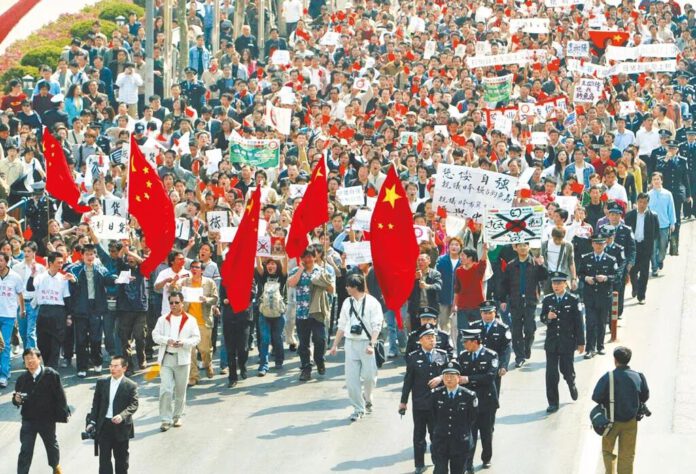
For years, China and Japan have tried to stabilize their relationship through summit meetings, carefully worded joint statements and gestures of “people-to-people friendship.” Yet public opinion polls in both countries now show mutual dislike hovering around 90 percent. That stark reality forces a difficult question: what if the real problem is not simply diplomatic miscalculation, but something much deeper—how the two societies see each other?
Much of the current tension can be traced back to 2012, when the dispute over the Diaoyu Islands erupted into a full-blown crisis. Japan’s decision to “nationalize” the islands triggered protests in China and hardened attitudes in Japan. But the episode did not emerge from nowhere. It revealed the collapse of an older formula that “the foundation of friendship lies among the people.”
That formula assumed a distinction between Japanese militarists and ordinary Japanese citizens. In theory, if governments clashed, civil society could still anchor the relationship. In practice, however, Japanese public opinion had already shifted. During the years when Junichiro Koizumi repeatedly visited the Yasukuni Shrine, more than half of Japanese respondents began expressing unfavorable views of China. After 2012, negative perceptions surged even higher. Japanese leaders were no longer acting against public sentiment; they were operating within it.
After World War II, Japan’s image of China went through dramatic transformations. In the early postwar years, many Japanese intellectuals admired the Chinese Revolution. The establishment of the People’s Republic in 1949 was seen by parts of the Japanese left as a fresh start—an anti-imperialist success story that contrasted with Japan’s own wartime defeat.
That optimism did not last. As Cold War lines hardened and China entered the Korean War, conservative voices gained ground in Japan. The image of a “new China” gradually shifted toward that of a “Red China.” The decisive turning point, however, came during the Cultural Revolution. Reports of political violence and chaos shattered earlier romanticism. Japanese scholars began to treat China not as a moral beacon or revolutionary partner, but as an object of detached study.
Out of this shift emerged what might be called “modern China studies” in Japan—research rooted in social science methods, realism, and national interest. China became something to observe, measure and evaluate, rather than embrace. This approach carried intellectual authority. It appeared objective, empirical and aligned with universal values such as democracy and human rights. Over time, it shaped media narratives and public opinion.
From this foundation grew a series of arguments that continue to influence Japanese debate: China as unstable, China as opaque, China as rising power, China as threat. Even when analysts predicted China’s economic takeoff in the 1990s, the tone was often strategic rather than sympathetic. Whether forecasting collapse or ascent, the underlying posture remained one of distance, and often of skepticism.
This matters because foreign policy in a democracy does not float above society. Politicians, journalists, scholars and civic activists form what might be called a “citizen diplomacy” ecosystem. They write, debate, publish and appear on television. Their ideas circulate, harden into public sentiment, and eventually constrain elected leaders. In Japan, this ecosystem has been active and pluralistic. Arguments about China, supportive, critical or alarmist, have competed in public forums and influenced policy debates.
China, by contrast, has struggled to build an equivalent international knowledge presence. When history cannot be fully researched at home, it becomes difficult to engage confidently in global academic debates. The result is a structural imbalance: Japan produces influential analyses about China that circulate internationally, while Chinese scholarship has less impact on how the world understands China.
This imbalance also shapes bilateral disputes. When tensions flare, over wartime memory, textbooks or territorial claims, Japanese narratives are often backed by networks of scholars, media platforms and civic organizations. Chinese responses tend to rely more heavily on official statements and moral denunciation. Accusations of militarism or appeals to historical justice may resonate domestically, but they rarely shift foreign public opinion if they are not supported by sustained, credible research and international dialogue.
The problem is not that China lacks arguments. It is that arguments alone do not constitute influence. Influence requires institutions, archives, independent scholarship and open debate, forms of intellectual production that can enter global conversations as equals. Without them, a country risks being studied, interpreted and even judged primarily through other people’s frameworks.
The contrast with South Korea is instructive. In negotiations with Japan over the comfort women issue in 2015, civic groups and scholars played a visible role in shaping both domestic opinion and international awareness. Although the agreement was controversial and later reassessed, the process demonstrated how organized civil society and academic research can amplify a country’s moral claims in global forums. China’s disputes with Japan, including over the Diaoyu Islands, have not benefited from the same depth of internationally networked scholarly engagement.
Ultimately, the deterioration of China–Japan relations cannot be explained solely by nationalism or by the personalities of leaders such as Shinzo Abe. Nor can it be solved by staging more summits or invoking the language of eternal friendship. The roots lie in decades of shifting perceptions, in how each society narrates history, and in who controls the production of knowledge about the other.
In today’s world, power operates not only through military strength or trade volumes, but also through ideas. National dignity and strategic interests are first contested in what might be called the symbolic arena—universities, publishing houses, newsrooms and public debates. If one side dominates that arena, it shapes the terms of discussion before diplomats even meet.
Rebuilding a stable relationship between China and Japan will therefore require more than tactical compromise. It will require a serious investment in historical research, greater openness to difficult chapters of the past, and a willingness to engage foreign scholars and publics on equal intellectual footing.
Source: paper people, bjnews, opentimes, xinhua