


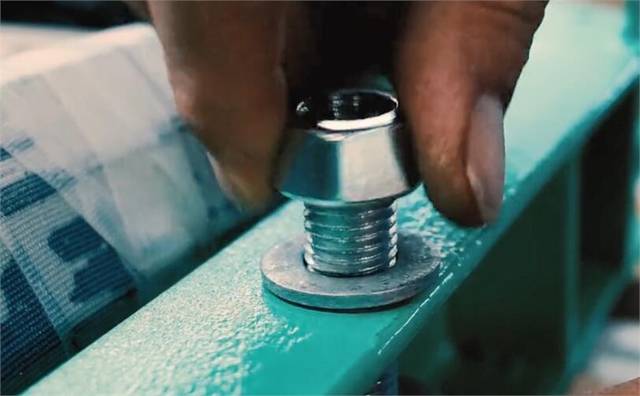
In the vast landscape of China’s manufacturing industry, Yongnian District in Handan, Hebei Province, may not appear particularly prominent at first glance. Yet the tiny screws and bolts produced here are deeply embedded in the backbone of modern industry. From eyeglasses and watches to high-speed railways, bridges, ships, and aerospace equipment, almost every aspect of industrial production depends on fasteners.
Fasteners are indispensable components in modern manufacturing. With approximately 58 percent of China’s market share, Yongnian has become the country’s largest fastener production and distribution center, earning the title of “China’s Fastener Capital.”
In 2025, Yongnian’s fastener output reached 7.8 million tons, generating an industrial output value of 55.16 billion RMB. Few would imagine that this massive industry, now worth more than 50 billion RMB annually, began decades ago in rural blacksmith workshops illuminated by furnace fire.
The origins of Yongnian’s fastener industry can be traced back to the 1960s and 1970s. In villages such as Hebeipu and Dongtantou, local production teams sought ways to increase collective income during the agricultural off-season. Blacksmiths operated small furnaces, forging screws and nuts by hand.
After China’s reform and opening-up, many villagers who had mastered the craft began operating family-run workshops. Using small furnaces, they produced screws and bolts and transported them to markets across the country. By the late 1980s, the introduction of cold-heading machines marked the industry’s transition from handcrafting to mechanized production, dramatically boosting productivity. However, rapid expansion also brought serious problems: small-scale enterprises, product homogenization, cutthroat price competition, environmental pollution, and disorderly market practices gradually became obstacles to further development.
A true turning point came in 2017. As China intensified its environmental protection campaign, Yongnian’s fastener industry faced unprecedented pressure. Enterprises that failed to upgrade would either be shut down or eliminated. Confronted with this challenge, local authorities launched a sweeping industrial restructuring campaign. More than 9,000 fastener enterprises were categorized under a strategy of “eliminating some, upgrading some, relocating some into industrial parks, consolidating some, and introducing high-end enterprises.”
Within a single year, more than 5,000 non-compliant enterprises were shut down, while over 2,000 completed standardized upgrades. Numerous companies moved into modern industrial parks equipped with standardized workshops and centralized pollution-control systems. The scattered family workshops that once dominated Yongnian gradually gave way to large-scale, standardized, and environmentally compliant production facilities. At the same time, Yongnian successfully registered the collective trademark Yongnian Standard Parts, laying the foundation for a regional industrial brand.
Although painful in the short term, the transformation fundamentally reshaped the industry’s development model. Yongnian’s fastener sector began shifting away from low-end expansion toward high-quality growth, while steadily building a complete industrial chain.
Today, production inside Yongnian’s factories bears little resemblance to the traditional image of screw manufacturing. In modern workshops, CNC cold-heading machines operate at high speed, processing long stainless-steel bars into thousands of precision fasteners within minutes. Machines that once produced only 120 screws per minute have now doubled their efficiency while reducing energy consumption by 40 percent through joint technological innovation between enterprises and university research teams. Automated systems have replaced labor-intensive manual loading and transportation processes, greatly improving productivity and consistency.
More importantly, Yongnian is moving beyond low-end manufacturing and into higher-value sectors. In recent years, the district has promoted a strategy known as “building industrial chains and forming clusters.” By establishing industry alliances, local enterprises now coordinate raw material procurement, technology development, and collaborative sales. Bulk purchasing of stainless-steel materials has reduced production costs by around 10 percent while stabilizing raw material quality and increasing overall sales by roughly 20 percent.
The strengthening of the industrial chain has also accelerated the development of high-end products. Today, Yongnian manufactures high-strength bolts with tensile strengths reaching 1,220 megapascals for ultra-high-voltage transmission towers, as well as precision fasteners used in high-speed rail, automotive manufacturing, aerospace, and power engineering. The district now produces more than 30,000 types and specifications of fasteners across 12 national-standard categories. The proportion of mid-to-high-end products has risen from 40 percent to 70 percent, while average product profits have doubled.
Behind this industrial upgrading lies a growing capacity for innovation. Yongnian has established a series of public technology service platforms in cooperation with institutions such as Hebei University of Engineering, Yanshan University, and the China Academy of Machinery Science and Technology. These platforms have developed more than 30 shared technologies, including furnace-emission treatment, zinc-aluminum coating, and advanced surface-treatment technologies. Yongnian is also home to Hebei Province’s only provincial-level fastener quality inspection center. Several local enterprises have begun participating in the formulation and revision of national industry standards, marking a historic transition from “manufacturing products” to “defining standards.”
At the same time, local authorities have strengthened vocational education and talent cultivation. In 2025, Yongnian Campus of Handan Polytechnic officially opened, enrolling its first 500 students. Specialized technician training programs for the fastener industry have already achieved full employment placement for graduates. Multiple research projects on high-temperature alloy forming processes and intelligent inspection technologies have also been selected for provincial-level science and technology initiatives. A traditional manufacturing cluster is gradually building its own ecosystem of innovation, research, and skilled talent.
Having experienced the painful lessons of environmental degradation, Yongnian now places green development at the center of its industrial strategy. Traditional electroplating and phosphating processes once generated severe wastewater pollution. Today, through centralized treatment facilities, wastewater recycling systems, intelligent environmental monitoring, and the promotion of new energy logistics vehicles, the district has achieved significant progress in green manufacturing. Pollution-control costs have fallen by 70 percent, wastewater recycling rates exceed 90 percent, and PM2.5 emissions have dropped substantially. An industry once criticized for pollution has undergone a remarkable transformation toward sustainable development.
Industrial upgrading has also accelerated Yongnian’s integration into global markets. In recent years, local fastener enterprises have actively expanded overseas. The government has organized companies to participate in international trade exhibitions, provided foreign trade training, and supported the construction of overseas warehouses to stabilize international supply chains. The first Yongnian Fastener Industry Expo, held in 2025, attracted buyers from 43 countries and regions, generating on-site transactions worth 138 million RMB. Meanwhile, Yongnian added new overseas warehouses in Indonesia, Kazakhstan, and other countries, bringing the district’s total overseas warehouse count to 12.
An increasing number of Yongnian enterprises are now entering high-end international markets. Some companies have signed orders worth hundreds of millions of dollars with German manufacturers, while others have established supply-chain networks in Southeast Asia through overseas warehouses in Indonesia. From January to November 2025, Yongnian’s total import and export volume reached 2.465 billion RMB, of which exports accounted for 2.447 billion RMB, reflecting the district’s accelerating internationalization.
From sparks flying in rural blacksmith workshops to the hum of intelligent machinery in modern factories, from scattered low-end workshops to a globally connected industrial cluster, Yongnian’s fastener industry has undergone a profound transformation over nearly six decades.
Source: gxt hebei gov cn, china news, xinhua, guancha, jjckb, sina, sohu