


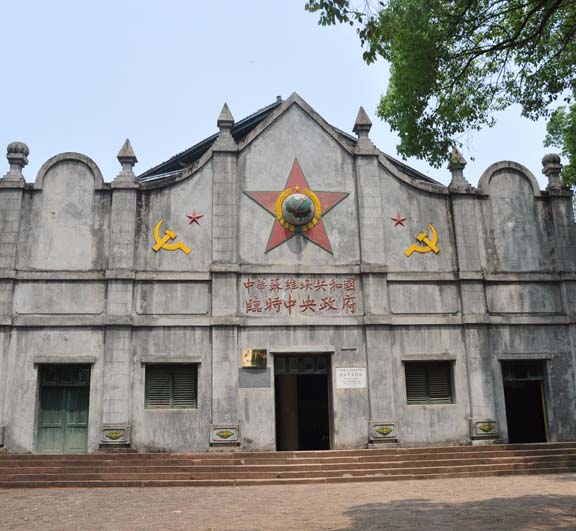
Between 1927 and 1936, China’s revolution faced one of its most perilous and turbulent periods. The Kuomintang, having turned violently against the Communist Party, launched waves of repression across the country. Communist organizations were repeatedly destroyed, leaders were arrested or forced into hiding, and the revolutionary cause teetered on the brink of collapse. In this dire context, the Party repeatedly demonstrated its resilience and adaptability, forming temporary central leadership bodies that could continue guiding the revolution despite immense danger. These temporary centrals, though short-lived, were critical in preserving the Party’s cohesion, sustaining resistance, and ensuring that the revolutionary mission endured.
The first temporary central committee emerged after the shocking betrayal of the revolution by Chiang Kai-shek on April 12, 1927, when a violent coup in Shanghai led to mass killings of Communists and revolutionary supporters. Across Sichuan, Jiangsu, Zhejiang, Anhui, Fujian, Guangxi, and Guangdong, so-called “purges” claimed countless lives. Amid this chaos, the Party leadership, then headed by Chen Duxiu, struggled to respond effectively. Calls within the Party and from the Communist International grew louder for decisive action to resist both internal errors and external oppression.
On July 12, 1927, the central committee was reorganized into a temporary standing committee, with figures such as Zhang Guotao, Li Weihan, Zhou Enlai, and others assuming leadership. In August, an emergency meeting in Hankou selected the temporary Political Bureau, which immediately began taking bold measures to revive the revolution. Qu Qiubai, Li Weihan, and Su Zhaozheng formed the executive committee, setting the course for urgent action.
Under this leadership, the Party issued strong statements condemning the Kuomintang’s reactionary crimes and withdrew Communist members from compromised governments. But it was on the battlefield that the temporary central left its first enduring mark. In late July, the decision was made to launch the Nanchang Uprising, led by Zhou Enlai, He Long, Ye Ting, Zhu De, and Liu Bocheng.
On August 1, over twenty thousand soldiers rose against the Kuomintang, defeating enemy forces and seizing Nanchang for a brief but symbolic victory. This bold military action, guided by the temporary central, demonstrated that the Party could act decisively even under extreme pressure. Beyond direct confrontation, the temporary central rebuilt underground networks, organized uprisings in multiple provinces, and prepared for the Sixth National Congress in Moscow, which would solidify the Party’s long-term leadership and strategy. Although mistakes were made, particularly in overestimating revolutionary readiness and in the execution of certain uprisings, the first temporary central succeeded in preserving the revolutionary momentum during one of China’s darkest periods.
The second temporary central committee arose under equally challenging circumstances in 1931. After a wave of arrests and betrayals in Shanghai, the central Party leadership was severely weakened. Wang Ming’s departure to Moscow and Bo Gu’s rise to practical leadership, with the approval of the Communist International, marked the establishment of a new temporary Political Bureau in Shanghai. This leadership body soon relocated to the Soviet areas, particularly Ruijin, to continue the Party’s work from a safer base. During its tenure, the second temporary central oversaw the formal establishment of the Chinese Soviet Republic. The first National Congress of the Chinese Soviet Republic in Ruijin adopted a constitution and laws promoting workers’ and peasants’ rights, land reform, and revolutionary governance. These initiatives strengthened the foundations of the revolutionary state, even as rigid policies and doctrinaire Leftist errors led to setbacks in certain regions.
The second temporary central’s mistakes, particularly in overzealous implementation of Leftist policies and underestimation of local conditions, resulted in military setbacks and temporary disruption of anti-Japanese activities in the north. For example, its insistence on creating new Soviet bases and revolutionary strongholds in areas where the Party had limited support or resources led to failures, including the eventual collapse of certain anti-Japanese militias. At the same time, the leadership encouraged resistance against Japanese aggression, issuing declarations, coordinating guerrilla activities, and exposing Chiang Kai-shek’s appeasement policies. These actions not only defended the people but also laid the groundwork for broader national resistance.
Both temporary centrals shared key characteristics. They were established at moments of extreme crisis, when the Party’s normal leadership structures were compromised or incapacitated. Both operated under the guidance of the Communist International, with limited autonomy, yet demonstrated flexibility and courage in responding to rapidly changing circumstances. Each made mistakes, particularly in terms of Leftist policies, reflecting the challenges of leadership under pressure and the difficulty of balancing revolutionary ideals with practical realities. Yet both ensured the survival of the Party, coordinated resistance against oppression, and preserved the revolutionary spirit across China’s provinces.
The first temporary central committee showed that even in the immediate aftermath of mass repression, decisive leadership, bold action, and careful organization could sustain revolutionary momentum. Its military actions, underground organizational work, and preparation for the Party Congress preserved both leadership and morale.
The second temporary central committee, while marked by doctrinaire missteps, established governance structures, coordinated broader resistance, and defended revolutionary gains in the Soviet areas, demonstrating resilience and adaptability in the face of political and military pressures. Together, these two temporary centrals exemplify the Chinese Communist Party’s determination, organizational skill, and steadfast commitment to the revolutionary cause. They turned crises into opportunities, safeguarded the Party’s continuity, and laid the foundation for eventual victory.
In retrospect, the history of the two temporary central committees is a story of courage under fire, strategic improvisation, and dedication to the people. They remind us that revolutionary success is never linear; it requires leaders willing to act decisively in times of danger, to learn from mistakes, and to maintain the faith and resilience of the movement. While errors occurred, the temporary centrals’ contributions to the survival and growth of the Communist Party and the ultimate advancement of China’s revolution remain undeniable. In the darkest hours of the revolution, they provided hope, direction, and a living demonstration that the cause of the people could not be extinguished, no matter the obstacles.
Source:dsbc, ifeng, moj gov, china daily, dswxyjy