


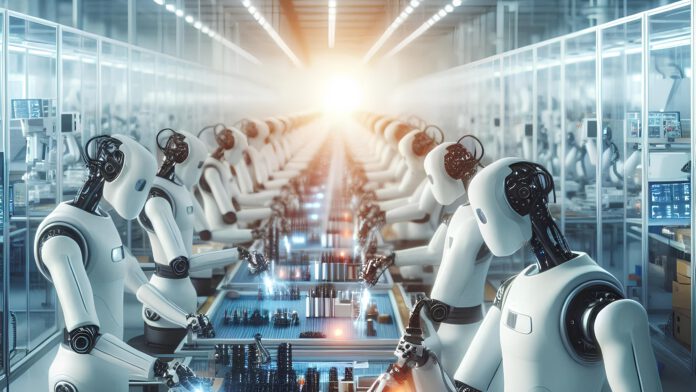
In the past two years, the surging wave of artificial intelligence has left many manufacturing entrepreneurs and executives anxious and uncertain. Most recognize that AI is no longer optional: to ignore it risks being left behind and forfeiting a place in the future industrial landscape.
Yet when companies attempt to embrace AI in earnest, they often discover that beyond a few straightforward applications or the adoption of mature, off-the-shelf technologies, they do not know where to begin. Systematic transformation proves elusive, and even serious efforts frequently fall short of expectations.
A 2025 survey by the Massachusetts Institute of Technology found that among companies attempting to deploy AI systematically, only about 5 percent achieved meaningful success.
In theory, the vision is compelling: an end-to-end smart factory in which AI replaces or dominates human roles across the manufacturing value chain. From research and development to design, production, marketing and after-sales service, every link would be driven by intelligent systems. The goal is not merely incremental efficiency gains but seamless, predictive and adaptive production—an industrial environment that is fully autonomous and self-optimizing.
Reality, however, lags far behind that ideal. Most manufacturers remain in what might be called a stage of “point intelligence,” where AI assists in isolated tasks rather than orchestrating the system as a whole. In research and development, AI can accelerate certain processes but contributes little to breakthrough innovation.
R&D is fundamentally about creative leaps, while today’s AI, whether rule-based systems, machine learning models or large language models excels at pattern recognition and data analysis rather than original invention. It performs admirably as a research assistant, summarizing academic literature or identifying correlations.
A notable example came in 2023, when researchers at Google DeepMind reported in the journal Nature that their GNOME tool, powered by graph neural networks, had identified more than 528 potential lithium-ion conductors, roughly 25 times the number previously known, offering promising avenues for battery performance improvements. Yet even here, AI plays a supporting role; core innovation still relies on human intuition and judgment.
In design, generative AI has demonstrated striking potential, though its depth of application varies widely. It can rapidly produce text, images and video, dramatically increasing the speed of graphic design work. But when it comes to complex industrial design, such as the overall form of an automobile, AI outputs tend to remain conceptual, unable to fully account for aerodynamic constraints, ergonomics, material strength and cost considerations. Even at companies like Tesla, which are often seen as AI pioneers, engineers must ultimately intervene to finalize vehicle designs. In high-precision domains such as chip and circuit board layout, AI has begun to show value in optimization tasks, including tools developed by Nvidia, but overall penetration remains limited.
On the factory floor, AI has delivered more tangible results in specific nodes such as quality inspection and predictive maintenance. Bosch has disclosed that AI-driven inspection systems on certain production lines achieve accuracy rates of 99.8 percent, surpassing the roughly 95 percent achieved by human inspectors, while reducing inspection time per unit from 20 seconds to about five and cutting costs by roughly half.
Predictive maintenance systems that analyze sensor data to anticipate equipment failures have also generated substantial savings; GE Aviation has reportedly saved hundreds of millions of dollars annually through such technologies. Yet in more complex domains, intelligent production scheduling, dynamic process parameter adjustment, end-to-end workflow optimization and personalized manufacturing, AI’s impact remains limited. A 2025 report by McKinsey & Company found that while 88 percent of companies use AI in some form, only 6 percent report that it has had an enterprise-level impact on earnings before interest and taxes.
Sales and service functions have progressed further, partly because these scenarios tolerate higher error rates. An imperfect automated response can be corrected by a human, and the tasks, language processing and knowledge retrieval, align closely with the strengths of large language models. In supply chain management, AI’s long-term potential is widely acknowledged, but practical implementation is constrained by internal data silos, fragmented communication between companies, complex procurement rules and the inherent uncertainty of global logistics.
Overall, AI in manufacturing remains heavily dependent on traditional machine learning rather than cutting-edge foundation models, and its applications are typically isolated optimizations rather than integrated systems. The gap between ambition and reality stems from the intrinsic complexity of manufacturing, its deep entanglement with the physical world and its unforgiving performance standards, conditions that do not align neatly with the current AI paradigm.
Manufacturing systems are complex along multiple dimensions. Production chains are long and tightly coupled, spanning planning, scheduling, equipment management, environmental controls, logistics, quality assurance and after-sales support. A change in one node can ripple across the entire chain. The knowledge base is equally intricate, encompassing mechanics, materials science, control systems, thermodynamics, chemistry, fluid dynamics and electrical engineering.
Standards and processes are often fragmented across spreadsheets, PDFs, legacy systems and even the tacit knowledge of veteran employees. Industry differences are vast: semiconductor fabrication, steelmaking and food processing share little in terms of reusable expertise, and even companies within the same sector differ in equipment configurations and operational models. These realities demand strong reasoning, planning and generalization capabilities, supported by comprehensive, high-quality data.
The challenge is compounded by the need for deep interaction with the physical world. Unlike advertising or online education, manufacturing requires AI to operate within physical environments governed by rigid laws of physics. While today’s large models excel at semantic understanding and statistical association, they struggle with embodied perception, spatial reasoning and a robust grasp of physical rules.
Advances in embodied intelligence and world models will be necessary before AI can fully meet industrial demands. Moreover, manufacturing data is messy and heterogeneous, flowing from temperature, pressure, vibration and visual sensors, programmable logic controllers and CNC machines, each with distinct formats and protocols. Noise, interference and missing data are common, and strategies trained in simulation often fail in real-world settings due to the persistent sim-to-real gap.
High standards further complicate adoption. Manufacturing systems often require real-time responses within tightly coupled physical control loops; delays can result not in minor inconvenience but in scrapped products, damaged equipment or threats to human safety. Error tolerance is extremely low, particularly in high-end manufacturing. A defect in a jet engine blade could trigger catastrophe; a malfunctioning medical device could cost lives; a flaw in a nuclear component could have disastrous consequences. Large models, which can be slow and prone to hallucination, face formidable reliability challenges in such environments.
Closing the gap between aspiration and execution will require both technological breakthroughs and strategic shifts within enterprises. Industrial AI systems must evolve beyond general-purpose language models to become domain-specific “industrial foundation models” that integrate deep sector knowledge. This demands high-quality data for fine-tuning and retrieval-augmented generation, as well as improved reliability through hybrid approaches that combine large models with knowledge graphs and symbolic reasoning. Models must also be optimized for speed and lightweight deployment to meet industrial timing constraints.
Equally important is comprehensive data acquisition across the value chain. AI is fundamentally data-driven; without complete and high-quality data, it cannot deliver meaningful results. Smart factories must develop advanced digital twins—not static replicas of equipment and inventory, but dynamic simulations that embed physical constraints and business logic, enabling real-time scenario analysis and optimization.
Initiatives such as the industrial metaverse concept promoted by Siemens hint at this direction, using digital twins to simulate entire factory ecosystems and anticipate potential failures. Yet before such visions can be realized, companies must integrate data scattered across MES, ERP, WMS and QMS systems, align formats and timestamps and ensure cross-source consistency. They must also generate high-quality labeled datasets; unlike large language models trained on vast self-supervised corpora, industrial models often require expert-annotated data, such as detailed fault diagnoses provided by seasoned engineers.
Ultimately, AI in manufacturing must demonstrate the ability to operate under complex physical, safety, regulatory and commercial constraints, balancing multiple objectives such as delivery times, cost, yield and safety. It must learn continuously from errors, adapt to uncertainty in demand and supply and, ideally, employ reinforcement learning to design experiments that generate new knowledge. Embodied intelligence will be essential, as manufacturing is fundamentally a process of physical transformation; AI must not only perceive but also act in the real world, coordinating across diverse robots and equipment from multiple vendors. All of this must occur under stringent requirements for reliability, safety and determinism.
Achieving these capabilities will require sustained investment and organizational transformation. In the short term, manufacturers can pursue targeted applications, knowledge assistants powered by large models, machine-learning-based defect detection and predictive maintenance, to accumulate experience and build confidence. Over the long term, the strategic priority is the construction of robust data assets.
Companies that control high-quality industrial data will occupy a privileged position in the emerging AI ecosystem. While technology giants may lead in model development, manufacturers that cultivate and leverage proprietary data can secure upstream influence. As AI technologies mature, those with the strongest data foundations will be best positioned to expand from isolated optimizations to fully integrated, end-to-end intelligent factories.
Source: TrendMicro, paper people, xinhua, fened, CSDN