


In 2025, the artificial intelligence (AI) industry continued to accelerate rapidly. Large models kept growing in scale, with parameter counts reaching new highs, and new state-of-the-art systems appearing frequently. However, as the industry moves into 2026, the focus is clearly shifting.
Instead of asking “what can AI do?”, companies and investors are increasingly asking a more practical question: “where can AI actually be applied in a way that creates real business value?” Technical capability is no longer the main bottleneck. Commercial viability and real-world deployment have become the key criteria.
In simple terms, the industry now has powerful AI tools often described as a highly advanced “hammer.” The challenge is no longer building the hammer, but finding the right “nails”: concrete, high-value scenarios where AI can be reliably and profitably used.
This transition is not easy. On one side, AI companies often possess strong technical capabilities but lack deep understanding of specific industries and real operational needs. On the other side, traditional industries have rich data and practical use cases but remain cautious about AI systems, which are often perceived as complex “black boxes.” This gap between technology and industry knowledge continues to slow large-scale adoption.
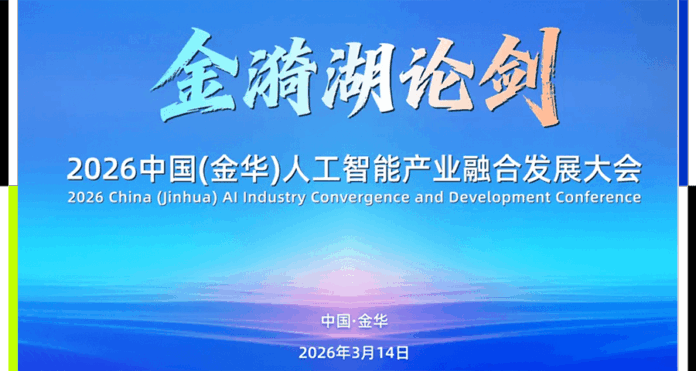
To help bridge this gap, a major industry event was held on March 14, 2026, in Jinhua, a city in Zhejiang Province, China. The event aims to connect AI technology providers, industrial companies, and investors, focusing on how AI can be integrated into real-world industrial systems.
Jinhua is not one of China’s largest metropolitan hubs, but it plays an important role in the country’s manufacturing and logistics network. In 2025, the city’s GDP exceeded 100 billion USD, reflecting steady growth. It is also part of Zhejiang Province’s broader economic development strategy, with ambitions to further upgrade its industrial structure in the coming years.
One of Jinhua’s key strengths is its strong manufacturing base. The city has long been known for traditional industries such as hardware manufacturing and automotive components. This industrial foundation provides a practical environment for testing and deploying new technologies, especially in areas such as smart manufacturing and robotics.
A notable example is the local development of the new energy vehicle (NEV) industry. In recent years, Jinhua has become an important production base for electric vehicles in Zhejiang Province. In 2025, the city produced around 665,000 new energy vehicles, accounting for nearly half of the province’s total output. This reflects how traditional manufacturing capabilities are gradually integrating with new technological trends.
Such industrial ecosystems are particularly relevant for AI applications. Technologies such as industrial automation, robotics, and embodied intelligence require not only algorithms but also real-world manufacturing environments. Jinhua’s existing industrial base provides a useful testing ground where AI systems can be directly applied to production lines and logistics operations.
Another important advantage of Jinhua is its logistics and trade network. The city is closely linked to Yiwu, a global center for small commodity trade. Together, they form one of the most active logistics hubs in China. In 2025, Jinhua handled approximately 18.85 billion express deliveries, ranking among the highest in the country.
This high-intensity logistics environment generates large volumes of operational data and complex scheduling challenges. It also creates strong demand for efficiency improvements in warehousing, transportation, and cross-border supply chains. These are exactly the types of problems where AI systems such as optimization algorithms, predictive models, and autonomous robots can provide value.
For example, AI can be used to improve warehouse sorting efficiency, optimize delivery routes, or manage cross-border logistics flows. Unlike laboratory settings, these applications operate in highly dynamic and large-scale real environments, making them ideal for testing the robustness of AI systems.
From a broader perspective, Jinhua offers a combination of manufacturing capacity and real-world logistics complexity. This makes it a useful “stress test” environment for AI companies seeking to move beyond pilot projects and into large-scale deployment.
The upcoming conference in Jinhua will bring together researchers, industry leaders, and startups. Discussions will focus on areas such as industrial AI systems, robotics, AI chips, and spatial intelligence. Rather than emphasizing theoretical advancements, the emphasis will be on how these technologies can be integrated into actual business operations.
In addition, several early-stage companies will present projects in fields such as AI-enabled robotics, new energy systems, life sciences, and advanced materials. These presentations aim to explore potential connections between technological innovation and industrial demand.
From a regional development perspective, the event will take place in the Jinyi New District, a development zone in Jinhua that is part of China’s Yangtze River Delta integration strategy. The area benefits from strong transport connectivity, including highways, railways, and proximity to major economic centers such as Hangzhou and Shanghai.
More importantly, the region is actively working to upgrade its industrial structure, encouraging the integration of digital technologies with traditional manufacturing. Policies in the area emphasize industrial modernization, innovation support, and talent attraction, particularly for young entrepreneurs and technology companies.
In summary, as AI enters a new stage of development, the key challenge is no longer technological progress alone, but practical integration into real economic systems. Cities like Jinhua combining manufacturing strength, logistics scale, and growing openness to innovation illustrate where this transition may take shape.
The broader shift is clear: AI is moving from a phase of rapid technological expansion to a phase of industrial adoption. The ultimate test is no longer how powerful the models are, but how effectively they can be embedded into real-world production and services, and whether they can consistently generate measurable value.
Source: china news, sina