


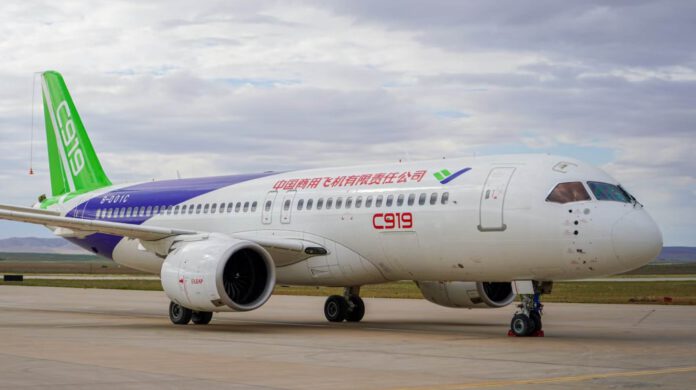
China’s domestically produced large passenger aircraft, the C919, has entered a pivotal phase of large-scale delivery, coinciding with the largest capital injection in the history of its manufacturer, the Commercial Aircraft Corporation of China (COMAC). According to China National Enterprise Credit Information Publicity System, COMAC recently updated its industrial and commercial registration, raising its registered capital from approximately €6.08 billion to approximately €11.42 billion, an increase of roughly 88%.
COMAC’s shareholders include the State-owned Assets Supervision and Administration Commission of the State Council (SASAC) and eight other state-owned enterprises. In this round of capital injection, all shareholders except Sinochem Group contributed additional capital. SASAC led the investment with nearly €3.03 billion, increasing its shareholding to 53.08% and establishing absolute control.
Key upstream players in the aviation manufacturing sector, such as Aluminum Corporation of China (CHINALCO), China National Building Materials Group (CNBM), and China Electronics Technology Group Corporation (CETC), also increased their stakes. CHINALCO invested €340.2 million, raising its shareholding from 4.11% to 5.17%; CNBM contributed €322.6 million, increasing its stake from 2.98% to 4.40%; and CETC invested €210.3 million, raising its shareholding from 1.99% to 2.90%. These investments underscore the deep integration of COMAC’s large aircraft projects with essential upstream suppliers, including aluminum materials, composite materials, and avionics systems.
Other shareholders experienced varying degrees of dilution. Shanghai Guosheng Group, representing local state-owned assets, invested €974.1 million, bringing its total contribution to €2.245 billion. Despite this, its shareholding slightly decreased from 20.91% to 19.64%, remaining COMAC’s second-largest shareholder. Aviation Industry Corporation of China (AVIC), China Baowu Steel Group, and SASAC also made capital contributions of €182.6 million, €190.5 million, and €92.1 million respectively, leading to reduced holdings of 6.90%, 3.85%, and 1.86%. Sinochem Group, which did not participate in this capital increase, saw its stake diluted to 2.2%.
Established in March 2008 and headquartered in Shanghai, COMAC is the main entity implementing China’s National Major Project for Large Aircraft Development. It coordinates the development of trunk and regional aircraft while driving the industrialization of China’s civil aviation sector. COMAC has developed two independent commercial aircraft models: the C909 regional jet and the C919 mainline passenger jet.
The timing of this substantial capital injection aligns with a critical juncture in the C919’s commercial operation and large-scale delivery. The C919, China’s first independently developed medium-range jet-powered trunk passenger aircraft with full intellectual property rights, was developed in compliance with international airworthiness standards. COMAC delivered the first C919 to China Eastern Airlines in December 2022, and its first commercial flight took place in May 2023. To date, 26 C919 aircraft have been delivered, serving over 30 routes and transporting more than two million passengers in just over two years. Meanwhile, the C909 is operated by 12 airlines, including 10 passenger carriers and 2 cargo airlines, with international presence in Indonesia, Laos, and Vietnam.
With more than 1,000 orders already received for the C919 from airlines and leasing companies, COMAC faces urgent challenges in scaling production, optimizing its supply chain, and enhancing its after-sales service system. A research report indicates that COMAC plans to expand the C919’s production capacity to 150 aircraft per year by 2027 and further to 200 aircraft per year by 2029. Beyond the C909 and C919, COMAC is advancing the development of the long-range wide-body C929 aircraft, which will seat approximately 280 passengers and offer a range of up to 12,000 kilometers. The C929 is currently in the preliminary design phase and aims to meet both international and regional market demands.
The civil aircraft industry is highly capital- and technology-intensive, characterized by long research and development cycles and substantial investment requirements. Industry analysts note that COMAC’s recent capital increase provides critical financial support for production capacity expansion, technological upgrades, and the construction of a comprehensive service network. It also reflects the commitment of China’s national and state-owned shareholders to support the long-term growth of the domestic civil aviation sector.
Globally, the civil aviation market is dominated by Boeing and Airbus. COMAC seeks to incrementally expand the market share of domestically produced aircraft through continuous R&D and international market penetration. At the Dubai Airshow on November 17, COMAC showcased both the C919 and C909, marking its first participation in the event. One C919 performed a flight demonstration, while another, from China Southern Airlines, was displayed alongside the C909 in the static display area, signaling COMAC’s ambitions in the global aviation market.
C919 flight operations in Southeast Asia are accelerating. The Brunei Civil Aviation Authority recently adopted the airworthiness standards of the Civil Aviation Administration of China (CAAC), enabling Bruneian airlines to operate COMAC-manufactured aircraft. Looking ahead, COMAC’s Annual Market Forecast Report (2024-2043) predicts that China’s passenger traffic will grow at an average annual rate of 5.25% over the next two decades, with the domestic fleet expanding at 4.4% annually.
The country is projected to require 9,323 jetliners during this period, with its fleet reaching 10,061 aircraft by 2043 and accounting for 20.6% of the global passenger aircraft fleet, potentially making China the world’s largest single air transport market. This aligns closely with Airbus’s forecast, which anticipates China will require over 9,500 new passenger and freighter aircraft over the next 20 years, representing more than 20% of global demand, driven by the growth of the middle class and rising per capita air travel from 0.5 trips in 2023 to 1.7 by 2043.
Source: stcn, finance sina, xueqiu, hznet, caifuhao, ccaonline