



On November 26, the Xingyan Space Situational Awareness (SSA) constellation plan was officially unveiled in Beijing by Space Insighter. Founded in 2016, Space Insighter focuses on in-orbit spacecraft management and ground-to-space communications. It has developed an integrated, intelligent system for space measurement, control, communication, and traffic management, enhancing the capabilities and efficiency of space systems and providing comprehensive space management solutions to users worldwide.
Globally, the number of satellite launches has surged in recent years, with large-scale constellation deployments becoming mainstream as commercial space activity enters a phase of rapid growth. At the same time, the space environment faces unprecedented challenges. The sharp increase in the number of on-orbit satellites has intensified collision risks, while the proliferation of space debris poses a severe threat to the sustainable use of space.
According to the European Space Agency’s 2025 Space Environment Report, there are more than 50,000 pieces of space debris larger than 10 centimeters, approximately 1.2 million pieces between 1 and 10 centimeters, and around 140 million pieces between 1 millimeter and 1 centimeter. Traveling at several kilometers per second, these objects can damage spacecraft surfaces, disrupt critical systems, or even cause explosions upon impact.
There have already been multiple incidents highlighting these dangers. On November 5, 2025, the return capsule window of China’s Shenzhou-20 spacecraft cracked due to space debris during its planned return, forcing the original mission to be canceled, with the crew returning aboard Shenzhou-21 instead. In 2023, the solar array of China’s Tiangong space station suffered localized damage from micrometeoroid impacts, which was successfully repaired by astronauts during a spacewalk. In December 2022, the MS-22 spacecraft of the International Space Station experienced a micrometeoroid collision that caused a coolant leak.
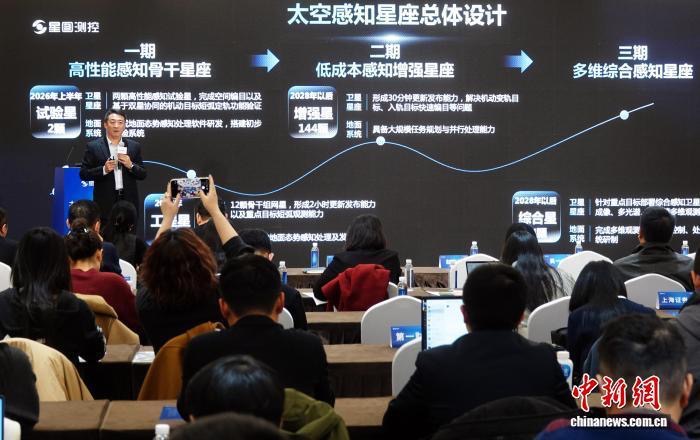
According to Hu Yu, head of the Xingyan SSA constellation and chairman of Space Insighter, space situational awareness satellites can monitor on-orbit spacecraft and debris, collect and analyze data, and provide actionable insights to satellites to prevent collisions between satellites and with debris.
Space Insighter plans to launch two experimental satellites in the first half of 2026, followed by ten operational satellites in 2027, with additional enhancement and comprehensive satellites to be deployed subsequently. Leveraging its proprietary Observer spatial information analysis platform and the space management service platform Space Cloud, the Xingyan constellation will track and catalog satellites, monitor space debris, analyze orbital data, and predict collision risks. This will provide precise, efficient space traffic management services, addressing the growing congestion and debris threats in low Earth orbit and ensuring safer operations in space.
The Xingyan constellation is designed to independently observe and catalog low-Earth orbit targets, while also monitoring key high-orbit areas as needed. Its capabilities emphasize rapid short-arc orbit determination and anomaly detection. The satellites are equipped with wide-field cameras, infrared and multispectral imagers, electromagnetic monitoring instruments, onboard computing units, and intelligent processing software, integrating AI-driven early warning and automated collision avoidance technologies.
Construction of the constellation will proceed in two phases. Phase one will establish a core network of 12 high-performance satellites focused on rapid orbit determination and anomaly identification. Phase two will deploy 144 low-cost enhancement satellites, utilizing integrated payload and satellite platform design to reduce costs. The large-scale deployment will enhance the timeliness of low-orbit monitoring, with particular focus on quickly cataloging and tracking newly launched or maneuvering satellites.
Positioned as a critical infrastructure in the commercial space era, the Xingyan constellation establishes a comprehensive “monitoring-warning-service” ecosystem. With the global low-Earth orbit satellite count surpassing ten thousand, its commercial applications extend across multiple sectors. In data services, it provides subscription-based space traffic management reports to commercial space companies. In insurance and risk assessment, it helps satellite insurers quantify collision probabilities to inform underwriting decisions. In launch support, it provides safety analysis for launch trajectories, helping to secure launch missions from collision hazards.
Internationally, many commercial SSA companies rely on ground-based telescopes or phased-array radars to provide global observation and analytical services. In contrast, space-based SSA offers distinct advantages, including broader coverage and higher detection efficiency. For example, NorthStar Earth & Space is constructing a 52-satellite low-Earth orbit SKYLARK constellation, having launched four SSA satellites in January 2024. Turion Space’s DROID.001 satellite was launched in June 2023. Domestically, the first satellite of the Guangshi constellation, planned for 24 satellites, was launched by Kaiyun United on September 5, 2025. Space Insighter plans its Xingyan experimental satellites to launch in the first half of 2026.
Space Insighter emphasizes that it will continue to enhance its space management capabilities through sustained research and development, strengthening core SSA competencies, and collaborating with industry partners to build a shared, integrated space situational awareness network.
This effort supports a safer, more orderly space environment and aligns with China’s strategic goals of advancing its space capabilities, strengthening national security in emerging domains, and transitioning from a spacefaring nation to a space power. The development of SSA technology is not only essential for collision prediction and avoidance but also forms the foundation for taking proactive control of space security and actively participating in future international space governance.
Source: rmzxw, geovis, guancha, xinhua, sina, space insighter, ifeng