


Looking at the technological evolution of the air conditioning industry is essentially a process of deepening human understanding of air management.
In the earliest functional era, air conditioners were designed around a single task: cooling or heating. Competition among manufacturers centered on more efficient compressors, higher energy efficiency ratings, and stronger airflow output.
But as users began demanding humidity regulation, air purification, and fresh air circulation, the limitations of single-function systems became increasingly obvious. Cooling, heating, dehumidification, and other functions existed in isolation, often requiring multiple devices to meet basic comfort needs. This product form gradually created a “functional silo” experience.
The next stage was the platform era. Manufacturers standardized core hardware design, enabling compressors, heat exchangers, and air ducts to be modular and reusable. Different models could share the same underlying technology platform.
On this basis, companies began integrating fragmented functional modules into preset “packages,” allowing users to choose combinations such as cooling, heating, and fresh air systems. These bundled solutions improved usability but still followed a logic of function stacking: each capability existed independently, operating in separate modes, lacking true coordination, and unable to dynamically adapt to environmental or user needs.
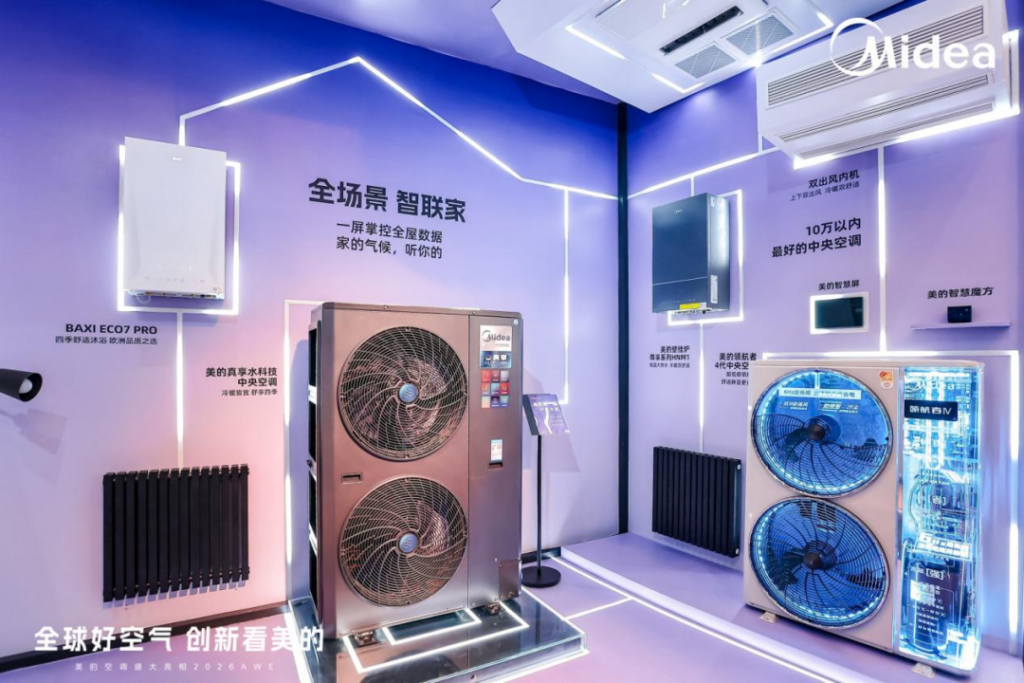
A truly effective solution is not to add more devices or options, but to use a unified system to coordinate temperature, humidity, air quality, and airflow, achieving systematic air management. This is why architectural systems represent the real technological watershed for the air conditioning industry.
On one hand, architecture transforms air conditioners from a collection of loosely connected functions into a system with a central “brain.” Fresh air purification, temperature control, humidity control, and airflow modules are no longer independent, but are dynamically orchestrated based on AI perception of environmental conditions and user needs.
On the other hand, through embedded technical interfaces and system openness, future air conditioners will have the ability to continuously evolve. This means they will no longer be closed devices, but expandable terminals that can integrate new modules, connect to third-party ecosystems, and continuously extend their capabilities.
Just as architecture transformed the automotive industry, turning mechanically controlled machines into software-driven intelligent terminals, architectural systems in air conditioning represent a shift toward a higher level of technological sophistication in air management. It is no longer about selling an air conditioner, but about defining the technological foundation of air management itself.
The future competition in the air conditioning industry will be defined by architectural technological capabilities.
As architecture becomes the next-generation solution for the industry, a new question arises: what kind of architecture can truly be considered industry-leading?
At the AWE 2026 exhibition, Midea Air Conditioning’s Wanxiang Air Architecture attracted widespread attention and discussion.
As the world’s first intelligent air conditioning architecture, it is fundamentally built around reconstructing home air systems from the ground up. Through modular design and centralized intelligent scheduling, it enables different air-related capabilities to operate collaboratively within a single system, breaking away from the traditional logic of function stacking. Under this architecture, conventional air conditioners are restructured into three core modules working in coordination: the air conditioning module, the air quality module, and the AI module, forming a complete air management system.
The air conditioning module is responsible for basic environmental regulation, controlling temperature, humidity, and airflow to ensure stable comfort. The air quality module integrates fresh air intake, purification, and sterilization, ensuring healthy breathing environments indoors.
The AI module acts as the intelligent brain. Through L5-level intelligent voice interaction, large-scale AI models, and multi-dimensional sensing capabilities, it unifies and orchestrates the capabilities of previously separate systems, enabling intelligent home air management.
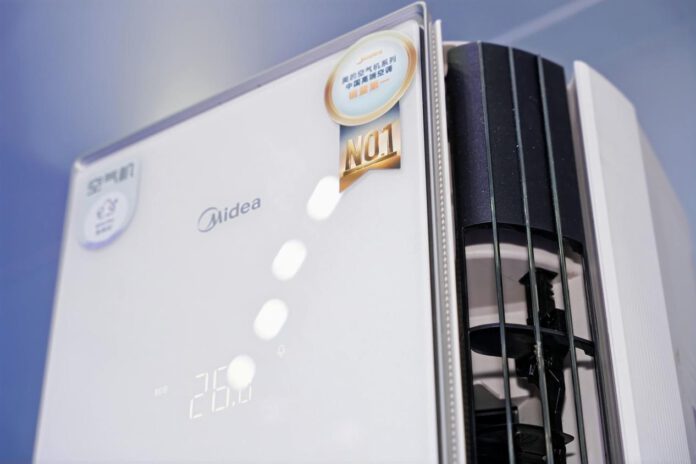
With the underlying technology of air management redefined, a “super air conditioner” has emerged. Midea’s Air Machine family, built on the Wanxiang Air Architecture, represents a new species in the air conditioning industry. As a flagship example, the Midea Air Machine T6 integrates air conditioning, air quality, and AI modules into a single system, achieving what can be described as “one device replacing six.”
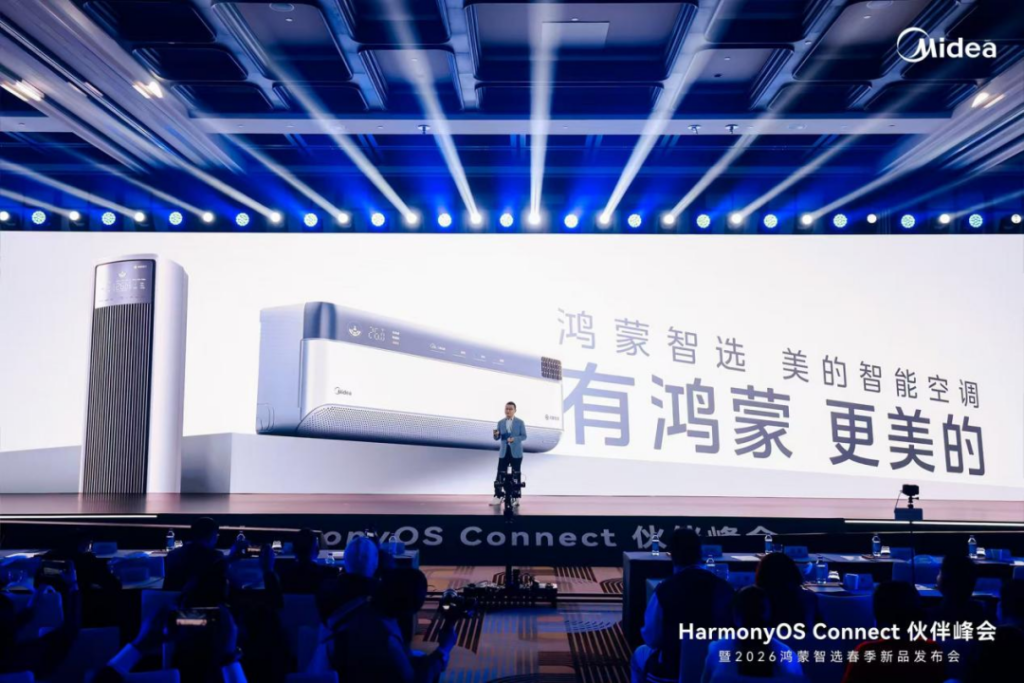
Notably, Midea has also deeply collaborated with Huawei and fully integrated into the HarmonyOS ecosystem. At the March 10 HarmonyOS Partner Summit, Midea’s first HarmonyOS-enabled air conditioner and its fully connected smart air system were unveiled. Based on HarmonyOS, the air conditioner is no longer just a temperature regulator but becomes a “smart air steward” deeply integrated into Huawei’s whole-home intelligence system. This reflects one of the core features of the Omni Air Architecture: ecosystem openness, seamless integration with multiple AI models and partners, and distributed capability sharing of air data and user states, enabling more intelligent air management experiences. This is why Midea’s system is not only multifunctional but also provides endless extensibility through a single interface.
The Omni Air Architecture also reserves open technical interfaces, allowing continuous evolution. In the future, new sensors and smart ecosystem devices can be connected to the system, continuously expanding the boundaries of air management capabilities.
Midea’s Omni Air Architecture represents a major leap for the air conditioning industry over the past decades. From a product perspective, it transforms air conditioners into air management centers in the form of “air machines,” breaking the limitations of single-function devices. At the same time, by moving beyond function-stacking logic, it establishes a new technological paradigm for the industry.
As competition around air management architecture unfolds, a key question arises: why is Midea able to master core technological innovation in this field and lead the industry into a new era defined by architecture-driven ecosystems?
In reality, this is the inevitable result of accumulated industrial capabilities reaching a critical threshold.
The core capabilities of the global air conditioning industry are now highly concentrated in China. After decades of development, China has not only become the world’s largest air conditioner consumer market, but also established the most complete industrial chain, from compressors and control systems to full product manufacturing, as well as supply chain and distribution networks. According to industry data, China accounts for approximately 85% of global air conditioner production capacity, manufacturing the vast majority of products used worldwide.
When manufacturing capability, supply chain systems, and engineering expertise are highly concentrated in one country, core technological innovation tends to emerge there as well. Similar trajectories have been seen in Japan’s automotive industry and South Korea’s semiconductor industry.
Within China’s air conditioning ecosystem, Midea is one of the most representative companies. Founded in 1985 as an air conditioning manufacturing plant, it has developed over 40 years into a fully integrated enterprise covering R&D, production, sales, design, installation, and after-sales service.
Over four decades, Midea Air Conditioning has gone through multiple stages of industrial upgrading in China’s household appliance sector. It evolved from OEM manufacturing, to ODM design and manufacturing, and finally to OBM branding and technology leadership. Throughout this process, it has been both a participant and a key driver of industry development.
Today, among all air conditioners sold globally, one in every four is manufactured by Midea. According to a 2026 consumer electronics report by Euromonitor, Midea Air Conditioning once again ranked first globally in sales in 2025. When industrial scale and supply chain strength converge, a company’s role changes: it is no longer just a participant in the industry, but begins to define its direction.
It is therefore not surprising that while some competitors are still focused on incremental functional improvements, Midea has already completed a fundamental architectural transformation of the industry.
True disruptive innovation is rarely about a single technology breakthrough, but rather about redefining industry rules through accumulated industrial capability. In this sense, Midea’s Omni Air Architecture represents a structural leap that reshapes the traditional air conditioning industry from the ground up.
Source: Huawei, Midea, 36kr, sina, aiab live