


As China’s pig farming industry enters an era of more than 700 million hogs slaughtered annually, with large-scale farms accounting for over 70 percent of production, the business of raising pigs is being fundamentally redefined.
Over the past two decades, the industry has completed its first major transformation from backyard farming to industrial-scale production. Today, however, the true competitive edge of a modern pig farm no longer lies simply in the number of barns or animals it manages, but in its ability to coordinate environmental control, nutrition, disease prevention, and energy efficiency with precision.
In large-scale operations, even minor management errors can quickly be amplified by scale. Farms using the same breeds and similar facilities can end up with vastly different results: some maintain stable costs and efficient production cycles, while others struggle with disease outbreaks, feed waste, and rising labor expenses.
For decades, pig farming relied heavily on the intuition and experience of veteran workers. Farmers judged a pig’s health by observing its movement, appetite, and behavior. But when a single farm manages tens of thousands of animals, experience alone is no longer enough to sustain efficiency. As a result, “smart farming” has become the industry’s next inevitable step.
In Changling County, Jilin Province, a smart farming project jointly developed by COFCO Joycome, Huawei, and iFlytek is attempting to answer a critical question: after achieving scale, how can China’s livestock industry truly move toward intelligent and refined operations?
Inside the barns, the contrast with the freezing winter outside is striking. While temperatures outdoors fall well below zero, the indoor environment remains stable and comfortable for the pigs. Instead of relying on workers to manually adjust ventilation and heating, the farm uses an AI-powered environmental control system. Sensors distributed throughout the barns continuously collect data on temperature, humidity, carbon dioxide, and ammonia levels. These data streams are analyzed in real time by AI models that automatically calculate the optimal ventilation, heating, and cooling strategies, reducing both energy consumption and stress on the animals.
Health management has also undergone a major transformation. Traditionally, workers spent hours walking through barns to observe pigs individually, checking their appetite, posture, and waste. At the Changling farm, many of these tasks are handled by rail-mounted inspection robots equipped with fisheye cameras, thermal imaging devices, 3D sensors, and environmental monitors. The system can automatically count pigs, estimate body weight, evaluate fat levels, and identify abnormal body temperatures.
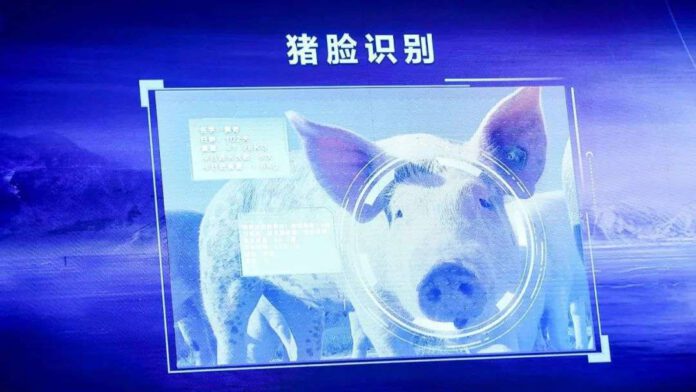
Through large-scale image training, AI systems have learned to recognize individual pigs, analyze behavior patterns, and detect signs of disease risk. In some farrowing units, a single worker can now oversee nearly 800 piglets.
Sound analysis has become another layer of disease prevention. AI-powered acoustic monitoring systems installed in nursery barns are trained on massive libraries of abnormal pig vocalizations. By filtering background noise, the system can identify coughing and sneezing patterns associated with respiratory illness. In the past, diseases were often discovered only after pigs showed obvious symptoms such as lethargy or loss of appetite. Now, AI systems can provide warnings two to three days earlier.
At its core, this transformation represents the conversion of traditional farming experience into measurable, reproducible, and continuously optimized data models. Decisions once dependent on individual judgment are increasingly being driven by algorithms.
Yet the real significance of smart farming lies not in making individual systems “smarter,” but in connecting previously isolated streams of data into a coordinated operational network.
Feed management provides the clearest example. Feed accounts for more than 60 percent of total pig farming costs and is one of the most critical variables affecting profitability. At the Changling farm, intelligent feeding systems generate customized nutrition plans based on each pig’s age, weight, growth rate, and body condition. Data collected by inspection robots are integrated with breeding and growth-cycle information to support dynamic feeding decisions.
The system not only adjusts feed quantities but also optimizes nutritional formulas in real time. Feed silos equipped with weighing systems continuously monitor feed consumption, while feeding devices record actual intake by individual pigs. Together, these data form a closed operational loop linking feeding, consumption, and growth performance.
The impact on efficiency is substantial. Traditional feeding practices often treated entire groups of pigs uniformly, regardless of individual differences. Today, precision feeding enables farms to tailor nutrition to each animal’s needs, reducing waste while improving feed conversion efficiency.
The same collaborative logic extends to environmental management and disease control. If ammonia levels rise in a particular section of the farm, the system can automatically trigger additional ventilation. If coughing frequency increases in one area, alerts are simultaneously sent to veterinarians and farm managers, along with recommendations to inspect temperature and humidity conditions that may be contributing to respiratory stress.
As a result, the pig farm increasingly resembles a highly integrated industrial system rather than a traditional agricultural operation.
This shift has also changed the role of workers. Farmers are no longer simply operators carrying out repetitive tasks. Instead, they are becoming managers of intelligent systems, focusing on decision-making and responding to exceptions, while AI handles continuous monitoring and routine adjustments around the clock.
Behind all of this lies a critical but often invisible foundation: digital infrastructure.
For a smart farm managing tens of thousands of pigs, the challenge is not merely deploying advanced devices, but enabling thousands of sensors and dozens of systems from different vendors to operate seamlessly together. At the Changling project, millions of data points are generated every day. Without unified platforms and reliable networks, even the most advanced equipment would remain isolated “data islands.”
To solve this problem, COFCO Joycome built a centralized smart farming operations platform integrating environmental control, feeding, health monitoring, and production management. Huawei provides the underlying digital infrastructure, including network connectivity, edge computing, and AI computing capabilities, ensuring that massive amounts of data can be transmitted and processed in real time. iFlytek contributes AI algorithms for sound recognition, machine vision, and intelligent inspection systems.
The value of this collaboration is ultimately reflected in the farm’s key performance indicators. The Changling farm has raised its PSY, the number of piglets weaned per sow per year, to above 29, placing it among the industry’s leading operations. This achievement is not the result of a single technological breakthrough, but of coordinated improvements across environmental control, precision feeding, health prediction, and data integration.
More importantly, the significance of this experiment extends far beyond one farm.
China’s livestock industry previously achieved its first major leap through large-scale industrialization. Now, a second transformation driven by data and artificial intelligence is underway. Traditional agriculture, once dependent primarily on labor and experience, is gradually acquiring the stability, predictability, and standardization associated with modern manufacturing.
Within the Changling project, each participant plays a distinct role: COFCO Joycome contributes livestock expertise and operational knowledge; Huawei provides the digital infrastructure and system architecture; iFlytek and other technology partners deliver AI algorithms and intelligent devices. Together, they are building a collaborative model that can potentially be replicated across the broader industry.
As pig farming evolves from experience-driven management to data-driven decision-making, and from isolated automation to fully integrated intelligent operations, this transformation represents more than a technological upgrade. It is a fundamental restructuring of agricultural production itself.
For China, the world’s largest pork producer and consumer, this may well mark the moment when traditional farming truly enters the age of AI.
Source: 36kr, huawei, sciif, sohu, hopelandiot