


On April 21, CATL held its Super Tech Day in Beijing, unveiling a comprehensive lineup of next-generation energy solutions, including the third-generation Shenxing ultra-fast charging battery, the third-generation Qilin battery, the Qilin condensed-state battery, the second-generation Choco-SEB super hybrid battery, the Naxtra sodium-ion battery, and its “super swap-integrated” full-scenario energy replenishment network. The announcements reflect CATL’s continued expansion from core battery innovation toward a fully integrated energy ecosystem spanning diverse mobility applications.
At the event, Wu Kai, academician of the Chinese Academy of Engineering and CATL’s chief scientist, outlined the evolving logic of battery technology pathways. He emphasized that lithium iron phosphate (LFP) batteries are approaching their theoretical energy density limits and are therefore best suited for ultra-fast charging and balanced performance development.
In contrast, ternary lithium batteries remain the dominant high-energy-density technology in global competition, while sodium-ion batteries are expected to play a larger role in extreme temperature environments and energy storage systems. He noted that the industry is entering a multi-chemistry era in which energy density remains a key benchmark of technological leadership, but no single chemistry can fully meet all future mobility demands.
Within this framework, CATL’s third-generation Shenxing ultra-fast charging battery focuses on resolving the long-standing trade-off between charging speed and battery lifespan. Rapid charging typically accelerates internal temperature rise, which in turn speeds up side reactions and degrades longevity.
Through innovations in heat generation reduction, thermal management enhancement, and precision control, the new battery achieves ultra-fast charging while maintaining long cycle life. It delivers a 10% to 80% state-of-charge in approximately 3 minutes and 44 seconds, and a full charge in around 6 minutes under normal conditions. Even after 1,000 full charge cycles, it retains about 90% capacity. The system supports peak charging rates of up to 15C and remains effective in extreme cold conditions down to -30°C, aided by self-heating technology and a compatible swap-and-charge infrastructure.
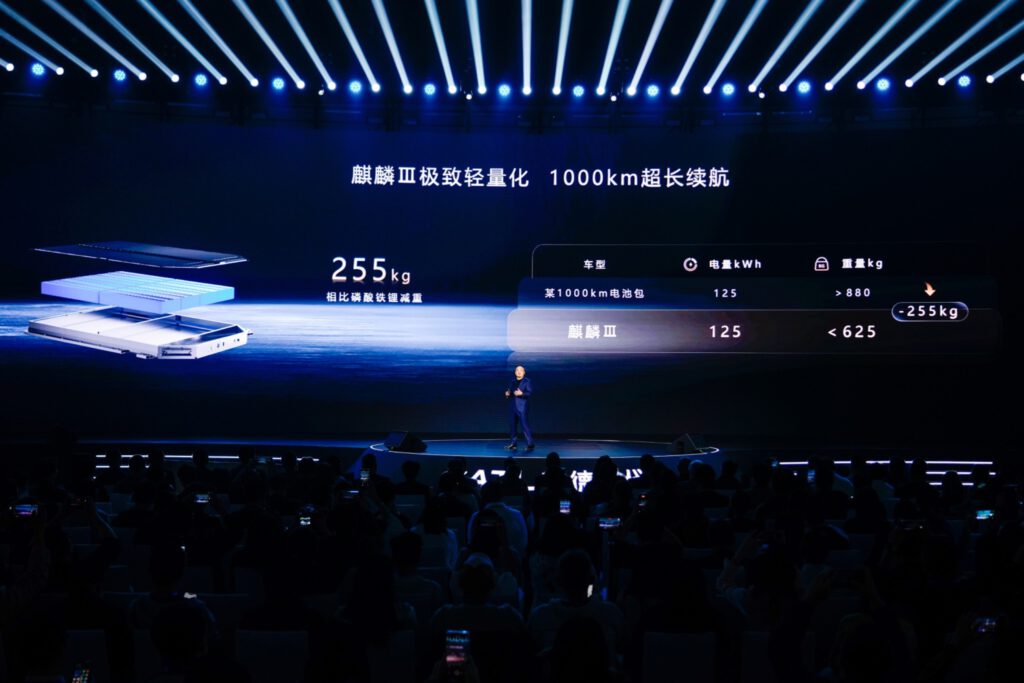
The third-generation Qilin battery targets the premium long-range EV segment. With an energy density of 280 Wh/kg, it enables vehicles to achieve up to 1,000 kilometers of driving range while supporting 10C fast charging. The battery pack weight is reduced to approximately 625 kg, significantly lighter than comparable long-range LFP-based systems, resulting in improved efficiency, handling, and structural optimization.
The lightweight design contributes to reduced energy consumption, shorter braking distances, improved stability in extreme maneuvers, and extended component lifespan. It also allows for better cabin space utilization and aerodynamic optimization. Safety has been further enhanced through a “thermal-electric separation” design that isolates thermal runaway pathways and prevents cascading failures within the battery pack.
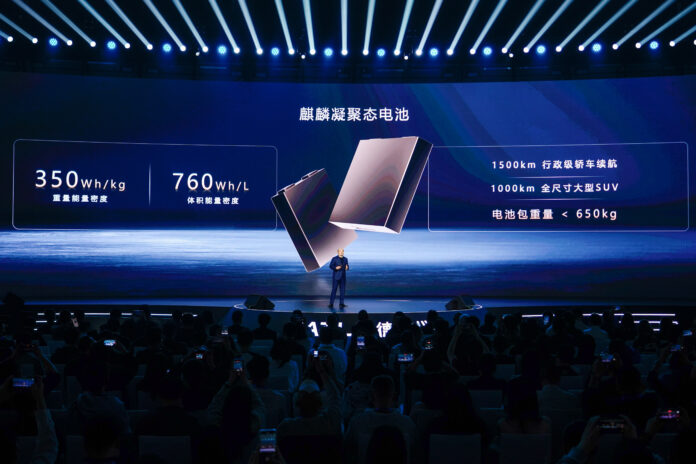
A more breakthrough innovation came in the form of the Qilin condensed-state battery, which marks the first application of aviation-grade condensed matter battery technology in passenger vehicles. It achieves a cell-level energy density of 350 Wh/kg and a volumetric energy density of 760 Wh/L, setting a new record for mass-produced batteries.
Based on this technology, sedans can reach up to 1,500 kilometers of range, while large SUVs can exceed 1,000 kilometers, with battery pack weight controlled under 650 kg. The technology was originally developed for electric aviation applications and has already been validated in a 4-ton-class aircraft, with further testing planned for heavier aircraft platforms. By replacing traditional liquid electrolytes with condensed-state electrolytes, the battery fundamentally eliminates leakage and flammability risks, significantly improving intrinsic safety.
In the hybrid segment, the second-generation Choco-SEB super hybrid battery extends the boundaries of plug-in hybrid performance. It enables up to 600 kilometers of pure electric range and over 2,000 kilometers of combined range, while fully supporting 10C fast charging. The system integrates multiple material pathways, including LFP, hybrid, and ternary configurations, to cover a broad range of applications from mainstream family vehicles to high-end hybrid platforms.
Even at low state-of-charge, it maintains strong power output, addressing the common issue of performance degradation in hybrid vehicles. In demanding scenarios such as off-road terrain, it can deliver peak power exceeding 1.5 megawatts, ensuring consistent performance regardless of battery level.
CATL also advanced its sodium-ion battery strategy with the Naxtra battery, marking a key step toward industrial-scale commercialization. The company has overcome several major engineering challenges, including moisture control, hard carbon gas generation, aluminum foil adhesion, and scalable anode manufacturing. Sodium-ion technology is expected to play an important role in energy storage and extreme climate mobility applications due to its resource abundance and strong low-temperature performance.
Beyond battery technology, CATL introduced its “super swap-integrated” energy replenishment system, which combines charging and battery swapping into a unified infrastructure network. The system reduces energy conversion losses, improves infrastructure utilization efficiency, and enables emergency power redistribution between charging and swapping stations. It also supports shared hardware architecture and higher operational efficiency.
CATL’s “Chocolate” swapping platform supports a full vehicle range from A0 to C-class models, with 800V architectures and modular battery packs. The company plans to deploy 4,000 integrated swap-and-charge stations by the end of 2026 across nearly 190 cities in China, forming a nationwide high-speed energy network in collaboration with multiple automotive and energy partners.
The company is pursuing a multi-path technological strategy aimed at addressing diverse mobility and energy demands. The underlying direction is clear: the future of electrification will not be defined by a single breakthrough, but by the coordinated evolution of multiple chemistries, system architectures, and energy ecosystems working together to reshape transportation at scale.
Source: the paper, CATL, xinhua, 21jingji, qichejingwei