


Under the guidance of China’s national “dual carbon” goals, durability has become the defining color of high-quality development. As a subsidiary of the Ping An Group specializing in financing and leasing, Ping An International Financial Leasing has, since its establishment, leveraged its close connection with the real economy and its “financing plus asset” business model to consistently uphold the concept of sustainable development.
The company has deeply integrated green finance into its business strategy and practice, becoming an important financial force driving industrial upgrading and green transformation. Focusing on green industries and serving national and public interests, Ping An Leasing actively responds to national strategies, earnestly promotes green finance, and integrates its professional capabilities with industry needs. It deploys financing and leasing services in major construction projects such as hydropower, wind power, and water conservancy, allowing financial resources to flow into new infrastructure and renewable energy sectors.
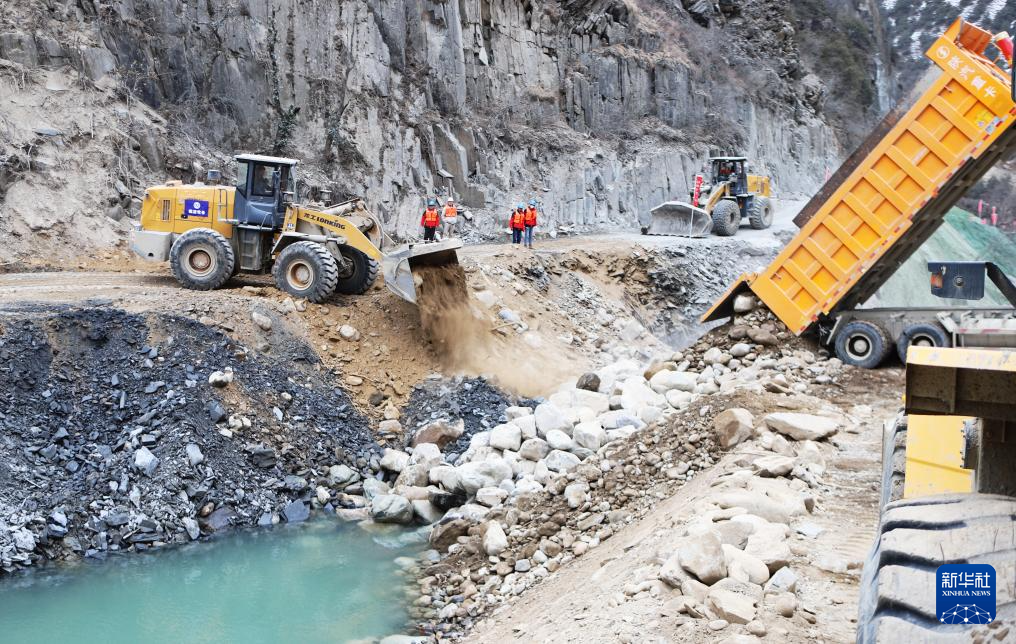
In hydropower, the Zala Hydropower Station in Tibet, the region’s first station with an installed capacity exceeding one million kilowatts, serves as a key power station for transmitting electricity from Tibet to other regions. The project is significant for promoting high-quality development in Tibet, regional sustainability, and ecological protection. Leveraging the scale of funds and multiple stakeholders, Ping An Leasing precisely aligned with the China Water Conservancy And Hydropower Engineering Bureau No.4 Co’s requirements, developing professional and accurate financial service plans for key project milestones, including river diversion, dam capping, water impoundment, and station commissioning. Customized repayment schedules based on project cash flow maximized capital efficiency and ensured smooth project implementation. Once operational, the hydropower station is expected to generate 3.946 billion kWh annually, saving 1.3 million tons of standard coal each year, significantly advancing clean energy development and utilization.
In the photovoltaic sector, Ping An Leasing keeps pace with new energy industry policies and trends, continuously supporting the development of the solar power industry. When informed that the Golmud A Photovoltaic Power Station in Qinghai Province faced expansion delays due to funding shortages, Ping An Leasing immediately responded, conducting in-depth research into procurement methods and capital requirements. By aligning dedicated credit resources with the station’s funding needs and construction schedule, the company removed financial barriers to capacity expansion, ensuring stable green power output that lights up thousands of households.
In charging infrastructure development, Ping An Leasing approaches the industry with innovative financing and leasing models, empowering urban infrastructure enterprises and creating resonance between emerging industries and green development. A leading charging service operator in Nanjing, with the company’s assistance, mobilized existing equipment assets and supplemented working capital, enabling rapid, large-scale business expansion and establishing itself as a key component of the city’s new energy ecosystem.
In the commercial new energy vehicle sector, Ping An Leasing explores niche areas such as short-distance port transportation, interprovincial transport, and urban delivery, designing innovative financing and leasing products for pure electric light trucks and battery-swapping heavy trucks. By offering diversified green finance products and innovative services, the company reduces vehicle acquisition costs, helps logistics companies phase out high-pollution, high-energy-consumption vehicles, and promotes the adoption of green, clean, and low-carbon energy systems in the logistics industry, filling gaps in green finance services and accelerating the sector’s transformation.
Collaborating with industry partners and clients, Ping An Leasing has brought financial support to rural revitalization. In July 2025, the 13th stop of the “Golden Sunshine Road” project visited Zhulinzhai Primary School in Qiaotou Township, Hekou Yao Autonomous County, Honghe Hani and Yi Autonomous Prefecture, Yunnan Province. Despite challenging transportation and construction conditions, the company, together with partners, completed a 30 kW distributed photovoltaic system in 20 days. The solar station, which converts sunlight into electricity through the photovoltaic effect, is expected to generate more than 25,000 kWh annually, fully covering the school’s teaching, living, and electronic equipment power needs, creating a stable and green learning environment for students and teachers.
The “Golden Sunshine Road” project, which aims to illuminate classrooms and dreams with green energy, focuses on the electricity needs of schools in remote areas. Since its launch in 2017, Ping An Leasing has donated distributed photovoltaic systems to schools in 13 remote regions, including Baise in Guangxi, Yulin in Shaanxi, Kashgar in Xinjiang, Tiandong in Guangxi, Wuwei in Gansu, Tongren in Qinghai, Heqing in Yunnan, Xichang in Sichuan, Bijie in Guizhou, Genhe in Inner Mongolia, and Honghe in Yunnan. By 2025, the company had cumulatively donated 204.8 kW of distributed photovoltaic systems, bringing green electricity to over 2,700 children in remote areas.
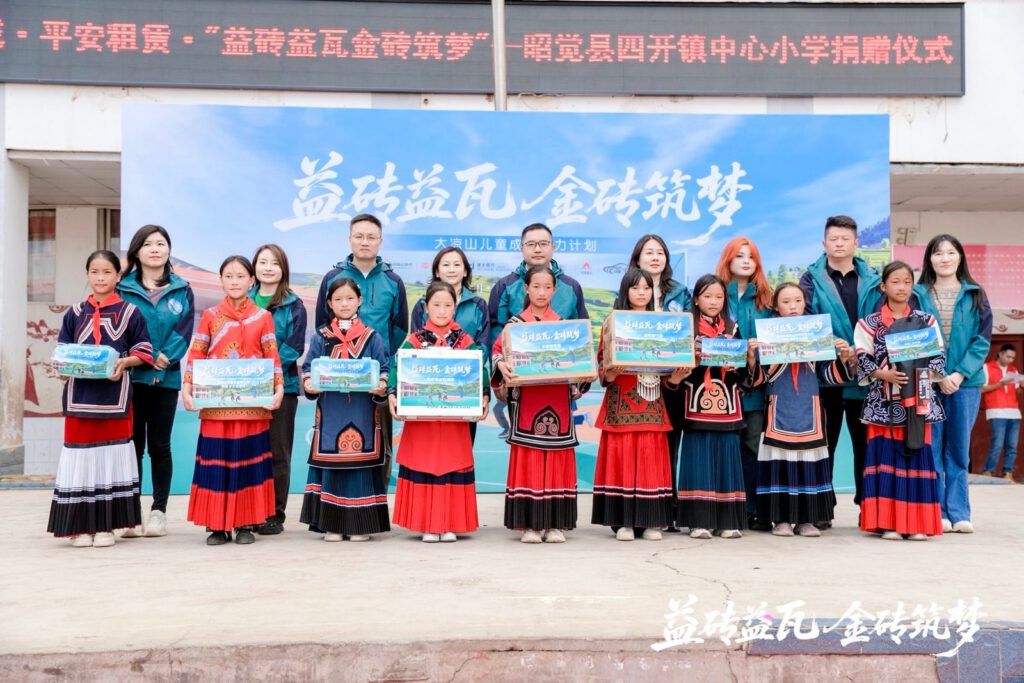
The “Building Dreams with Golden Bricks” initiative strengthens rural education infrastructure through industry expertise. Launched in 2020, the project focuses on renovating and upgrading campus facilities. In October 2025, the sixth stop visited Sikai Town Central Primary School in Zhaojue County, Liangshan Yi Autonomous Prefecture, Sichuan Province, where Ping An Leasing, in collaboration with industry partners, built a standard basketball court and provided sports equipment, offering students safe, professional spaces for physical education. Previous stops included regions in Hubei, Qinghai, Shaanxi, and Sichuan, benefiting over 5,000 students with new cafeterias, kitchens, basketball courts, and washrooms, enhancing rural school infrastructure and laying the foundation for educational revitalization.
Source: clover aviation capital, tibet news cn, xinhua cgtn, china daily, economic observer