


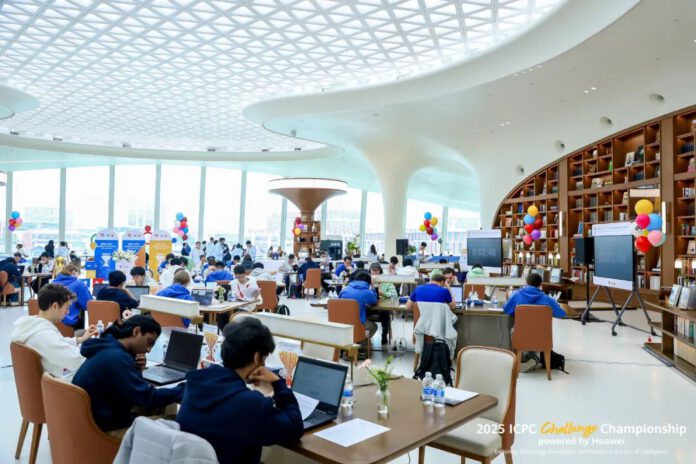
On November 14, CEO of Huawei Ren Zhengfei met with ICPC global winners and coaches at Huawei’s R&D Center in Shanghai to discuss the future of AI, the essence of education, and youth development.
The International Collegiate Programming Contest (ICPC) is one of the largest and most prestigious university-level programming competitions in the world. It consists of regional contests and a world finals, spanning approximately nine months each season, with nearly 50,000 students from over 2,000 universities across more than 100 countries and regions participating.
Ren Zhengfei emphasized that “education is education, business is business,” and highlighted that AI should focus on near-term, three- to five-year industrial applications to drive real progress in sectors like industry and healthcare. He encouraged young people to “move forward amid doubt” and to promote technological and cultural exchange through openness and collaboration.
How does Huawei view the challenges of the AI era, and how can the global community work together to address them?
I’m not an AI expert, but I see it in stages. In the near term, our focus is on practical applications of large models, big data, and computing power. In industry, AI can optimize steel production by predicting furnace temperatures and adjusting fuel and ore ratios, improving efficiency. In mining, operations can be fully unmanned, with real-time data enabling remote control and safety monitoring. Ports like Tianjin and Callao are already using AI for fully automated loading, stacking, and customs clearance.
In healthcare, AI models assist doctors in analyzing tissue slices and diagnosing eye conditions remotely, improving accuracy and access in underserved areas. In consumer technology, large models power autonomous driving and conversational assistants. We aim to solve real-world problems in production and daily life, while recognizing there is still much room for progress and accumulation of experience.
How can the International Olympiad in Informatics empower underdeveloped regions to improve programming and AI education, and how can Huawei support this mission?
In the past, top-quality education required attending prestigious schools in person. Today, online courses allow students in remote areas to access world-class knowledge, though guidance is still essential. The internet has shifted education from physically centralized to logically distributed, giving children in even the most remote areas the chance to learn and think independently.
AI and advanced networks are also accelerating progress. For example, in Tibet, a small ultrasound probe scans a herder’s liver, and data is sent 3,000 kilometers to Shenzhen for AI-assisted analysis. The same principles apply to education: online courses, remote guidance, and AI tools can bring high-quality learning to everyone, driving social advancement and empowering the next generation.
In the AI era, how can China invest more effectively in education to become a long-term technology leader?
As a company, our goal is to create commercial value, while universities focus on exploring humanity’s future. Schools conduct “0-to-1” research—pioneering work where failure is acceptable because it cultivates talent. That talent builds on previous theories to create the future. Companies take these theories and turn them into industrial reality.
Historically, most original inventions—like turbines, trains, ships, or mathematics—came from the West. Universities focus on research and innovation, while companies apply it. But China is catching up and producing original work. For example, a 22-year-old at our company developed a world-class weather model using European satellite data to predict crop yields, power generation, and typhoon paths. Another 22-year-old from Russia invented a new algorithm that could improve AI chip design, though we have not implemented it yet due to long chip development cycles.
Education’s role is to educate; companies’ role is to commercialize. Mixing the two too early can hinder progress.
Given the importance of university–industry collaboration, how can Huawei help young competition talents, both domestic and international, engage deeply to drive new breakthroughs?
Everyone has a different path in life. Some aim high, exploring science and innovation, while others contribute through practical work. For example, we trained over 3,000 graduates from remote areas in chip production and precision manufacturing. Education should guide people according to their strengths, while those capable of reaching the highest levels should pursue ambitious goals.
Chinese youth today focus on creating and innovating themselves. Millions are working in robotics and technology, and small companies are achieving breakthroughs like XPeng’s humanoid robot. Whether commercially successful or not, this effort trains highly capable talent, forming the backbone of China’s modernization and driving progress in the coming years.
If you could start over at 20, what would be your strategy for building your early career as an independent young professional?
I cannot go back to being 20, but you are in your 20s. At your age, it’s important to ride the wave of your era and be willing to explore the frontier. Don’t focus on money, status, or short-term sacrifices—focus on how your work can benefit humanity.
Many discoveries, like Mendel’s genes, were ignored for decades before their significance was understood. Success is not guaranteed, and most people will not achieve conventional success. But even in “failure,” you gain knowledge by testing ideas and learning from experience. That accumulated insight is a valuable asset in itself.
Having faced doubt in Huawei’s history, how do you advise breaking through criticism to continue innovating in AI and research?
Facing doubt is normal. Many breakthroughs, like Fourier’s series or the Higgs boson, were initially questioned. Huawei has faced similar skepticism with 5G Polar codes, Massive MIMO, and multi-lens cameras. Innovation requires courage and persistence.
In China, the railway is testing a 5G-R system for high-speed trains at 450 km/h, using AI and radar to monitor track and wheel safety in real time. The 12306 ticketing system, led by a young engineer, became a world-leading platform handling enormous traffic. China’s growing rail network, with hundreds of thousands of kilometers, will require top mathematicians and engineers to manage complex dispatch, logistics, and coordination—a real opportunity to apply advanced science.
With the potential rise of general AI, how can students select fields of study and skills that will remain valuable in the future?
The U.S. focuses on general AI and superintelligence, exploring humanity’s future, while China emphasizes practical applications that create value: city safety, public health, unmanned mining, and automated construction in extreme environments.
Automation raises workforce challenges. Retraining programs, such as learning vouchers and vocational schools, can help displaced workers transition to new roles. Unmanned production increases total output, and AI-assisted programming already reduces 30% of engineers’ workload, potentially up to 60–70%.
The key is implementing AI gradually to maintain social stability while increasing societal wealth and retraining people for the jobs of the future.
Given resource limitations in academia and industry, how should one navigate constraints to pursue the next breakthroughs?
I believe the future will be an era of computing power abundance, not shortage. Building hundreds or thousands of large models is a valid exploration. While we can estimate hardware needs—like how many “970” chips are required—demand may not follow a linear pattern, so precise prediction is difficult. But computing resources will eventually be sufficient. Model developers should focus on theory and research; whether their work finds commercial use is the role of industry application engineers.
Huawei is a technology company, not a scientific research institute. Science is for researchers; we focus on applying technology. Internal titles like “scientist” are simply classifications, not a societal standard.
Theoretical work is invaluable. Great theories—like Fourier transforms, Laplace equations, or Maxwell’s equations—were developed through reasoning and imagination, long before their societal applications were clear. True innovation comes from exploring ideas, and later, industry can apply them responsibly while respecting original contributions.
Given the potential of quantum chips to impact encryption and computing, how does Huawei approach this emerging field and future competition?
Quantum science will eventually see breakthroughs, and quantum computing will become possible, offering huge advantages for certain calculations. Research in quantum computing is a national and human endeavor; Huawei cannot afford it, though we may adopt quantum technology once it matures.
Predictions like breaking encryption or achieving nuclear fusion are uncertain. Fusion may succeed and transform energy, but we don’t know when. We cannot wait for a distant future; we still need to invest in today’s energy and technology systems. Quantum computing and AI will succeed in time, but uncertainty should not stop us from making progress now in other areas.
With top talent often drawn to high-paying opportunities abroad, how does China and Huawei plan to attract the best students and professionals to contribute locally?
The U.S. has fertile ground for talent, and it’s positive that many people, including Chinese youth, grow and innovate there. Contributions like Google’s Android benefit the world, including China. U.S. technology and innovation have advanced global progress, and their success often drives improvements in other countries’ industries.
While U.S. restrictions affect Huawei, most Chinese companies can still use American technology, which benefits China’s industrial development. Globalization allows us to stand on the shoulders of giants; complete self-reliance is not feasible. China must remain open, learn from other civilizations, and integrate global knowledge. This openness has brought wealth, but now the focus is on quality—high-quality products strengthen China’s international competitiveness.
Huawei itself has transitioned from a small, closed company to a more open platform. Collaboration with ICPC and international researchers builds global links. Mathematics and science have no borders, and global networks allow rapid exchange of ideas across countries, connecting talent and enabling shared progress.
Source: Guancha, Huawei, xinhua, eastmoney, icpc