


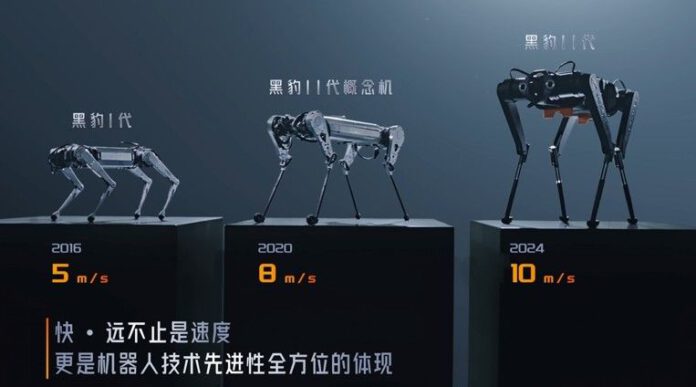
MirrorMe Technology stands out as an unconventional player in China’s humanoid robotics industry. Founded in May 2024, the company quickly distinguished itself by making a series of decisions that diverge sharply from prevailing industry trends.
While most tech startups have focused on improving robot intelligence, it has prioritized speed and physical performance. While capital markets have favored smaller, more commercially viable humanoids, it has insisted on building full-sized machines. While vision–language–action models have become the dominant narrative for both funding and long-term technological direction, it has chosen to begin with teleoperation. And while competitors race to deploy robots in factories and homes, it has instead directed its early efforts toward athletic tracks, literally positioning robots in competitive running scenarios. Though initially seen as counterintuitive, these choices have begun to produce striking results.
In November 2025, the company’s quadruped robot “Black Panther II” competed in a public demonstration against Olympic 100-meter champion Noah Lyles. Over a 50-meter sprint, the robot demonstrated exceptional acceleration, closely chasing the human athlete across the finish line. The footage quickly went viral, drawing widespread attention to robotic speed as a meaningful performance metric. Within a month, the robot’s top speed improved from approximately 11 meters per second to 13.4 meters per second, surpassing a long-standing benchmark set by Boston Dynamics and setting a new record for quadruped robots.
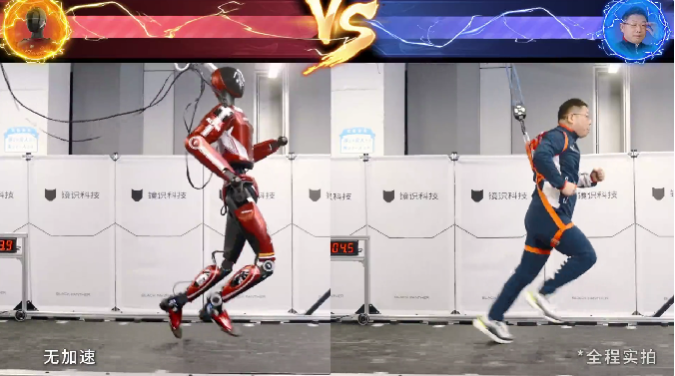
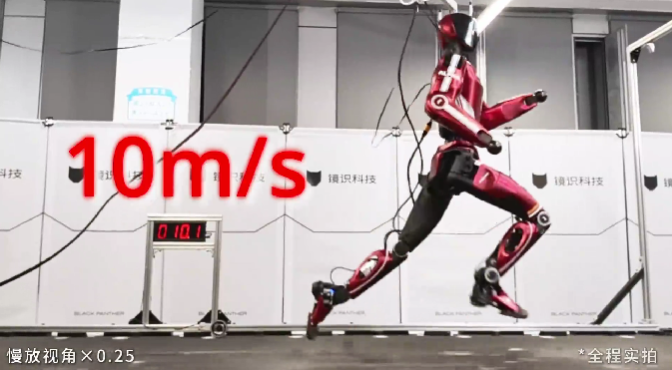
In February 2026, MirrorMe Technology introduced its first full-sized humanoid robot, Bolt. Standing 175 centimeters tall and weighing 75 kilograms, Bolt achieved a peak speed of 10 meters per second on a treadmill, making it the fastest full-sized humanoid robot at the time. This performance sparked discussion within the industry about the possibility of humanoid robots eventually completing a 100-meter sprint in under 10 seconds. Traditionally, robots that excel in performance tend to sacrifice human-like appearance, exposing mechanical structures and oversized joints, while more human-like designs lag behind in capability. Bolt represents an attempt to bridge this divide, combining a body structure close to human proportions with a novel transmission system that enables high power output without compromising form.
The technical philosophy behind these decisions is closely tied to the views of co-founder and CTO Jin Yongbin. With a background in high-speed legged robotics research, he has argued that as artificial intelligence algorithms continue to advance, robot control systems are approaching the limits imposed by hardware. In this context, the key constraint is no longer whether robots are “smart enough,” but whether their physical bodies are capable enough to execute tasks effectively. Human muscle power density is roughly 300 watts per kilogram, while electric motors can reach 3000 watts per kilogram or more. Yet robots still underperform compared to biological systems, largely due to inefficiencies in structure and power transmission. For MirrorMe Technology, pushing robots to extreme speeds is a way to expose these limitations and drive rapid iteration in mechanical design.
Within the company, “fast” is not defined narrowly as speed, but as a composite measure encompassing strength, responsiveness, stability, and smoothness. This philosophy is comparable to how acceleration metrics are used in the automotive industry to evaluate overall vehicle performance. MirrorMe Technology positions itself as the “Formula One of robotics,” aiming to use extreme performance engineering as a foundation for broader technological advancement that can later be translated into practical applications.
In terms of application strategy, the company has deliberately avoided jumping directly into highly complex household service scenarios. Instead, it has focused on more structured use cases such as robotic pacers for athletic training. Current data suggests that teleoperated robots still operate at only a fraction of human efficiency, with earlier international competitions showing performance levels around 10% of human capability. Even with algorithmic improvements, efficiency gains have been limited. MirrorMe Technology’s internal analysis concluded that the primary bottleneck lies not in control algorithms, but in hardware responsiveness. As a result, improving physical performance is seen as a prerequisite for closing the gap.
This reasoning also underpins its decision to pursue teleoperation as an intermediate pathway. By allowing humans to remotely control robots in real-world environments, the company can generate high-quality operational data while simultaneously delivering useful services. Over time, repeated tasks can be modularized into standardized “skill packages,” similar to software applications. This approach bypasses current limitations in general artificial intelligence while laying the groundwork for future autonomy. The team estimates that fully autonomous household robots may take around a decade to mature, whereas teleoperated systems could reach practical deployment within five years.
Looking further ahead, this model could reshape aspects of the service economy. Robots would serve as physical endpoints, operated remotely by distributed human workers. Labor could be organized across time zones, with operators in different regions taking shifts to control the same machine, enabling continuous operation without requiring physical relocation. This concept introduces a new form of “mobility,” where cognitive labor moves digitally rather than physically.
From an engineering perspective, MirrorMe Technology has also explored alternative design approaches. Conventional high-performance robots often rely on horizontally mounted motors, resulting in bulky joints that compromise human-like proportions. Bolt adopts a different configuration, aligning motor axes perpendicular to joint axes and using a 90-degree transmission mechanism. This allows the motors to be embedded within the narrow structure of the limbs, preserving a more natural silhouette while maintaining high power output. Although technically feasible, such designs have been rare in the industry, partly due to established design conventions and trade-offs between aesthetics and performance.
In parallel, the company is addressing a broader challenge in robotics development: the lack of systematic design tools. Due to the high degrees of freedom and complex force interactions in robotic systems, development often relies heavily on iterative prototyping, making it difficult to determine whether performance limitations stem from hardware or software. To address this, MirrorMe Technology has developed an internal modeling and optimization tool that can estimate a robot’s performance limits before physical construction. By inputting target parameters such as speed, weight, and size, the system can generate design recommendations for key components. This approach is conceptually similar to architectural frameworks in chip design or simulation systems in the automotive industry, potentially reducing development costs and improving efficiency.
Source: aibang bots, sina, 36kr, sohu, eastmoney