


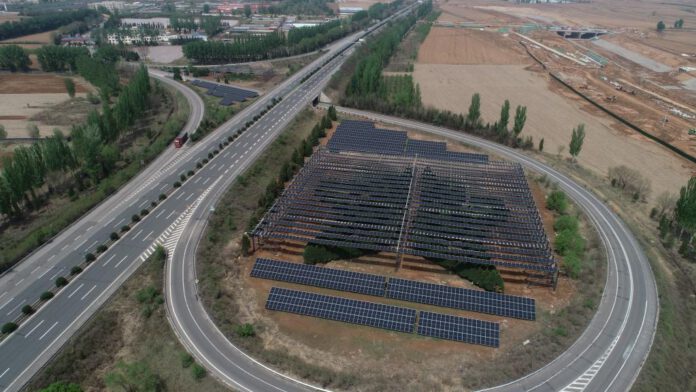
China is beginning to use its highways to generate electricity. In the past, highways were built primarily to improve transportation efficiency and support economic development. Once completed, their main sources of operating revenue were tolls, service areas, and related businesses.
Today, however, this business model is evolving. Highways are no longer just transportation infrastructure. They are increasingly becoming platforms for energy generation, storage, and electricity trading. Solar panels are appearing along roadside slopes, service-area rooftops, toll stations, and parking shelters, while charging stations, energy storage systems, and virtual power plants are becoming part of highway operations. China is turning its existing transportation infrastructure into an asset capable of generating additional energy revenue.
This transformation goes beyond simply installing solar panels beside roads. It represents a second phase in the development of existing infrastructure. China has nearly 200,000 kilometers of expressways, with extensive areas along these routes occupied by slopes, interchanges, service areas, and toll stations.
Although these spaces were created as part of highway construction, not all of them are directly used for vehicle movement. In the past, they primarily served functions such as road protection, parking, and passenger services. Today, suitable areas can also be used to generate electricity, allowing infrastructure originally designed for transportation to take on an additional role in energy production.
Early solar highway experiments in Jinan, Shandong Province, demonstrated the potential of combining road transportation with solar power generation. The experimental section incorporated photovoltaic technology into the road surface itself. However, large-scale deployment does not necessarily require covering every road with solar panels.
Considering construction costs, load-bearing requirements, maintenance difficulties, and power generation efficiency, service-area rooftops, parking shelters, and suitable roadside slopes are often more practical locations for expansion. The real objective is not to turn every square meter of pavement into a solar panel, but to make underutilized spaces along highways generate additional economic value without compromising road safety or normal operations.
Another major reason highway operators are expanding into renewable energy is the pressure on traditional business models. Expressway construction requires substantial capital investment and typically has a long payback period. Operators must also continue spending on maintenance, upgrades, and daily operations.
Toll revenue remains important, but it is affected by traffic volumes, toll policies, concession periods, and changes in the road network. Relying exclusively on tolls makes it difficult to secure long-term growth. Highway operators therefore need new sources of income, and the land, buildings, vehicle traffic, and existing electrical infrastructure along their routes provide a foundation for developing energy businesses.
Solar power can generate electricity sales revenue while reducing a highway operator’s own energy costs. Service areas, toll stations, tunnels, lighting systems, and monitoring equipment all consume electricity. If solar installations can meet part of this demand, operators can reduce their purchases from the grid. Surplus electricity can potentially be fed into the grid or sold through electricity markets, depending on the project’s configuration and local regulations.
Meanwhile, the growing number of electric vehicles is increasing demand for charging services at highway service areas. Charging infrastructure has consequently become another source of business opportunities. Through direct operation, partnerships, or site leasing, highway companies can earn charging revenue, rental income, or a share of operating profits while continuing to provide transportation services.
The significance of this model lies in its ability to create additional value without necessarily requiring an entirely new infrastructure network. It builds on existing roads, land, facilities, and operating systems. For highway companies that have already invested heavily in construction, energy services provide an additional revenue stream from existing assets.
Solar panels, storage systems, and charging facilities still require upfront investment and ongoing maintenance, and their economics depend on grid connections, electricity prices, and market conditions. Their revenue should not simply be treated as pure profit. Nevertheless, when projects are appropriately located and investment costs remain manageable, energy businesses can improve asset utilization and strengthen the long-term financial performance of highway operations.
A deeper reason behind this development is China’s growing demand for electricity. In the past, power consumption was driven mainly by industrial production, households, and traditional commercial activities. Today, the expansion of electric vehicles, manufacturing upgrades, data centers, and artificial intelligence is creating additional demand. Electricity is no longer simply a basic necessity for daily life.
It increasingly determines industrial capacity, the development of the digital economy, and national competitiveness. For a country with a vast manufacturing sector and an ongoing industrial transformation, energy planning cannot focus solely on whether current demand can be met. It must also prepare for future factories, computing centers, and the electrification of transportation.
This explains why highways are becoming more valuable as energy assets. China’s road network is a widely distributed infrastructure system with extensive land resources, established electricity-consuming facilities, and growing vehicle traffic. As electric vehicles become more common, highway service areas are evolving from simple rest stops into important energy supply hubs.
The greater the demand for charging, the more important reliable electricity supplies become. By combining solar generation with energy storage, some service areas can develop integrated systems that generate, store, and supply electricity. These systems can help manage concentrated charging demand and increase the local use of renewable energy.
The virtual power plant project developed by Hubei Communications Investment New Energy Company illustrates the direction this business could take. In June 2026, the project completed registration and public announcement through the Hubei Power Trading Center, obtaining the qualifications required to participate in market-based electricity trading. The company installed and commissioned specialized metering equipment and frequency-regulation gateways at high-power charging stations across the Xiaogan, Jianghan, and Enshi areas. The system achieved an adjustable capacity of 13.79 megawatts. According to the company’s estimates, participation in multiple electricity market services could generate more than RMB 2 million in annual combined revenue, with a static investment payback period of no more than six years.
A virtual power plant is not a conventional power station. Instead, it uses a digital platform to integrate distributed resources, including solar installations, energy storage systems, and charging stations across multiple service areas. These resources can then be monitored and dispatched as a coordinated system, enabling them to participate in electricity markets. For example, electricity can be stored when prices are low and released during periods of peak demand. When the power grid is under pressure, charging equipment can also adjust its consumption. This creates new opportunities to earn revenue from electricity trading and grid-support services. Equipment that once served only as a source of electricity demand can now help balance the power system.
This means competition in the highway energy business may eventually depend on more than the number of solar panels installed or charging points built. The ability to integrate generation, storage, charging, and electricity trading could become equally important. A standalone solar project generally depends on its output and the price of electricity. By improving self-consumption, shifting electricity use between different periods, deploying storage, and participating in market-based services through virtual power plants, operators may unlock additional value from the same energy resources. However, this approach still faces challenges involving technical integration, specialized talent, electricity market rules, and the distribution of returns among different parties. Actual results will depend on local policies, project conditions, and market mechanisms. The financial performance of one project cannot automatically be replicated across every highway.
At a broader level, the expansion of renewable energy along highways represents an extension of China’s infrastructure development strategy. In the past, infrastructure investment primarily focused on building the networks needed for transportation, water management, communications, and energy supply. The priority was to create the physical foundations for economic activity. Now, as the country’s existing infrastructure network continues to expand and new investment faces greater pressure to deliver economic returns, making existing assets serve multiple purposes is becoming increasingly important.
Highways can generate electricity, service areas can store and supply power, charging stations can help regulate electricity demand, and transportation networks can become integrated with energy networks. Infrastructure is therefore evolving beyond its traditional role as a cost of economic development. It can also become a productive asset and a distributed node in the energy system.
Of course, this does not mean solar installations along highways can solve all of China’s electricity needs. Development is constrained by sunlight, terrain, grid connection capacity, and road safety requirements. Solar generation is also intermittent and cannot replace the need for reliable power sources, grid expansion, and other energy investments. Its real value lies in increasing clean electricity generation by making use of an existing transportation network, potentially reducing the need for additional land while creating new revenue opportunities for highway operators.
As China’s industrial production, digital economy, and transportation systems become increasingly dependent on electricity, power supply will no longer come exclusively from conventional power stations and the grid. Factory rooftops, industrial parks, buildings, and highway corridors can all become components of a distributed energy system.
China’s highways are beginning to generate electricity not merely because transportation companies have discovered a new business opportunity, but because the country is seeking to extract greater economic value from its enormous infrastructure network. Assets once designed primarily to move people and goods are now being developed to support energy generation, supply, and regulation as well.
This is both a shift from single-purpose infrastructure toward integrated resource utilization and a practical attempt to expand electricity supply capacity in preparation for China’s future energy needs.
Source: global net zero, sasac, xinhua, nea gov cn, china daily, sohu