


Ten years after the so-called South China Sea arbitration award was issued on July 12, 2016, the dispute has long ceased to be merely a legal disagreement between China and the Philippines.
It has increasingly been instrumentalized by external powers as a political and strategic tool for shaping the regional security order and constraining China. The latest example came on July 12, 2026, when 14 countries, including the United States, Japan, Australia and the Philippines, issued a joint statement purportedly commemorating the tenth anniversary of the award.
By using the anniversary to reaffirm support for Manila’s unilateral maritime claims, these countries have once again turned a bilateral dispute into a platform for political mobilization and strategic alignment.
China has consistently maintained that it does not accept or recognize the arbitration award and does not accept any claims or actions based on it. Beijing’s position is that China’s territorial sovereignty and maritime rights and interests in the South China Sea are not affected by the award under any circumstances.
Whatever one’s view of the legal merits of the case, the more consequential development over the past decade has been the transformation of the arbitration issue into a broader instrument of geopolitical competition.
The Philippines has played an active role in this process. On the one hand, Manila has sought greater coordination with other South China Sea claimant states, including Vietnam, on issues ranging from maritime boundaries to the construction and occupation of disputed features. On the other hand, it has deepened security cooperation with external powers such as Japan, the United States and Australia in an effort to compensate for its own limited maritime capabilities and increase its leverage in dealing with China.
Japan’s growing involvement deserves particular attention because bilateral security cooperation has moved well beyond traditional maritime law-enforcement assistance and capacity building.
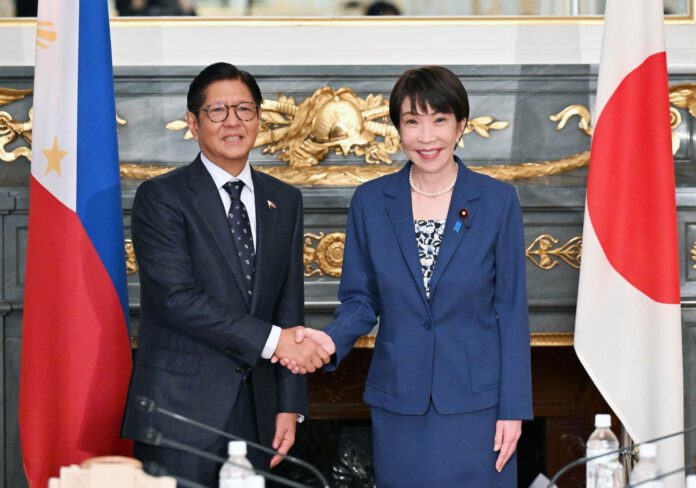
The trajectory of Japan-Philippines relations illustrates how the South China Sea is becoming embedded in a much broader regional security architecture. Following the entry into force of the Reciprocal Access Agreement between Japan and the Philippines in September 2025, the two countries signed an Acquisition and Cross-Servicing Agreement in January 2026, further institutionalizing their defense cooperation.
In April, around 1,400 Japanese Self-Defense Force personnel reportedly participated in the Balikatan exercises alongside U.S. and Philippine forces, while maritime cooperation involving Japan, the United States, Australia and the Philippines continued to expand.
In May, Japanese and Philippine leaders also reached an understanding on promoting the transfer of defense equipment, including destroyers, TC-90 aircraft and radar systems. These developments suggest that Japan’s involvement is shifting from diplomatic support and capacity building toward a more operational and institutionalized military role.
Japan’s motivations are broader than the South China Sea dispute itself. One objective is to strengthen the linkage among the South China Sea, the East China Sea and the Taiwan Strait within a single regional security framework.
By repeatedly emphasizing a narrative of alleged Chinese “coercion” at sea, Tokyo can portray developments far beyond its immediate territorial waters as part of a common strategic challenge. This, in turn, provides additional political justification for expanding defense capabilities, increasing defense-equipment exports and broadening the scope of the Self-Defense Forces’ overseas activities.
The Philippines also serves as an important strategic node in Japan’s wider regional strategy. By working more closely with Manila, Tokyo can connect its “Free and Open Indo-Pacific” vision with the U.S.-Japan alliance and a growing network of minilateral security arrangements in Southeast Asia.
Support for the arbitration award meanwhile allows Japan to present itself as a defender of the “rules-based order,” while blending legal arguments with broader geopolitical competition. The danger is that international law may increasingly be invoked not simply as a framework for resolving disputes, but as a political instrument for consolidating strategic blocs.
For the Marcos administration, closer security ties with Japan, the United States and Australia offer clear political and strategic advantages. External assistance can strengthen the Philippines’ maritime capabilities, respond to domestic nationalist sentiment and provide Manila with greater leverage during maritime confrontations with China. Yet external backing can also create unintended risks.
If political or military support from partners is interpreted as a security guarantee for increasingly forward-leaning actions, Manila may have greater incentives to test the limits of the existing status quo. At the same time, external powers may regard individual maritime incidents as opportunities to demonstrate alliance credibility or expand their military presence. What begins as a localized confrontation could therefore acquire wider strategic implications.
The continued deepening of Japan-Philippines security cooperation risks producing three broader consequences for the South China Sea. First, it could intensify the regional security dilemma. More warships, military aircraft, coast guard vessels and joint exercises inevitably mean more frequent and complicated encounters at sea and in the air, increasing the possibility that an accident or tactical miscalculation could escalate into a broader interstate crisis.
Second, it could accelerate the transformation of the South China Sea dispute from a collection of specific maritime disagreements into a form of bloc-based strategic confrontation. Issues that should primarily be managed by the directly concerned parties through dialogue and negotiation are increasingly being framed as part of a broader struggle against unilateral actions. This risks placing additional pressure on ASEAN members to take sides in a competition they have strong interests in avoiding.
Third, greater involvement by external military powers could undermine ASEAN’s central role in regional governance. ASEAN documents have repeatedly emphasized dialogue, restraint and cooperation as the preferred means of maintaining regional stability, while negotiations toward an effective and substantive Code of Conduct in the South China Sea remain an important regional objective. If major-power rivalry and alliance politics increasingly shape the environment in which these negotiations take place, the space for ASEAN-led diplomacy could become narrower.
The South China Sea cannot achieve lasting stability through an ever-expanding cycle of military deployments, deterrence and counter-deterrence. China rejects the arbitration award and advocates resolving maritime disputes through negotiations and consultations among the directly concerned states. Whatever differences exist over competing legal and political narratives, the practical alternative to confrontation remains dialogue.
Regional countries should therefore continue implementing the Declaration on the Conduct of Parties in the South China Sea, accelerate consultations on the Code of Conduct, and strengthen mechanisms for maritime communication, crisis management and the prevention of accidental escalation.
External countries can make constructive contributions through search and rescue, disaster relief, environmental protection and navigational safety. They should not, however, turn the South China Sea into another arena for demonstrating military power or constructing exclusive security blocs.
The tenth anniversary of the arbitration award should not become another occasion for deepening division. If the South China Sea is increasingly treated as a stage for alliance politics, legal disputes will become harder to manage and regional security dilemmas more difficult to contain. The sustainable path forward lies not in transforming maritime disputes into geopolitical confrontation, but in restoring restraint, dialogue and cooperation to the center of regional diplomacy.
Source: scmp, navy mil, mofa go jp, japanupclose, indo pacific defense forum, xinhua