


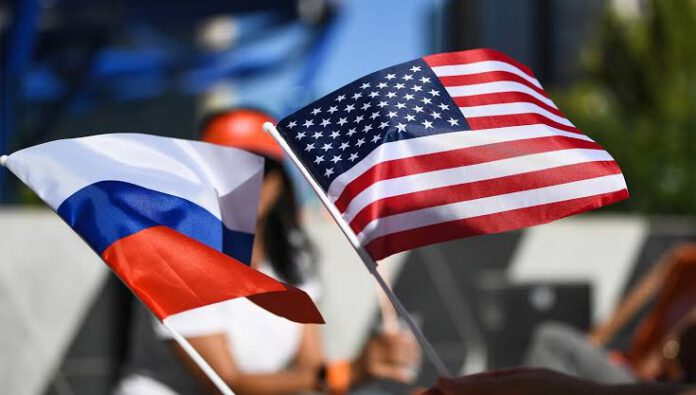
Russia and the United States are often portrayed as ideological opposites: one defends a sovereign civilization against Western dominance, while the other claims to uphold a liberal international order. Yet beneath their differences lies an uncomfortable similarity. Both have powerful traditions of national exceptionalism that their history, identity, and global mission make them unlike other countries, and that ordinary rules may not always apply to them.
This does not mean that Russia and America are politically identical. Their institutions, civil liberties, and systems of accountability differ substantially. Nor does it mean that their actions carry equal consequences in every situation. The deeper parallel lies elsewhere: both countries have political traditions that can turn national identity into a source of unlimited entitlement. Each can see itself not simply as one state among many, but as a country with a special right to shape the world around it.
Two tigers may share a mountain in theory. In practice, however, when both believe the mountain is theirs by historical right, coexistence becomes difficult. The rivalry between Russia and America is therefore not merely a struggle over territory, security, or economic advantage. It is also a collision between competing claims to exceptional status.
Russia’s civilizational argument has a long intellectual history. In the nineteenth century, the Russian thinker Nikolay Danilevsky challenged the idea that European civilization represented a universal model for humanity. He argued that different cultural and historical worlds developed according to their own principles, and that Russia and the Slavic peoples constituted a distinct civilizational type rather than an incomplete version of Western Europe.
The importance of this argument was not simply that Russia was different. It was that Russia’s difference could be presented as a source of independent historical legitimacy. If the West did not possess a universal standard by which all societies should be judged, Russia could reject Western criticism and claim the right to follow its own path.
Later Eurasianist thinkers developed this line of thought, emphasizing Russia’s position between Europe and Asia and portraying it as the center of a distinctive historical and cultural space. These ideas did not always lead to the same political conclusions, but they offered an enduring alternative to the belief that Russia’s future depended on becoming more like the West.
The collapse of the Soviet Union gave this tradition renewed relevance. For many Russians, the 1990s brought not only economic hardship and political instability, but also a profound loss of international status. The expectation that Russia would gradually integrate into a Western-led order did not produce the partnership many had hoped for. NATO enlargement, conflicts over the post-Soviet space, and disagreements about the meaning of European security reinforced the perception among Russian elites that the West was willing to accept Russia only on subordinate terms.
That perception was not the only possible interpretation of the post-Cold War settlement, and it does not justify Russia’s subsequent use of force against its neighbors. But it helps explain why civilizational arguments gained political traction. They offered a way to reinterpret national weakness as historical distinctiveness: Russia was not failing to become Western; it was supposedly following a different and equally legitimate path.
Under Vladimir Putin, this language has become increasingly important to the state’s account of itself. Russia is presented as a sovereign civilization with its own moral traditions, historical experience, and security requirements. Western liberalism is portrayed not simply as a competing political philosophy, but as an external influence that threatens Russia’s identity and cohesion.
The problem begins when this claim moves from cultural independence to geopolitical entitlement. A country has every right to preserve its language, traditions, and institutions. It does not follow that it has a special right to determine the political choices of neighboring countries. Ukraine, for example, has its own national identity and right to political independence. Russia’s historical ties to Ukraine cannot erase that sovereignty.
Civilizational language can blur this distinction. If a neighboring country is described as belonging naturally to a larger historical space, its independent choices may be treated as artificial, illegitimate, or the result of foreign manipulation. The argument then becomes circular: Russia must control its neighborhood because it is a distinct civilization, and its civilization must be protected by maintaining control over its neighborhood.
Here the rhetoric of historical destiny becomes a justification for power. National identity, which should help people understand their past, is transformed into a political claim over other people’s futures.
America’s exceptionalism has a different history and a different political setting, but it contains a related tension. The United States has often described itself as a country founded on universal principles: individual liberty, representative government, equality before the law, and the right of peoples to political self-determination. These ideals have inspired movements for freedom around the world and remain central to America’s national identity.
Yet American political culture has also nurtured the conviction that the United States occupies a unique position in history. If America represents a universal ideal, its leaders may come to believe that American power serves humanity as a whole. Actions taken in the national interest can then be presented as actions taken for the benefit of the international community.
This is one of the enduring contradictions of American foreign policy. Universal principles can restrain power, but they can also be used to legitimize it. Washington has defended international institutions and alliances, yet it has also resisted rules it considers incompatible with American freedom of action. It has condemned other governments for violating international norms while at times interpreting those norms selectively when American interests are at stake.
The “America First” approach makes this contradiction more explicit. It questions the assumption that the United States should bear disproportionate costs for maintaining the international order, and it treats alliances, trade arrangements, and multilateral commitments more openly as instruments to be judged by their direct benefits to America.
There are legitimate reasons for any government to reconsider its international commitments. Alliances should not be immune from debate, and international institutions can be inefficient or unfair. But a different principle is at work when a country claims the benefits of an international order while reserving the right to disregard its constraints whenever they become inconvenient.
In that respect, the Russian and American narratives can begin to resemble each other. Russia invokes civilizational sovereignty to resist what it sees as Western domination. America invokes national sovereignty to resist obligations it sees as unfair or contrary to its interests. Their histories and political systems remain different, but both narratives can place national discretion above shared rules.
This is the paradox of exceptionalism: two countries may disagree about almost everything and still share the belief that their own status entitles them to special treatment. Their rivalry becomes particularly dangerous when each interprets the other’s independence as a threat to its own rightful position.
For Russia, the expansion of Western influence near its borders can be portrayed as an existential challenge to its civilization. For the United States, the emergence of a rival power capable of challenging American leadership can be portrayed as a threat to the stability of the international order. Both countries may sincerely believe that they are acting defensively. Yet when each side defines security as the preservation of its own privileged position, measures presented as defensive by one are experienced as offensive by the other.
This dynamic creates a familiar spiral. One power strengthens its military position to protect its interests; the other sees that move as evidence of hostile intent and responds in kind. Each side points to the other’s response as proof that its original fears were justified. Over time, compromise becomes politically harder because concessions appear to betray not merely a practical interest but a national mission.
The result is a world in which geopolitical competition acquires the emotional force of a struggle over identity and historical legitimacy. Negotiations that might resolve specific disputes become more difficult when each side believes that accepting limits would mean surrendering its rightful place in history.
The consequences extend beyond Russia and America. As international competition intensifies, governments elsewhere may increasingly use the language of civilization, sovereignty, and national destiny to justify their own ambitions. International institutions then risk becoming arenas in which powerful states defend their privileges rather than mechanisms through which all states accept common constraints.
This is especially troubling in an age of rapid technological change. Artificial intelligence, cyber conflict, climate change, pandemics, and the governance of global markets all create problems that no country can manage entirely on its own. Even the most powerful state depends on information, cooperation, and standards that cross national borders. If every government treats international rules as optional whenever they conflict with its own exceptional mission, collective action becomes much harder.
None of this requires the world to adopt a single political model. Cultural diversity is real, and the assumption that every society must follow one historical path has often produced arrogance and intervention. Countries should have room to develop their own institutions and preserve their own traditions. The mistake is to confuse the right to be different with the right to dominate.
The same distinction applies to national sovereignty. Sovereignty protects a country’s independence; it does not grant an unlimited license to interfere in the independence of others. Nor should universal principles be used selectively as a cover for the ambitions of powerful states. If international rules are to command respect, they must apply consistently, including when compliance is inconvenient for the strongest countries.
Russia and America do not need to become alike in order to coexist. They do, however, need to accept that neither possesses an exclusive right to define the international order. A stable world cannot depend on the assumption that one great power is destined to lead or that another is entitled to control its neighbors. It requires the recognition that national interests, however important, exist alongside the legitimate interests and rights of other nations.
The real danger is not that Russia and America are too different. It is that, in different ways, both can be drawn toward the same conviction: that their own exceptional status entitles them to a freedom of action denied to others.
Two tigers may not be destined to fight simply because they are tigers. But when each believes that the mountain belongs to it alone, conflict becomes much more likely. The task of international politics is not to decide which tiger has the greater historical claim. It is to establish rules that prevent either from claiming the entire mountain.
Only when great powers accept limits on their own exceptionalism can national independence coexist with international order. Without those limits, the language of civilization and national greatness may promise dignity and security, while leading instead to suspicion, confrontation, and an increasingly dangerous struggle for dominance.
Source: chn belta, brookings, riddle russia, fpri, cscr