


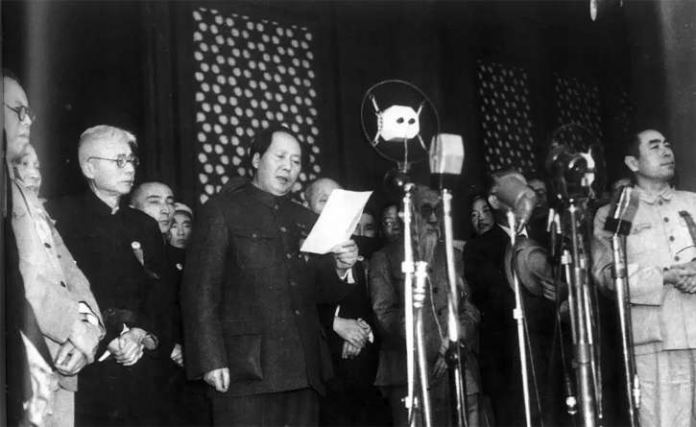
On October 1, 1949, Mao Zedong stood atop Tiananmen Gate in Beijing and proclaimed the establishment of the People’s Republic of China and the Central People’s Government. The moment was soon written into the historical memory of an entire nation. Yet from the perspective of that day itself, China’s war was far from completely over. Fighting continued across large parts of the country, and the new government had not yet established effective control over every region.
Guangzhou was not liberated until October 14, Guilin on November 22, Nanning on December 4, and Guangxi as a whole was declared liberated on December 11. Chengdu followed on December 27. Hainan Island was not liberated until May 1, 1950, while the agreement on measures for the peaceful liberation of Tibet was signed on May 23, 1951. In other words, when the founding ceremony was held in Beijing, military operations were still under way in southwest and south China, along the coast and on the islands, while the political and administrative integration of the border regions remained unfinished. Remnants of the Kuomintang armed forces were still resisting, and the process of national reunification had not yet reached its final stage.
This naturally raises a question: if the country had not yet been completely unified, why did the Communist leadership not simply wait until the last major battlefield had been settled before formally establishing the new republic?
The answer lies in one of the most important strategic judgments of the Chinese revolution in 1949. The founding of the People’s Republic was not merely a ceremony celebrating the end of a civil war. It was a decision about timing, political legitimacy, state authority and China’s position in the international order. In that sense, the establishment of the new government was not the reward that came after the revolution had completely finished. It was itself an essential part of completing the revolution.
By the time the three major campaigns of Liaoshen, Huaihai and Pingjin had ended, the main military strength of the Kuomintang had been decisively weakened. The People’s Liberation Army crossed the Yangtze River in April 1949, Nanjing was liberated that month, and Shanghai followed in May. From a purely military perspective, the Communist forces could have continued fighting and waited until the remaining Kuomintang forces had been defeated before establishing a national government.
But the question facing the Communist leadership was no longer purely military. Once the overall outcome of the civil war had become clear, the central problem was how quickly military victory could be transformed into effective national authority.
A victorious revolutionary army and an established sovereign government were not the same thing. One represented a political and military force that was winning a civil war; the other represented a state claiming responsibility for the country as a whole. The distinction was crucial.
China in 1949 was not changing governments in a political vacuum. The international environment was already being shaped by the emerging Cold War, and foreign powers were closely watching the collapse of the Kuomintang government and the rise of the Chinese Communist Party. If the old government was losing its control over the mainland while a new central government remained unestablished for an extended period, uncertainty over China’s political and diplomatic status could create opportunities for outside intervention.
Such intervention did not necessarily have to take the form of direct military action. Foreign powers could invoke the protection of their citizens, commercial interests or strategic positions, or claim a need to preserve order during a period of political instability. The longer the transition lasted, the more room there could be for competing interpretations of who legitimately represented China.
This was particularly significant because the Kuomintang government had not simply disappeared. Even after losing most of mainland China, it continued to claim that it was the legitimate government of the country and retained international relationships of considerable importance. Its remaining military forces were still fighting, while foreign governments had yet to fully adjust to the rapidly changing political reality in China.
For the Communist leadership, therefore, delaying the establishment of a central government until every battlefield had been cleared could create unnecessary political risks. The country needed not only an army capable of continuing the advance, but also a government capable of speaking in the name of China.
The importance of this calculation can also be seen in the diplomatic preparations undertaken before the founding of the People’s Republic. From June to August 1949, Liu Shaoqi led a delegation of the Central Committee of the Chinese Communist Party on a secret visit to the Soviet Union, where the Chinese side briefed Soviet leaders on the progress of the revolution and preparations for the establishment of the new government. The visit was an important diplomatic step on the eve of the founding of the People’s Republic.
Historical accounts have also frequently referred to Soviet advice that China should not delay the establishment of its new government. Whatever differences there may be in the details of individual historical accounts, the strategic logic behind the idea was clear: once the military balance had decisively shifted, the earlier a new central government was publicly established, the sooner political uncertainty could be reduced and the space for outside interference narrowed.
Mao Zedong and the Communist leadership understood that a revolutionary army advancing toward victory and a sovereign government exercising state authority carried very different political meanings internationally. The former could still be treated as one side in an internal conflict. The latter represented a new national government with the authority to organize administration at home and establish diplomatic relations abroad.
That was why the establishment of the People’s Republic could not simply be regarded as a ceremonial announcement made after the war was over. It was a political act that transformed the nature of the victory itself.
The preparations for the new state had already begun before October 1. In September 1949, the First Plenary Session of the Chinese People’s Political Consultative Conference was held in Beiping. Representatives of the Communist Party, democratic parties, people’s organizations and other political groups gathered to establish the political and institutional foundations of the new country.
The conference adopted the Common Program of the Chinese People’s Political Consultative Conference, which served as the basic political framework for the new state during its early years. It also decided that Beiping would become the capital and be renamed Beijing. The conference adopted the Five-Starred Red Flag as the national flag and designated “March of the Volunteers” as the provisional national anthem. These decisions rapidly gave the new country a complete set of political and national symbols.
The speed of the transition was striking. The conference opened on September 21 and closed on September 30. The following day, October 1, the founding ceremony was held in Tiananmen Square. This sequence was not evidence of haste or improvisation. Rather, it demonstrated that the Communist leadership had concluded that the time had come to convert the political and military victory into a functioning national government.
The military victory had created the necessary foundation. The Political Consultative Conference had provided political integration and an institutional framework. The establishment of the Central People’s Government transformed that foundation into a new state order.
Even the details of the founding ceremony reflected the circumstances of the time. The ceremony was held in the afternoon, when concerns about possible air attacks by remaining Kuomintang aircraft were still real. Security and practical considerations therefore played a role in the timing. What may appear today to be merely ceremonial arrangements were, in the context of 1949, closely connected with military security, political authority and the management of a country still at war.
The significance of October 1 became even clearer in the months that followed. The establishment of the People’s Republic did not bring military operations to an immediate halt. The People’s Liberation Army continued its advance into southwest and south China and toward the remaining coastal islands. Guangzhou, Guangxi and Chengdu were subsequently brought under the control of the new government, and Hainan Island was liberated in 1950. The question of Tibet was addressed within the framework of the new Chinese government, culminating in the signing of the Seventeen Point Agreement in May 1951.
Yet after October 1, these campaigns were taking place under a fundamentally different political framework. They were no longer simply the advance of a revolutionary movement seeking to overthrow an existing government. They were increasingly presented as actions undertaken by the newly established central government to complete national reunification and establish its authority throughout the country.
That distinction mattered enormously. Once a central government had been established, military operations, local administration and the transfer of political authority could be coordinated under a single national structure. The new government could issue orders, organize institutions, conduct diplomacy and negotiate with foreign governments while its armies continued to advance.
The diplomatic consequences were equally important. On October 2, the Soviet government responded to Beijing and expressed its willingness to establish diplomatic relations with the People’s Republic. Formal diplomatic relations between the Soviet Union and the People’s Republic of China were established on October 3, making the Soviet Union the first country to establish diplomatic relations with the new government. Other socialist states, including Bulgaria, Romania, Hungary and North Korea, subsequently established relations with Beijing.
Diplomatic recognition did not by itself determine the outcome of the Chinese civil war, but it had major political significance. The People’s Republic was no longer merely a domestic political force controlling large areas of China. It was becoming an identifiable participant in the international system, with a government capable of conducting foreign relations.
This development also placed increasing pressure on the Kuomintang’s claim to represent China. Its remaining military forces could continue to resist, but the establishment of a new government on the mainland meant that the political balance had changed. Domestic forces could increasingly see which side possessed the momentum of history, while foreign governments had to confront the reality that a new Chinese state had come into existence.
Seen from this perspective, the decision to establish the People’s Republic on October 1, 1949, was not premature. It was based on the judgment that the strategic outcome of the revolution had already been determined even though the military process was not yet complete.
Waiting until the last battlefield had been settled might have appeared more orderly. It might even have seemed symbolically cleaner to declare the founding of the country only after every remaining Kuomintang position had fallen. But politics rarely follows such a neat sequence. States are not established only after every problem has disappeared. In moments of major political transition, a central authority may have to be established precisely in order to deal with the problems that remain.
This was the logic behind the decision in 1949. The Communist leadership did not believe that every military, political or territorial question had to be resolved before the state could be established. Instead, it judged that the overall balance of power had already shifted decisively and that establishing the state would provide the authority and organizational structure needed to complete the remaining tasks.
In that sense, October 1 was more than the declaration of victory in a civil war. It was the moment when the Chinese revolution crossed a critical boundary: from the struggle to seize political power to the exercise of power through a national government.
The founding of the People’s Republic therefore had two dimensions. Domestically, it established a central authority capable of organizing the country and directing the continuing process of reunification. Internationally, it announced that a new Chinese government had assumed responsibility for the country and was ready to conduct relations with the outside world.
The decision to establish the new state before the fighting had completely ended was consequently not a sign of impatience. It was a strategic calculation about the relationship between military victory, political legitimacy and international recognition. The Communist leadership understood that military control alone could not settle the question of who governed China. A government had to be established, institutions had to be created and the new political reality had to be made unmistakable both at home and abroad.
The deeper significance of October 1, 1949, therefore lies not simply in the fact that a new country was proclaimed in Tiananmen Square. Its importance lies in the timing. The leadership chose to establish the state when the broad outcome of the revolution had become clear, rather than waiting for every remaining conflict to disappear. By doing so, it sought to consolidate the gains already achieved, establish a clear central authority, strengthen its diplomatic position and provide a political framework for completing national reunification.
The founding of the People’s Republic was thus not the final act of a war that had already ended. It was the beginning of a new phase in which the political and military victory of the revolution was converted into the authority of a state.
October 1, 1949, was therefore not merely the birthday of the People’s Republic of China. It was the dividing line between two historical processes: the struggle to take power and the far more complicated task of exercising it. The guns had not yet fallen silent everywhere, but the political direction of China had already been decided. The new state was established not because every problem had been solved, but because the leadership believed that only a functioning central government could provide the authority and organization needed to solve the problems that remained.
Source: sohu, cctv, china news, 12371 cn