


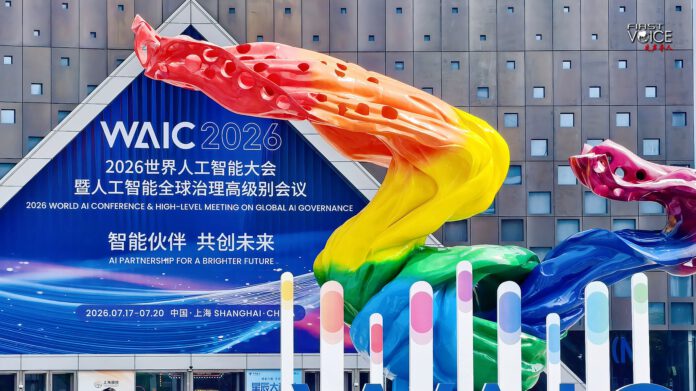
The 2026 World Artificial Intelligence Conference and High-Level Meeting on Global AI Governance marked more than another milestone in technological development. It signaled a turning point in humanity’s relationship with artificial intelligence.
With the establishment of the World AI Cooperation Organization, alongside the release of the conference’s Chair’s Statement and national action plans, global AI governance began moving beyond fragmented national approaches toward coordinated institutions, shared rules, and collective responsibility. This transition reflects a profound reality: artificial intelligence is no longer simply a technological issue, and it has become a defining force shaping the future of human civilization.
Few places illustrate this transformation more vividly than Shanghai. As one of the world’s largest and most dynamic cities, it has become not only a center for AI innovation but also a living laboratory where intelligent technologies and urban life continuously reshape one another. The relationship between AI and the modern metropolis is no longer one of technology serving the city. Instead, cities and artificial intelligence are entering an era of mutual evolution, where each becomes both the catalyst and the beneficiary of the other’s transformation.
Humanity once debated whether machines could think. Today, the more pressing question is different: as machines increasingly think alongside us, how should humanity redesign its cities, institutions, and values? This question may ultimately define the next chapter of civilization.
Large cities have always been engines of progress because they concentrate on what innovation requires most: people, industries, infrastructure, capital, and ideas. Yet these same characteristics also generate extraordinary complexity. Population density, massive transportation networks, intricate public services, environmental pressures, and increasingly interconnected economic systems make governing a megacity one of humanity’s greatest organizational challenges.
For decades, urban governance largely relied on human experience, fragmented information, and reactive decision-making. Congestion was managed after it occurred. Infrastructure failures were repaired after damage became visible. Public services responded to demand rather than anticipating it. Such approaches proved increasingly insufficient as cities expanded beyond the limits of traditional management.
Artificial intelligence changes this equation.
What makes AI particularly valuable is not merely automation but its ability to perceive patterns invisible to human observation, integrate enormous volumes of data, and generate predictive insights at unprecedented speed. In cities like Shanghai, intelligent traffic systems forecast congestion before roads become gridlocked.
Smart infrastructure continuously monitors bridges, pipelines, and flood defenses. Digital government platforms eliminate administrative silos by connecting agencies that once operated independently. AI-assisted healthcare, elderly care, and community services increasingly bring high-quality public resources closer to every neighborhood rather than concentrating them in city centers.
The city itself becomes a vast learning environment. Every street, hospital, subway station, industrial park, and residential community generates data that continuously improves intelligent systems. Unlike laboratory experiments, cities provide real-world complexity, uncertainty, and diversity. They are not simply places where AI is deployed; they are environments where AI matures.
At the same time, artificial intelligence fundamentally reshapes how cities function.
Urban governance is gradually shifting from responding to crises toward anticipating them. Instead of merely repairing problems, intelligent systems help prevent them. Instead of relying solely on periodic inspections, cities increasingly operate through continuous perception and dynamic coordination. Decision-makers gain the ability to understand urban systems as interconnected networks rather than isolated departments.
Yet AI is not replacing human governance. On the contrary, its greatest value lies in strengthening human judgment. Algorithms excel at processing information, but cities are ultimately governed by values, ethics, and political choices that remain profoundly human. The future belongs not to machine-led cities but to cities where human wisdom and artificial intelligence complement one another. The influence of AI extends far beyond public administration. It is also redefining urban economies.
Megacities have long served as economic powerhouses because they connect innovation with industrial capacity. Artificial intelligence accelerates this role by transforming manufacturing through digital twins, intelligent quality control, and industrial foundation models. Financial services become more resilient through intelligent risk management. Global trade benefits from smarter logistics and cross-border digital platforms. Cultural industries increasingly combine historical heritage with generative technologies, allowing cities to preserve memory while creating entirely new forms of expression.
This creates a powerful cycle of mutual reinforcement. Cities provide the ecosystems where AI technologies are developed, tested, and refined. AI, in turn, strengthens cities by generating new industries, improving productivity, and enhancing competitiveness. Urban development and technological innovation no longer advance separately, and they increasingly evolve together.
Yet perhaps the most meaningful transformation occurs not in industry but in everyday life.
The true measure of a great city has never been its skyline or economic output alone. It lies in whether ordinary people experience dignity, opportunity, and security. Artificial intelligence possesses remarkable potential to reduce longstanding inequalities that have challenged urban development for decades.
Remote medical diagnostics can extend high-quality healthcare to underserved communities. Intelligent educational platforms can narrow disparities in learning opportunities. Smart elderly care technologies enable aging populations to live more independently and safely. Accessible digital public services allow governments to respond more precisely to diverse social needs.
Technology reaches its highest purpose when it becomes nearly invisible—when it quietly removes barriers, expands opportunity, and improves daily life without drawing attention to itself. The ultimate success of AI will not be measured by the sophistication of algorithms but by the extent to which every citizen benefits from their application.
Nevertheless, every technological revolution carries its own paradox. The same algorithms that optimize public services can also reinforce hidden biases. The same interconnected data that enable intelligent governance can expose societies to unprecedented cybersecurity risks. The same predictive capabilities that improve efficiency may also raise difficult questions about privacy, transparency, accountability, and individual autonomy.
As artificial intelligence assumes greater influence over public decision-making, technical excellence alone is no longer sufficient. Governance must evolve as rapidly as innovation itself. This requires moving beyond the traditional belief that regulation inevitably slows technological progress. In reality, well-designed governance creates the trust that allows innovation to flourish sustainably. Ethical standards, transparent algorithms, data protection, and clear institutional accountability are not obstacles to AI development; they are the conditions under which society is willing to embrace it.
Technology without governance risks becoming uncontrolled power. Governance without innovation risks becoming a stagnant bureaucracy. Sustainable progress demands that both evolve together. This is precisely why the emergence of international AI governance institutions represents more than diplomatic symbolism. Artificial intelligence is inherently global. Algorithms cross borders. Data flows transcend jurisdictions. Risks and opportunities alike cannot be managed by any single nation acting alone.
The establishment of the World AI Cooperation Organization represents an important step toward building shared global mechanisms capable of balancing innovation with responsibility, national development with international cooperation, and technological competition with common human interests. It reflects an increasingly recognized understanding that the future of AI governance must be collaborative rather than fragmented.
Shanghai occupies a uniquely significant position within this historical transformation. As one of the world’s largest metropolitan regions, it combines advanced technological capacity, complex governance challenges, global economic connectivity, and a longstanding tradition of openness. Its experience demonstrates how local innovation can contribute to global public goods.
More importantly, it illustrates a broader shift in China’s role within global AI governance, from participating in existing discussions to helping shape international agendas and institutional frameworks. The evolution of Chinese megacities increasingly provides practical experience that may inform how other rapidly urbanizing societies approach intelligent governance.
History reminds us that every great leap in civilization has emerged from the interaction between transformative technologies and evolving social institutions. Steam power reshaped industrial cities. Electricity transformed modern life. The internet redefined global connectivity. Artificial intelligence may now become the foundational technology of the intelligent city.
Yet history also teaches another lesson: technology alone never determines the future. Human choices do. The cities of tomorrow will not be remembered simply for deploying the most advanced AI systems. They will be judged by whether they used intelligence to deepen justice rather than inequality, strengthen trust rather than surveillance, expand opportunity rather than exclusion, and enrich humanity rather than diminish it.
The future therefore is not about cities becoming more intelligent while people become less essential. It is about creating cities where artificial intelligence amplifies human wisdom, where governance remains rooted in human values, and where innovation serves the enduring aspirations of civilization.
Perhaps the most profound relationship emerging in the twenty-first century is not between humans and machines, nor between technology and governance, but between artificial intelligence and the city itself. One supplies the complexity that inspires innovation; the other provides the intelligence that enables complexity to flourish.
When cities cultivate artificial intelligence responsibly, and artificial intelligence elevates cities humanely, they do more than transform urban life, and they redefine what civilization itself can become.
Source: the paper, cgtn, south china morning post, x