


As wind and solar power continue to expand on a massive scale, the central challenge of the energy transition is no longer simply how to generate more clean electricity, but how to make intermittent electricity stable, dispatchable, and available when it is needed.
Wind speeds fluctuate, sunlight varies throughout the day, and renewable power generation does not always coincide with electricity demand. This mismatch between electricity production and consumption has become one of the major constraints on the further development of renewable energy.
Energy storage is essential to addressing this challenge. Among the emerging technologies, China is advancing liquid air energy storage (LAES) from laboratory research toward large-scale commercial deployment.
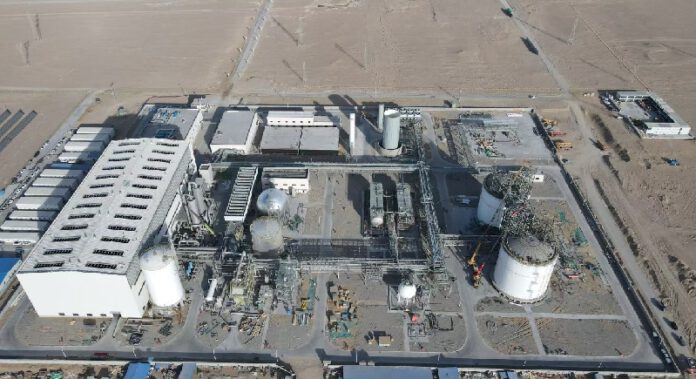
On October 30, 2025, the world’s largest liquid air energy storage national demonstration project, with a rated power of 60 MW and an energy storage capacity of 600 MWh, successfully connected to the grid in Golmud, Qinghai Province. This milestone represents more than the commissioning of a large-scale storage facility. It demonstrates China’s ability to engineer and integrate a utility-scale LAES system, marking a major step toward the industrialization of long-duration energy storage.
The significance of this achievement lies not simply in cooling air to minus 194°C, but in introducing an alternative approach to storing electricity. Rather than relying on battery chemistry or specific geological formations, LAES uses the liquefaction and subsequent expansion of air to convert electricity into stored physical energy that can be retained and released when required.
At its core, liquid air energy storage uses changes in the physical state of air to transfer electricity across time. During periods of surplus renewable generation or low electricity demand, excess power is used to liquefy air. When demand rises, the stored liquid air is converted back into electricity through a thermodynamic cycle.
During the charging process, electricity drives multistage compressors that compress purified ambient air into high-temperature, high-pressure gas. The heat generated during compression is recovered and stored. The compressed air is then cooled through a cryogenic liquefaction system until it becomes liquid air, which is stored in insulated tanks at low temperature and atmospheric pressure. Compared with air in its gaseous state at room temperature, liquid air has approximately 750 times the density, significantly reducing the storage volume required.
During discharge, liquid air is pumped to a higher pressure and passed through a cold-storage system, where it is warmed and vaporized. The recovered compression heat is then used to further heat the gas, producing high-temperature, high-pressure air that drives an expansion turbine to generate electricity. In this way, electricity is converted into liquid air during periods of surplus supply and converted back into electricity when demand increases.
Although the principle appears straightforward, its industrial implementation involves considerable technical complexity. Cryogenic liquefaction, cold-energy recovery, thermal management, atmospheric-pressure storage, and overall system efficiency are all critical to reliable operation.
One particularly important challenge is air purification. Ambient air contains moisture and carbon dioxide, which can freeze under extremely low-temperature conditions and potentially block pipelines and heat exchangers. Effective purification, cryogenic heat exchange, cold-storage materials, and integrated control systems are therefore essential to maintaining long-term operational stability.
China’s progress in liquid air energy storage has been built on years of systematic research into these challenges. The research team led by Professor Wang Junjie at the Technical Institute of Physics and Chemistry of the Chinese Academy of Sciences has spent more than a decade developing air-based energy storage technologies, establishing an innovation chain spanning fundamental research, critical equipment development, system integration, and engineering demonstration.
In 2014, the team established a 500 kW non-combustion compressed air energy storage demonstration platform in Wuhu, Anhui Province, and developed China’s first 500 kW three-stage coaxial regenerative air turbine expander. In 2017, the team developed a high-efficiency liquid-phase cold-storage system in Langfang, Hebei Province, increasing cold-storage efficiency from approximately 60% to 90%, and commissioned a 100 kW liquid air energy storage demonstration platform. In 2020, a research platform for deep-cryogenic cold-storage technologies was established, covering solid-phase cold storage at the 10 kW and 500 kW levels, as well as mixed-working-fluid liquid-phase cold storage at the 100 kW level. By 2021, the team had further developed process technologies for integrating multiple energy sources and supplying multiple forms of energy through LAES systems.
This development trajectory highlights an important point: scaling up liquid air energy storage is not simply a matter of installing larger compressors and storage tanks. It requires simultaneous advances in thermodynamic cycles, cold-storage efficiency, equipment reliability, and coordinated system control. The transition from laboratory-scale platforms to a 60 MW industrial-scale project required the redesign and integration of an entire technological system.
The Golmud project represents the culmination of these advances. Invested in and developed by China Green Development Investment Group, in collaboration with research and industrial partners including the Chinese Academy of Sciences, the project is located in Golmud, Haixi Mongolian and Tibetan Autonomous Prefecture, Qinghai Province. It has a rated power of 60 MW and a storage capacity of 600 MWh, operating with a cryogenic liquefaction process at approximately minus 194°C. Its design enables up to 10 hours of continuous electricity generation during discharge.
Its industrial significance extends beyond its storage capacity. The project has achieved a 100% domestic equipment localization rate, establishing an independently controlled equipment and technology system. To realize the project, research and engineering teams developed a series of critical components, including an ultra-large horizontally split centrifugal compressor, a high-capacity liquid expander, high-efficiency cryogenic cold-storage units, an integrated liquefaction and reheating cold box, advanced air purification equipment, and high-head liquid air pumps.
Several of these systems represent first-of-their-kind applications at the relevant industrial scale, demonstrating China’s growing capabilities in the design and manufacture of large-scale LAES equipment. More importantly, the breakthrough is not confined to individual components. It encompasses the entire industrial chain, from core equipment and system integration to engineering implementation and operational control.
The project integrates compressor control, expander control, process automation, safety instrumentation, and gas detection systems. These technologies enable precise control throughout the entire compression, liquefaction, storage, and power generation process, while coordinating the real-time management of multiple energy flows, including cooling, heating, electricity, and gas.
For a utility-scale energy storage facility, operational reliability, safety, and dispatchability are just as important as installed capacity. Successful grid connection therefore provides an important engineering validation of China’s ability to operate an integrated megawatt-scale liquid air energy storage system.
From a technological perspective, LAES differs fundamentally from electrochemical energy storage, including lithium-ion batteries. Electrochemical storage relies on chemical reactions within battery cells to store and release energy. It offers fast response times and a high degree of modularity, but large-scale, long-duration applications must also consider battery degradation, material costs, thermal management, and safety requirements.
Liquid air energy storage, by contrast, relies on thermodynamic cycles and changes in the physical state of air. Its main equipment consists of compressors, heat exchangers, storage tanks, pumps, and expansion turbines. This gives the technology a strong foundation in industrial mechanical engineering and thermal systems.
One of its most distinctive advantages is atmospheric-pressure storage. Although liquid air must be maintained at extremely low temperatures, it does not need to be stored as a high-pressure gas. This allows the system to achieve relatively high volumetric energy density while avoiding some of the risks associated with high-pressure gas storage.
Air is also abundant and readily available as the working fluid. The operating process does not involve combustion and produces no direct carbon dioxide or conventional pollutant emissions during normal operation. Its major mechanical components can be designed for long service lives, making the technology potentially suitable for frequent cycling and long-duration storage.
Unlike pumped hydro and certain compressed air energy storage systems, LAES does not depend on specific geological formations or geographical conditions. This provides greater flexibility in site selection, including applications in deserts, high-altitude regions, and areas with abundant renewable energy resources.
However, these advantages do not mean that liquid air energy storage can replace other storage technologies. Its strengths are primarily associated with large-scale, long-duration applications rather than every segment of the energy storage market.
The deep-cryogenic refrigeration, compression, and vaporization processes involve multiple energy conversion stages. Overall system efficiency depends on heat and cold recovery, equipment performance, and the availability of external thermal resources. Capital expenditure, maintenance costs, actual round-trip efficiency, and market revenues must also be evaluated through long-term commercial operation.
The more practical direction for the future is therefore a diversified energy storage portfolio in which lithium-ion batteries, pumped hydro, compressed air energy storage, and liquid air energy storage complement one another according to their respective strengths.
The strategic importance of LAES extends well beyond the storage of electricity. It has the potential to reshape how renewable power is integrated into the energy system.
On the generation side, wind and solar power frequently produce electricity at times when demand is relatively low. Large-scale liquid air energy storage can absorb surplus renewable electricity and release it when generation falls or demand rises. This can reduce renewable curtailment and improve the utilization of wind and solar resources, particularly in large-scale renewable energy bases.
On the grid side, LAES can support peak shaving, frequency regulation, voltage management, and reserve services. By improving the balance between electricity supply and demand, it can enhance grid flexibility and operational stability. As the proportion of renewable energy increases, storage is evolving from a supplementary facility into an essential component of the modern power system.
On the demand side, LAES also offers opportunities for integration with industrial waste heat, waste cold, and liquefied natural gas (LNG) cold energy. LNG releases substantial amounts of cold energy during regasification. Integrating this resource into liquid air energy storage systems can reduce the energy required for air liquefaction, improve overall system performance, and enable more efficient cascade utilization of energy.
In addition, integrated systems can potentially supply multiple forms of energy, including cooling, heating, electricity, and industrial gases. This creates opportunities for LAES to evolve beyond a standalone electricity storage technology into a platform for integrated energy management in industrial parks and large-scale energy systems.
The significance of the Golmud project, therefore, cannot be measured solely by its 60 MW power rating or 600 MWh storage capacity. It demonstrates the feasibility of an independently developed, large-scale, long-duration energy storage technology, together with the domestic equipment manufacturing and system integration capabilities required to support its industrial deployment.
The project is also associated with a 250 MW photovoltaic development, providing a practical foundation for coordinating renewable electricity generation with long-duration energy storage. According to project estimates, it can store and deliver approximately 600,000 kWh of electricity in a full cycle of operation, with annual electricity delivery of around 180 million kWh, equivalent to the yearly electricity consumption of approximately 30,000 households.
Viewed in the broader context of China’s energy transition, the larger the installed capacity of renewable energy becomes, the greater the need for flexible resources capable of balancing electricity supply and demand. The future competition in the energy sector will not be determined solely by the cost of electricity generation. It will increasingly depend on storage capacity, system flexibility, dispatch capabilities, and energy conversion efficiency. The ability to transform intermittent renewable generation into stable and reliable electricity at competitive overall costs will be a decisive factor in the development of next-generation energy systems.
China’s progress from more than a decade of research to the commissioning of the 60 MW Golmud demonstration project represents a significant step toward establishing an independent technological pathway for large-scale, long-duration energy storage.
However, grid connection marks the beginning of commercialization rather than its completion. The technology’s long-term competitiveness will ultimately depend on operational data, lifecycle costs, round-trip efficiency, equipment reliability, and the development of sustainable commercial business models.
Source: tech gmw, xinhuanet, ydyl china, sohu, china daily