


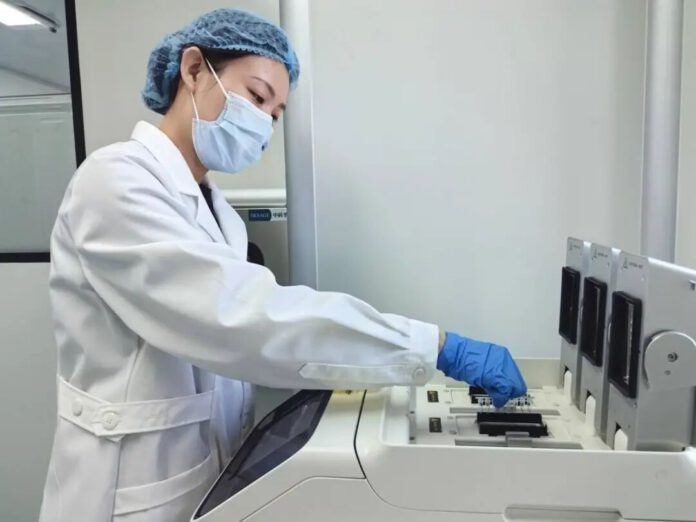
Inside a spotless forensic laboratory in Xiangyang, central China’s Hubei Province, DNA analyst Zhang Mengting works in full protective gear, carefully transferring tiny amounts of liquid into test tubes with unwavering precision. Every movement demands absolute accuracy, because in forensic DNA analysis, even the smallest mistake can have profound consequences.
Since joining the Criminal Investigation Division of the Xiangyang Public Security Bureau in 2019, Zhang has examined more than 16,400 biological samples without a single recorded error. Over the past six years, she has helped identify suspects in more than 320 major and difficult criminal cases, located 35 missing or trafficked individuals, and reunited 42 separated families. In recognition of her contributions, she was awarded the Hubei May Day Labor Medal in 2025.
According to Zhang, DNA analysis is a profession that leaves no room for error. Any mistake could not only derail a criminal investigation but also permanently damage a forensic scientist’s professional credibility. She believes that meticulous attention to detail, patience, and scientific rigor are essential for uncovering the truth hidden within microscopic biological evidence.
One of her most remarkable investigations began in August 2020, when a serious criminal case occurred in Gucheng County, Xiangyang.
The crime scene yielded few useful clues, and investigators struggled to identify the suspects. Following the suspects’ escape route, police discovered a makeshift shelter in a remote rural area where they were believed to have spent the night. The shelter contained almost nothing of evidentiary value except an old bamboo sleeping mat.
While others saw little hope, Zhang carefully examined the mat centimeter by centimeter. Hidden inside a narrow seam, she discovered an extremely small bloodstain measuring only about two millimeters across. After closer inspection, she concluded that it was most likely the remains of a mosquito that had been crushed after feeding on human blood.
Because mosquitoes retain freshly ingested human blood for a period of time after feeding, the insect itself can preserve valuable human DNA. Zhang brought the mosquito remains back to the laboratory, where she and her colleagues spent more than 50 hours extracting and analyzing the tiny amount of genetic material mixed with the dried blood.
Their efforts succeeded. The recovered DNA profile matched records in the national database and directly identified the suspect.
Only nine days after the crime, police tracked down and arrested two fugitives in Jiujiang, Jiangxi Province. The case quickly attracted nationwide attention, with many Chinese internet users describing it as a real-life version of the forensic crime drama Forensic Heroes. The suspects had never imagined that a mosquito they casually swatted would ultimately become the key witness that led investigators directly to them.
For Zhang, however, the case simply illustrated a principle that guides all of her work. She believes that a single strand of hair, a drop of sweat, a tiny piece of skin, or any seemingly insignificant trace may become the key to revealing the truth. Physical evidence never presents itself voluntarily; only careful observation and painstaking examination can uncover the decisive clue hidden among countless insignificant details.
This philosophy has shaped many of her investigations. In 2024, a glass bottle thrown from a high-rise apartment building struck a parked car in Xiangcheng District of Xiangyang. The residential building contained more than 50 households, making a building-wide DNA collection impractical and extremely time-consuming.
Instead of requesting samples from every resident, Zhang extracted a male DNA profile from the shattered bottle and conducted further forensic analysis. By comparing the evidence with an existing local family DNA profile, she successfully narrowed the investigation and accurately identified the individual responsible for the high-altitude littering incident, saving investigators significant time and resources.
Beyond criminal investigations, Zhang has also used forensic genetics to reunite long-separated families. One particularly moving case involved a man surnamed Zhao, who had been abducted in 1974 at the age of three. His parents searched for him for decades without success. In 2017, his mother submitted a DNA sample to the national missing-person database, but because his father’s DNA was unavailable, investigators were unable to establish a complete genetic relationship.
In 2024, Zhang and her team adopted an innovative approach by analyzing DNA from Zhao’s biological brother to reconstruct the missing paternal genetic information. The reconstructed profile eventually led to a successful match, allowing Zhao to reunite with his family after nearly half a century apart.
By combining advanced forensic science with creative analytical methods, Zhang has helped return 35 missing or trafficked individuals to their families and brought closure to dozens of long-separated relatives.
The use of mosquito-derived DNA as forensic evidence was not unprecedented in China. In 2006, forensic expert Shen Gaofang helped solve the murder of a taxi driver in Yangzhou, Jiangsu Province, after investigators recovered a dead mosquito from a suspect’s residence. DNA extracted from the mosquito’s blood meal provided the crucial breakthrough that solved the case, and the investigation later became a classic teaching example within China’s criminal investigation system.
Similar cases have also appeared overseas. Finnish investigators once extracted human DNA from a blood-filled mosquito discovered inside a stolen vehicle and successfully identified a theft suspect through database comparison, demonstrating the growing capabilities of modern forensic science.
As DNA sequencing technologies become increasingly sensitive, even the smallest biological traces can provide decisive evidence. Hair, skin cells, sweat, blood, and even an ordinary mosquito may preserve the genetic information needed to solve a crime.
Working quietly behind laboratory doors, Zhang Mengting and countless other forensic scientists continue to transform silent traces into powerful evidence. Their meticulous work ensures that even the smallest fragment of biological material can help reveal the truth, bring criminals to justice, and reunite families separated for decades.
Source: sohu, 163, sina, cbgc scol, people