


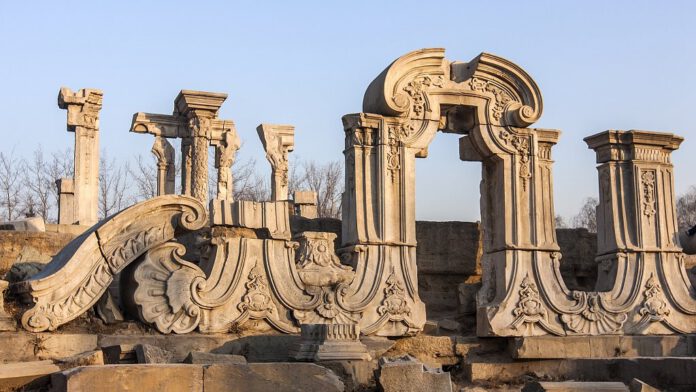
In November 1861, the French Romantic writer Victor Hugo expressed his hope that one day a liberated and cleansed France would return to China the treasures that had been looted from it in his famous Letter to Captain Butler Concerning the Anglo-French Expedition to China. In the letter, Hugo bitterly denounced the Anglo-French forces as bandits who had looted the Yuanmingyuan, or the Old Summer Palace, and expressed his profound sorrow over the destruction.
More than 160 years later, Hugo’s wish has finally received an echo. On April 13, 2026, the French National Assembly unanimously passed, with 170 votes in favor, the Bill on the Restitution of Cultural Property Dispossessed through Illicit Appropriation.
For Chinese national treasures that have remained in France for generations, the prospect of returning home has finally begun to emerge, sparking widespread discussion both in China and abroad.
People hope that the bill will help deliver a long-delayed measure of justice and, at last, ease some of the pain left by one of the darkest episodes in the history of human civilization. Among the greatest concerns is the possible return of cultural treasures looted from the Yuanmingyuan.
Once praised highly by intellectuals such as Voltaire and Victor Hugo, the Yuanmingyuan was reduced to ruins during the looting and burning that accompanied the Second Opium War. Its destruction remains a painful memory for all humanity and, above all, a profound wound in the history of the Chinese nation.
In 1743, during the eighth year of the Qianlong Emperor’s reign in the Qing dynasty, the French Jesuit missionary Jean-Denis Attiret, whose Chinese name was Wang Zhicheng (王致诚), mentioned in a letter to a French friend the extraordinary beauty of the Yuanmingyuan. The garden subsequently became famous in Europe as a “Garden of Gardens,” or Yuanmingyuan, and its fame also helped make it an object of fascination and a tempting target for European colonial powers.
During the Second Opium War, at around 7 p.m. on October 6, 1860, French troops appeared at the Yuanmingyuan’s western gardens. General Charles Cousin-Montauban, commander of the French expeditionary force, established his headquarters there. The looting began almost immediately and soon became uncontrollable.
British troops arrived the following day. When they discovered that the French had already begun taking the treasures, they rushed to catch up with their French allies in the plunder.
For two days, more than 20,000 invading troops rampaged through the Yuanmingyuan, taking bronze vessels, enamelware, imperial jade objects, and countless other treasures. Among the objects looted were a gilt-bronze Buddhist stupa, the unique copy of the Forty Views of the Yuanmingyuan, a cloisonné-enamel qilin, a golden mandala set, and the armor worn by the Qianlong Emperor for the Grand Review of the Troops.
By conservative estimates, the Yuanmingyuan contained more than one million cultural objects, not to mention the countless works of art embodied in its furnishings and everyday imperial possessions.
After the looting, on October 18, 1860, the invading forces set fire to the Yuanmingyuan. In a matter of days, a magnificent complex once regarded as a wonder of the world was reduced to ruins. The troops selected the most precious objects as gifts for Queen Victoria of Britain and Emperor Napoleon III of France, while the rest were left for soldiers of the allied forces to divide among themselves.
Three years later, Empress Eugénie, the wife of Napoleon III, ordered the construction of a Chinese Museum at the Palace of Fontainebleau in France specifically to house objects brought back from China, including treasures looted from the Yuanmingyuan.
Among them was a cloisonné-enamel qilin, originally housed at the Yuanmingyuan. It was later taken to France and placed at the Palace of Fontainebleau, where it has since disappeared.
Another important object is the Forty Views of the Yuanmingyuan. Commissioned by the Qianlong Emperor and painted by court artists including Shen Yuan and Tang Dai, the work consists of forty paintings depicting the principal scenic and architectural complexes of the Yuanmingyuan at the height of its glory. The unique surviving album is of extraordinary importance to the study of Chinese garden and architectural history. Its disappearance overseas represents a profound loss to China’s cultural heritage.
For many years afterward, Chinese people did not even have adequate visual materials with which to reconstruct what the Yuanmingyuan had actually looked like. In 1928, the Commercial Press published Forty Leaves of the Yuanmingyuan, allowing Chinese readers to see photographic reproductions of the original Forty Views of the Yuanmingyuan.
In more recent years, the National Library of France made high-resolution digital files of Poems on the Forty Views of the Yuanmingyuan available to the public. In 2025, the Central Academy of Fine Arts in China completed a digital reconstruction of the forty scenic views, giving people an opportunity to glimpse the splendor of the “Garden of Gardens” as it once existed.
The destruction of the Yuanmingyuan remains heartbreaking. Yet it was only the beginning of a much broader history of the large-scale and sustained loss of Chinese cultural heritage to France and other countries overseas.
In 1900, during the Boxer Uprising and the Eight-Nation Alliance intervention in China, French troops once again looted sites including the Forbidden City, the Summer Palace, and the Temple of Heaven, taking imperial seals, ancient bronze vessels, imperial porcelain, paintings and calligraphic works, and other treasures. Large numbers of Chinese cultural objects consequently entered French collections.
Unlike the violent plunder carried out during wartime, however, the actions of the French sinologist Paul Pelliot in 1908 were conducted under the guise of scholarly exploration. He acquired thousands of manuscripts and artworks from the Dunhuang Library Cave, often through purchases at prices that were grossly disproportionate to their historical value.
Beginning in 1906, Pelliot’s expedition spent years conducting what was presented as archaeological and scholarly exploration in Central Asia, visiting places including Kashgar, Tumshuq, Kucha, and Ürümqi, and collecting large numbers of artifacts and manuscripts dating from the Tang dynasty and earlier periods.
In February 1908, Pelliot arrived at Dunhuang and met Wang Yuanlu, the Daoist monk who had accidentally discovered the hidden library cave several years earlier. After paying Wang 500 silver taels, Pelliot gained access to the cave, a secluded chamber that had remained unknown for centuries and contained tens of thousands of precious manuscripts.
Over the following days, Pelliot carefully selected and packed large numbers of manuscripts, paintings, and documents. The materials were of extraordinary historical and linguistic value. They included texts in Khotanese, Sogdian, Old Turkic, Old Uyghur, Brahmi, Tocharian, and Tibetan, among other languages and scripts.
Pelliot ultimately took thousands of manuscripts and paintings back to France. His expedition collected more than 6,000 manuscripts and paintings from the Dunhuang caves. The surviving records of the BnF show that the Pelliot collection includes documents in numerous languages and scripts, and that the manuscripts were brought to the National Library of France in the early twentieth century.
Today, many of these treasures are held by the National Library of France (BnF) and the Guimet Museum in Paris. The BnF describes its Dunhuang collection as containing manuscripts dating from before the beginning of the eleventh century, discovered in Cave 17 of the Mogao Caves and brought to France by Pelliot’s expedition. For China, the dispersal of the Dunhuang manuscripts became a deep and lasting cultural wound.
These manuscripts and artifacts provide some of the most direct surviving evidence of the plural and interconnected character of Chinese civilization. Once dispersed across different countries and collections, however, they can no longer be understood as part of a complete historical whole. A coherent record of civilization risks being fragmented into isolated objects presented merely as “exotic treasures” or “fragments of an Eastern civilization.”
The manuscripts from the Dunhuang Library Cave are particularly important. Had they remained together, they could have helped fill numerous gaps in our understanding of Chinese and Central Asian history. Once separated, however, the loss of individual documents can leave significant gaps in historical and academic research.
Since the 1980s, Chinese scholars have devoted themselves to the systematic study of Dunhuang Studies and Turpan Studies, driven by a strong sense of academic and cultural responsibility. One of their goals has been to change the long-standing situation summed up by the phrase: “Dunhuang is in China, but Dunhuang studies are abroad.”
The ancient Tibetan manuscripts from Dunhuang are a particularly important example. They are among the oldest surviving Tibetan manuscripts known today. Their contents include Buddhist scriptures, historical works, contracts, administrative documents, and legal texts. They constitute invaluable sources for the study of the history and culture of the Tibetan Empire and provide vivid historical evidence of the interactions, exchanges, and integration among different peoples.
Since 2005, over the course of two decades, Northwest Minzu University and Shanghai Ancient Books Publishing House, in cooperation with the British Library and the National Library of France, have completed the cataloguing and publication of the Tibetan manuscripts from Dunhuang and the Western Regions held in British and French collections.
The resulting publications have brought these scattered treasures back to China in another sense: not physically, but through high-resolution reproductions and systematic scholarly editions, allowing Chinese researchers and the public to study manuscripts that have been separated from their homeland for more than a century.
The BnF itself now actively cooperates with Chinese institutions on Dunhuang collections and digital preservation. Its International Dunhuang Programme and France-China digital heritage projects have made many of these manuscripts and artworks accessible to researchers around the world.
The French Cultural Restitution Bill, by abolishing the rigid principle that objects belonging to France’s public collections are ordinarily inalienable, and by requiring the government to publish annually a list of cultural objects suspected of having been acquired illegally, could provide a new institutional basis for the restitution of cultural property.
If implemented effectively, such a mechanism could help advance the principle that cultural objects unlawfully removed from their countries of origin should ultimately be returned. It could also provide a model for the recovery of the millions of Chinese cultural objects that have been dispersed around the world.
The return of these treasures would not merely fill gaps in museum collections. It would help restore the continuity of historical narratives and reconnect broken lines of cultural transmission.
Source: neac gov cn, cgtn, xinhua, sohu