


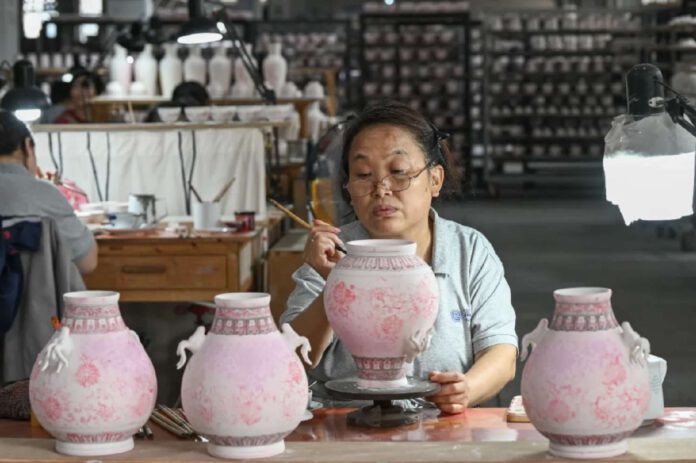
On July 25, 2026, in Busan, South Korea, the 48th session of the UNESCO World Heritage Committee adopted a resolution to inscribe the Jingdezhen Handicraft Porcelain Industry Sites on the World Heritage List. With the inscription, the number of World Heritage properties in China rose to 61.
For Jingdezhen, the moment marked not only the culmination of more than a decade of work toward World Heritage inscription, but also an international recognition of the way the city has come to understand and protect its own history.
People tend to think of Jingdezhen through individual objects: blue-and-white porcelain, imperial kilns, and the celebrated description of porcelain as “white as jade, bright as a mirror, thin as paper, and resonant as a bell.”
But what Jingdezhen presented to the world this time was neither a single masterpiece nor a single ancient kiln. It was an entire handmade porcelain-making industry and the landscape that sustained it.
The heritage property comprises five components: the urban porcelain-production center, the Hutian Ancient Porcelain Kiln Site, the Gaoling Kaolin Mining Site, the Changling Porcelain-Stone Mining Site, and the Jiaotan kiln-fuel production area. Together, they contain 15 groups of heritage elements and 45 individual heritage sites.
From mountain mines to kiln workshops, from the processing of raw materials to the transportation of finished products, these remains, scattered across the city, countryside and surrounding mountains, bear witness to more than nine centuries of continuous development in Jingdezhen’s handmade porcelain industry.
It is also the first time that China has submitted a World Heritage nomination centered on an industrial heritage system. The fundamental question facing Jingdezhen was therefore not whether the city possessed enough historic remains. It was something more difficult: What, exactly, was it about Jingdezhen that the world needed to understand? It took more than a decade for the answer to emerge.
Jingdezhen formally began its World Cultural Heritage nomination process in 2015. At the time, the city possessed an extraordinary number of ancient kiln sites, mining pits, docks and historic roads. Fuliang County, meanwhile, retained the clay, porcelain stone and kiln fuel resources that had once supplied the entire porcelain-making industry and formed the upper reaches of its production chain.
At first, the instinct was to include as many valuable remains as possible. But as research deepened, the nomination team came to understand that a World Heritage nomination could not simply be an exhaustive inventory of local historical resources.
More heritage sites do not necessarily make a clearer heritage story. What mattered was identifying those remains that could most convincingly demonstrate Jingdezhen’s outstanding universal value, and connecting them into a coherent system that could be understood internationally.
The nomination therefore became a process of subtraction. Some ancient kiln sites, despite their long histories and relatively good preservation, were ultimately removed from the proposed property. Other remains that had once seemed ordinary or received little attention were brought back into focus.
The center of the research shifted as well. The history of Jingdezhen’s porcelain industry had traditionally been told through famous kilns, celebrated wares and renowned techniques. This time, researchers stepped back from the finished object and began asking a different set of questions.
How did kaolin from Gaoling, porcelain stone from Changling and kiln fuel from Jiaotan enter the production system? How were raw materials processed? How were they transported by land and water to the urban workshops? How was labor divided among different stages of production? And how did thousands of workers, workshops and production facilities together sustain one of the world’s great centers of porcelain manufacture?
Once these questions were placed back into their historical context, Jingdezhen’s distinctiveness became clearer. The city was not simply home to a collection of ancient kilns. It had developed a vast industrial ecosystem, with an extensive spatial reach, a highly integrated production chain, complex systems of labor organization, and remarkable continuity over time.
It was this system that helped Jingdezhen emerge as one of China’s, and the world’s most important centers of porcelain production during the Song, Yuan, Ming and Qing periods. Porcelain made in Jingdezhen traveled along the Maritime and overland Silk Roads to distant markets. Behind that global reach stood a complex network linking mountains and cities, mines and kilns, waterways and workshops, craftsmen and markets.
The term “industrial heritage” therefore became central to the nomination. It also fundamentally changed the way Jingdezhen prepared for the inscription.
To demonstrate the integrity of the system, the city undertook years of field surveys, archaeological investigation, historical research and heritage interpretation. Heritage elements were repeatedly reviewed, boundaries were adjusted, and the city gradually established a conservation and management system aligned with international World Heritage standards.
The preparation was never simply about putting old sites behind fences. Jingdezhen had to demonstrate not only why its remains mattered to the world, but also whether it possessed the institutional capacity to protect them over the long term.
Unlike many World Heritage properties concentrated within a single site, Jingdezhen’s 45 heritage sites stretch across urban and rural areas, different natural environments and multiple administrative jurisdictions. Some are located in the historic production center; others lie deep in the mountains; still others are closely connected with mineral resources and traditional communities.
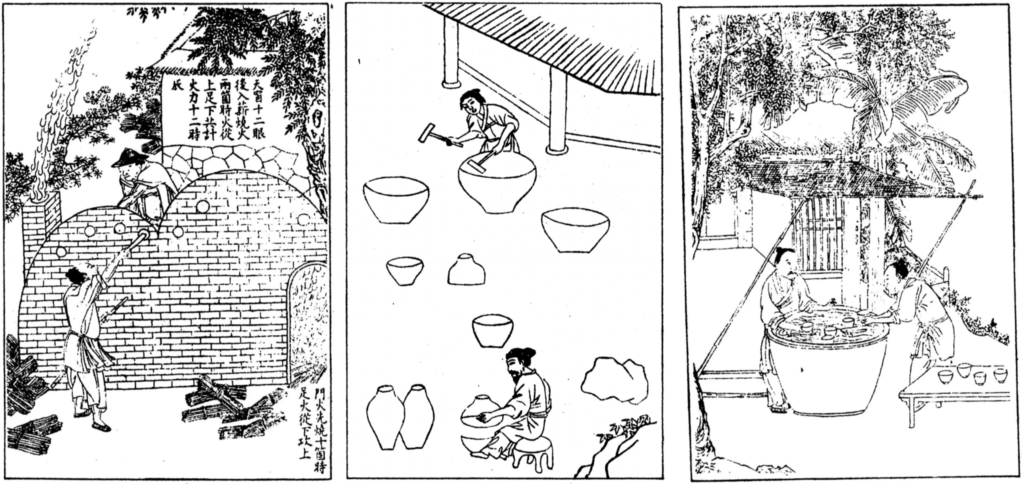
How could such seemingly scattered remains be managed as one coherent heritage property? This became one of the central governance challenges of the nomination.
Over the course of the preparation, Jingdezhen developed a coordinated conservation framework linking the heritage conservation center, relevant government departments and local protection stations. The heritage conservation center undertakes overall monitoring and supervision; administrative departments provide professional guidance; and local protection stations are responsible for routine inspection and maintenance.
The city also developed a digital monitoring platform, bringing information on the condition of heritage structures, changes in their surrounding environments and inspection records into a unified system. Such institutional arrangements may be less visible than ancient kilns or porcelain vessels, but they are fundamental to the credibility of a World Heritage nomination.
An international evaluation does not ask only how glorious a place was in the past. It also asks whether there is a credible system capable of protecting that heritage into the future. The city also faced a more complicated question: how to integrate the protection of the natural environment, tangible heritage and living traditions.
Porcelain production in Jingdezhen did not emerge in isolation. High-quality porcelain stone and clay, local water systems and climatic conditions provided the natural foundations for the industry. Centuries of production, in turn, generated a rich body of craftsmanship and traditional knowledge.
Mines, kiln sites, historic roads and docks are visible forms of heritage. The knowledge embedded in washing clay, shaping vessels, applying glazes and controlling firing is less visible, yet remains alive in the hands of craftsmen.
For this reason, Jingdezhen’s nomination placed emphasis on the relationship between culture and nature, and on the interaction between tangible heritage and intangible traditions.
Protecting the wider heritage environment, the city argued, could allow people to understand that the traditional idea that a place is “suited to pottery by virtue of its soil and water” is not merely a poetic expression. It reflects a long historical interaction between natural conditions and human technology. This relationship was captured in remarkable detail in a book published more than two decades ago.
In the late 1990s, Bai Ming, a professor at Tsinghua University’s Academy of Arts and Design and a practicing ceramic artist, began systematically documenting traditional porcelain-making in Jingdezhen.
To complete Traditional Crafts of Porcelain Making in Jingdezhen, he spent seven years repeatedly visiting workshops, mountain areas and production sites. He took nearly 2,000 photographs and ultimately selected more than 600 for the book.
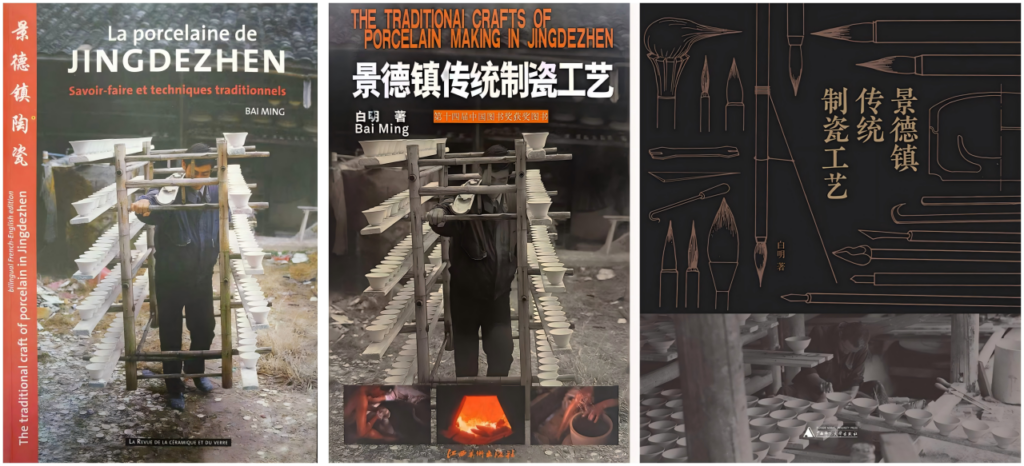
He deliberately refused to reconstruct the workshops for the camera. If the light was dim, he photographed the dim light. If the workshop was untidy, he left it that way. He recorded how individual craftsmen worked, where they placed their tools and how they organized their spaces.
What he wanted to preserve was not a carefully staged image of “tradition,” but tradition as it actually existed. Years later, as Jingdezhen began to seek World Heritage status not simply for individual kiln sites but for an entire industrial system, those records took on another significance.
In an old workshop, even a pool of water could form part of the porcelain-making process. Craftsmen combined a water pool with drying racks above it, creating what they called a “drying-rack pond.” In hot weather, water evaporated more quickly, increasing humidity around the workshop and slowing the loss of moisture from freshly formed clay bodies, thereby reducing the risk of cracking.
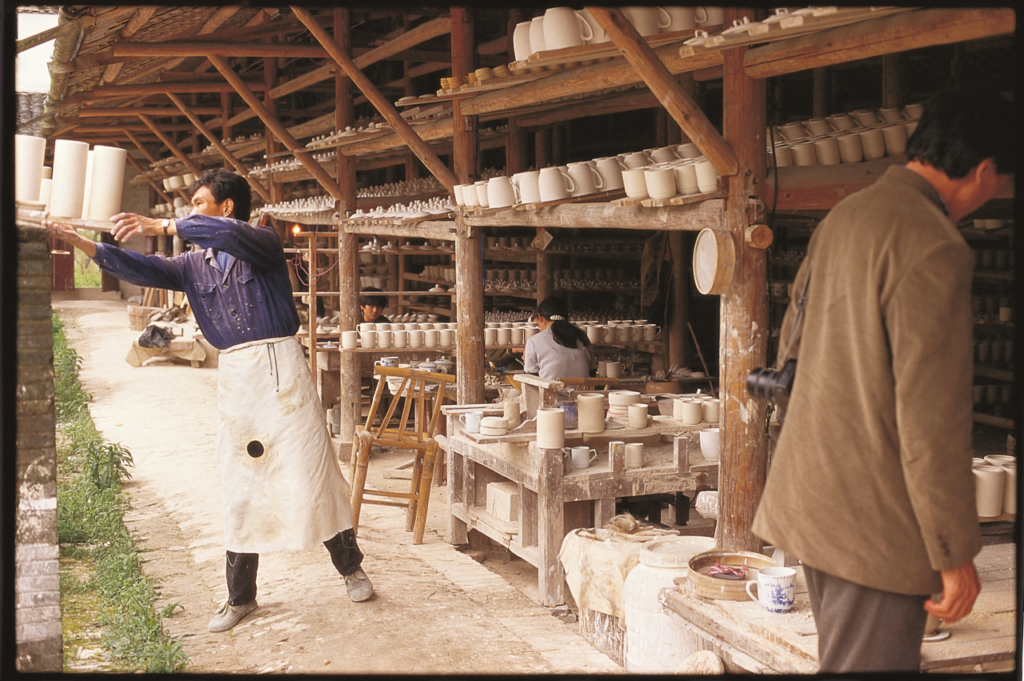
In other workshops, craftsmen treated water before using it to wash porcelain clay, relying on methods developed through generations of practical experience. Such knowledge rarely appears on the surface of a finished porcelain vessel. Yet it is precisely this knowledge that reveals how deeply the production system was rooted in the local environment.
Bai came to realize that most people see only the finished piece of porcelain. Far fewer understand what happened to the clay before it ever reached the kiln. The Jingdezhen nomination was, in many ways, an effort to make that invisible process visible. This understanding gradually became central to the city’s World Heritage narrative.
In January 2025, the Jingdezhen Handicraft Porcelain Industry Sites was formally submitted as China’s World Heritage nomination. By then, the city had already spent years conducting surveys and archaeological investigations, refining the heritage boundaries and components, articulating the site’s outstanding universal value, and building a conservation and management system.
In September of the same year, an international expert team arrived in Jingdezhen for a technical evaluation. It rained heavily throughout the visit, but the experts continued their intensive schedule, spending four and a half days visiting key heritage sites, examining their state of conservation, studying protection measures and reviewing management arrangements. Digital presentations were also used to reconstruct the ancient porcelain-making process.
At the command center of the heritage conservation system, a digital monitoring platform displayed information from sites across the property. What the experts saw was not simply a group of old kilns and abandoned mines. They saw an integrated conservation system covering multiple areas and different categories of heritage.
The evaluation reinforced a lesson that Jingdezhen had learned throughout the nomination process: World Heritage status is not simply a reward for the past. It is also a test of a place’s capacity to safeguard that past in the future. From a global perspective, the significance of Jingdezhen’s nomination extends beyond the city itself.
China’s existing World Heritage properties already include ceramic-related remains, including the Dehua and Cizao kiln sites associated with Quanzhou. But Jingdezhen is the first Chinese nomination to present porcelain-making itself as the central theme through a complete industrial heritage system.
It demonstrates not only the development of Chinese porcelain technology and ceramic art, but also how a traditional industry can become intertwined with natural resources, urban development, labor organization and international trade.
During the nomination process, Jingdezhen also became more active in international discussions on heritage conservation. At the World Heritage-related events in 2025, the city hosted a thematic side event on the creative conservation of industrial craft heritage, engaging with international peers on the protection and adaptive use of craft-based heritage.
The ambition is broader than securing a place on the World Heritage List. Jingdezhen hopes its experience can contribute to the research, conservation and future nominations of similar craft and industrial heritage sites around the world. But ultimately, the significance of the nomination returns to the city itself.
One of the immediate outcomes has been the expansion of Jingdezhen’s recognized heritage resources. Archaeological surveys and nomination research have brought previously overlooked sites back into public view.
Another has been a closer relationship between heritage and local communities. By incorporating porcelain-stone mining areas, kiln-fuel production zones and surrounding communities into the heritage system, the nomination has connected places of everyday life with the broader history of Jingdezhen’s porcelain industry. And perhaps most importantly, the process has strengthened the city’s conservation capacity.
Meeting international standards has required Jingdezhen to rethink how government departments coordinate, how heritage sites are monitored over the long term, how communities participate in conservation, and how development can be balanced with authenticity and integrity.
This may be the least visible, but one of the most important, legacies of the nomination. A World Heritage property is not truly successful simply because it has been inscribed. Its deeper test is whether it can establish a sustainable system of conservation after the ceremony is over.
Today, Jingdezhen remains a living porcelain city.
In the historic Taoyangli district, traditional workshops exist alongside new public spaces. At Taoxichuan, former industrial buildings have been revitalized as places where young ceramic artists and creative teams work and exchange ideas. Across the city, artists from around China, many of them part of the community known as “Jingpiao”, are experimenting with new forms, colors and designs while drawing on traditional techniques.
Master craftsmen continue to perform familiar gestures. Younger makers are finding their own language within them. This is also the new challenge facing Jingdezhen. How can more people experience the heritage without excessive commercialization undermining its authenticity? How can traditional techniques be passed on to younger generations rather than reduced to demonstrations for visitors? How can heritage conservation become part of community life instead of turning living communities into museum displays?
There are no simple answers, and none can be resolved on the day a property is inscribed on the World Heritage List. But Jingdezhen has taken an important step: it has found a clearer way to understand itself. A thousand years ago, porcelain clay was extracted from the mountains, washed and processed, shaped and fired, and transformed into vessels that traveled along rivers and across seas.
Today, the production system that once supported one of the world’s great porcelain centers has been made visible again through 45 heritage sites.
They reveal that great craftsmanship is never simply the achievement of a pair of skilled hands, nor is it contained in the beauty of a finished object. It is the accumulated knowledge of generations learning how to live with mountains and rivers, how to work with materials, how to respond to time, and how to pass experience from one generation to the next.
Jingdezhen nominated a collection of historic remains. What it is ultimately protecting is a civilization that has never entirely stopped. The kilns are still burning. And the story is still being written.
Source: tsinghua, brcn, cgtn, xinhua, sina, sohu