


For more than half a century, oil has been at the heart of the modern industrial economy. It has powered transportation, supplied energy and provided the raw materials for plastics, synthetic fibers, packaging, chemicals and countless other products. The abundance and relatively low cost of fossil-based materials have made them deeply embedded in global production and consumption.
But this dependence has also created growing environmental costs. Plastic pollution has evolved from a waste-management problem into a global ecological challenge. Plastics are produced largely from fossil resources, while discarded plastic can persist in the environment for decades or even centuries. Microplastics have been detected across ecosystems, and the production and disposal of plastics also contribute to greenhouse-gas emissions.
More than 140 countries have introduced restrictions or bans on plastics. Reducing plastic use and developing alternatives to petroleum-based materials have therefore become important elements of the global transition toward sustainable development.
Against this backdrop, China is pursuing a distinctive approach: replacing selected plastic products with bamboo-based alternatives.
The Bamboo as a Substitute for Plastic Initiative was proposed by the International Bamboo and Rattan Organisation in 2022. On June 24 that year, the High-level Dialogue on Global Development, chaired by Chinese President Xi Jinping, released a list of 32 outcomes, including a proposal for China and the International Bamboo and Rattan Organisation to jointly launch the Bamboo as a Substitute for Plastic initiative to reduce plastic pollution and address climate change.
The significance of the initiative goes beyond replacing plastic straws, tableware or shopping bags. At a deeper level, it represents an effort to reduce dependence on fossil-based materials by making greater use of renewable biological resources.
Bamboo is particularly well suited to this purpose. It is one of the fastest-growing plants in the world. Many bamboo species can reach usable maturity within several years, far faster than most conventional timber species. Bamboo also combines strength, flexibility and resilience with relatively good processing characteristics. Under proper management, bamboo forests can be continuously regenerated, while bamboo products can have advantages in terms of biodegradability at the end of their useful life.
Bamboo also has considerable potential as a carbon sink. Research has shown that bamboo forests can have significantly higher carbon-sequestration capacity than many conventional forest systems. This gives bamboo a dual role in the transition toward a low-carbon economy: it can provide renewable raw materials while contributing to ecosystem restoration and carbon sequestration.
China possesses an exceptional natural and industrial foundation for developing such an industry. The country has the world’s largest bamboo resources in terms of area, species diversity and reserves. China is home to 857 bamboo species belonging to 39 genera, accounting for more than half of the world’s recorded bamboo species. Its bamboo forests cover roughly 7 million hectares.
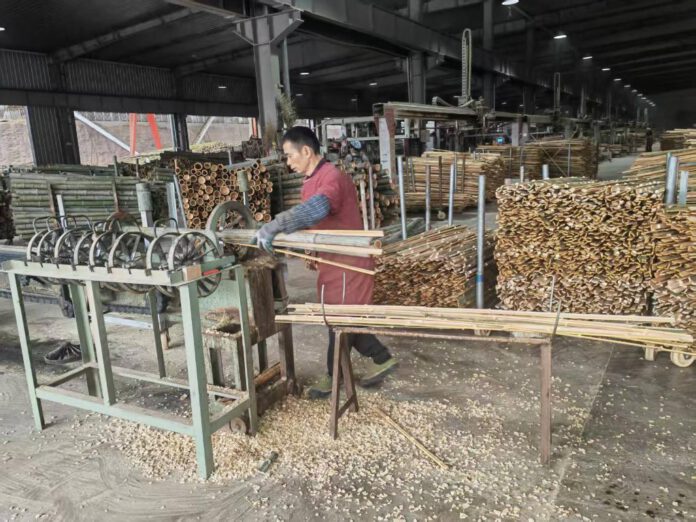
More importantly, China has developed one of the world’s most complete bamboo-processing industries. Bamboo has been cultivated and utilized in China for thousands of years, and modern technologies have transformed it from a traditional material into an increasingly sophisticated industrial resource.
The industrial chain now extends from bamboo cultivation and harvesting to processing, fiber extraction, composite materials, product manufacturing and international trade. This provides an important foundation for transforming bamboo from a traditional rural resource into a modern bio-based material.
Technological innovation is accelerating that transformation. Bamboo fibers, boards, tubes, molded products and engineered composites are increasingly being used in areas traditionally dominated by petroleum-based plastics or other synthetic materials. Bamboo-based products now cover household goods, office supplies, hotel amenities, food-service products, construction materials, industrial components and agricultural applications.
Some of the most promising applications are far removed from traditional bamboo products. Bamboo fiber is being used in automotive interiors and industrial packaging. Bamboo-based composite materials have been developed for pipelines and construction applications. Bamboo is also being processed into keyboards, speakers and other consumer electronics products.
The expansion of bamboo packaging illustrates how technological innovation can alter established industrial practices. Lenovo, for example, introduced biodegradable bamboo-fiber packaging technologies more than a decade ago and has progressively expanded their application. Since 2016, innovations in lightweight and renewable bamboo-fiber packaging have reportedly reduced the company’s use of packaging materials by more than 4,500 tonnes.
Such developments demonstrate that replacing plastic is not simply a matter of substituting one material for another. It requires improvements in material science, processing technology, product design, manufacturing equipment and supply-chain management.
China has therefore increased its investment in research and development related to bamboo-based alternatives. Projects supported by national scientific and industrial programs have focused on key technologies for bamboo-based substitute products, including bamboo drinking straws, bamboo fiber materials, flattened bamboo products and automotive components.
Standards are also becoming an increasingly important part of the transition. In September 2024, China’s National Forestry and Grassland Administration released a specialized standards system for Bamboo as a Substitute for Plastic, covering nine major categories and 140 standards. In January 2025, the International Organization for Standardization published the international standard for bamboo drinking straws, providing an important foundation for the international expansion of bamboo-based products.
Policy has played an equally important role. In November 2023, China’s National Development and Reform Commission and other government departments issued the Action Plan for Accelerating the Development of Bamboo as a Substitute for Plastic. The plan called for stronger technological innovation, improved mechanization in bamboo harvesting and transportation, greater industrial concentration, the cultivation of leading enterprises and expanded applications in key areas.
The objective is not simply to increase the number of bamboo products, but to build a competitive industrial system. Cost remains one of the biggest obstacles. Compared with mass-produced plastics, bamboo products can still be more expensive. Bamboo harvesting and transportation are relatively labor-intensive, while mechanization and automation in some production areas remain limited. Many bamboo-processing companies are small and medium-sized enterprises, making it difficult to achieve the economies of scale enjoyed by large petrochemical manufacturers.
These challenges explain why technological upgrading is essential. Greater mechanization can reduce harvesting costs. Better processing technologies can increase material utilization. Large-scale production can lower unit costs. Product innovation can move bamboo beyond low-value consumer goods and into higher-value industrial applications.
The economic significance extends beyond manufacturing. Much of China’s bamboo is grown in mountainous and rural areas. In many regions, bamboo forests have historically generated relatively low returns for farmers. Developing higher-value products can therefore connect ecological resources with rural incomes.
Jiangxi, Fujian and Guizhou are among the regions that have invested heavily in bamboo development. Jiangxi has launched a major bamboo-industry initiative backed by public investment. Fujian has focused on bamboo forest infrastructure and industrial upgrading. In Guizhou’s Chishui, one of China’s major bamboo-producing areas, hundreds of bamboo-related enterprises have developed products ranging from environmentally friendly tableware to agricultural films and other industrial materials.
The result is a new relationship between forests, farmers and manufacturing. A bamboo stalk growing in a mountain forest can enter a modern supply chain and eventually become packaging, construction material, automotive components or consumer products sold on international markets. This creates opportunities to increase the value of rural resources while providing incentives for better forest management.
The contrast with a fossil-based industrial model is significant. Oil is finite, geographically concentrated and highly sensitive to geopolitical conditions. Modern economies that depend heavily on petroleum-based materials are consequently exposed not only to environmental risks but also to fluctuations in energy prices and global supply chains.
Bamboo cannot replace oil entirely, nor can it replace every type of plastic. Plastics remain highly competitive in many applications because of their low cost, light weight, durability and efficient processing. The objective of Bamboo as a Substitute for Plastic is therefore not to eliminate petroleum from the global economy overnight. Its strategic value lies elsewhere. It expands the range of available raw materials and reduces dependence on non-renewable resources in areas where renewable alternatives are technically and economically viable.
In this sense, China’s bamboo initiative represents a broader approach to sustainable development. Rather than treating environmental protection solely as a constraint on economic growth, it seeks to turn ecological resources into new sources of industrial competitiveness.
The development of the bamboo industry also demonstrates how China’s manufacturing capacity can be combined with its ecological resources. A country that does not possess the world’s largest oil reserves can nevertheless build a competitive materials industry around renewable resources in which it has a comparative advantage. This is particularly important as the global economy searches for alternatives to fossil-based materials.
China’s contribution is also becoming increasingly international. The International Bamboo and Rattan Organisation has promoted the Bamboo as a Substitute for Plastic initiative at international forums, including discussions related to the global plastics treaty, sustainable trade and the United Nations Forum on Forests. China and international partners have organized conferences, exhibitions and technology exchanges to promote bamboo-based solutions.
Chinese bamboo products are already finding markets in Europe, the Middle East and other regions. Bamboo-fiber tableware, packaging and other products are increasingly being marketed not merely as traditional goods, but as part of a global shift toward renewable and low-carbon consumption.
The rapid expansion of the industry illustrates the scale of the transformation. China’s bamboo industry generated more than 520 billion yuan in annual output in 2025, with more than 10,000 bamboo-processing enterprises and over 29 million jobs supported across the value chain. Nearly ten counties and cities have developed bamboo industries worth more than 10 billion yuan each.
These figures show that Bamboo as a Substitute for Plastic has evolved beyond an environmental slogan. It is becoming an industrial strategy that connects ecological protection, technological innovation, rural development and international cooperation.
The broader lesson is not that bamboo will replace oil. The more important lesson is that modern economies can gradually reduce their dependence on a single class of non-renewable resources by developing alternatives based on local ecological advantages and technological innovation.
The transition away from fossil dependence will not happen through one material, one technology or one country. It will require a broad diversification of energy and material systems, supported by science, industrial policy, international standards and changing consumer behavior. China’s experience with bamboo demonstrates what such diversification can look like in practice.
A renewable resource growing in rural forests is being transformed through technology into industrial materials and consumer products. Traditional ecological knowledge is being combined with modern manufacturing. Rural resources are being connected to global markets. Environmental objectives are being linked with economic development.
The ultimate goal is not to return to a world without modern industry, nor to eliminate plastics from every aspect of life. It is to create an industrial system with more renewable choices, lower dependence on finite resources and greater compatibility with ecological limits.
From China’s bamboo forests, a different vision of industrial development is emerging: one in which economic strength does not have to depend exclusively on the continued extraction of fossil resources, and in which ecological advantages can become sources of technological innovation, industrial competitiveness and sustainable growth.
That may be the most important contribution of China’s bamboo strategy to the global search for a post-fossil future.
Source: forestry gov cn, ndrc gov cn, xinhuanet, china daily