


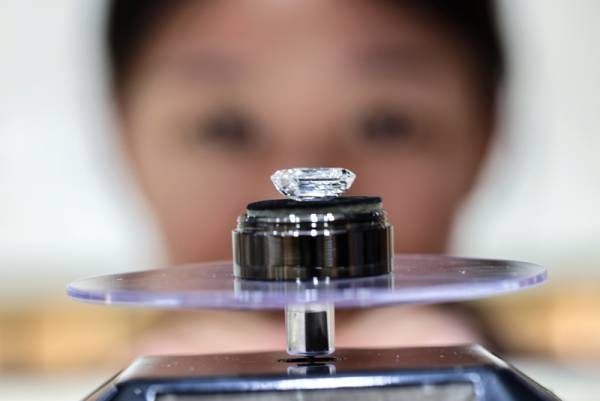
China’s synthetic diamond exports are accelerating, and the significance goes far beyond jewelry. In the first half of 2026, products related to synthetic diamonds worth $194 million were declared for general-trade exports through the Shanghai Diamond Exchange, up 65.3 percent from a year earlier, according to Shanghai customs data. The Shanghai Diamond Exchange, established in 2000, is mainland China’s only designated platform for diamond imports and exports.
The numbers point to a broader transformation. China is no longer simply a major producer of lab-grown diamonds for the jewelry market. It has become the world’s dominant manufacturing base for synthetic diamonds, with Chinese production accounting for more than half of global output by most industry estimates.
That matters because diamonds are no longer merely luxury goods. Their exceptional hardness, thermal conductivity, chemical stability and resistance to extreme environments make them useful in precision cutting, high-power electronics, lasers, advanced thermal management and emerging quantum technologies.
The strategic question is therefore changing. It is no longer simply whether lab-grown diamonds will replace some natural diamonds in jewelry. The more consequential question is whether China’s ability to manufacture diamond materials at industrial scale will give it an advantage in a growing range of advanced technologies.
China’s position did not emerge overnight. The country’s synthetic-diamond industry dates back to the early 1960s, when Chinese scientists developed the country’s first artificial diamond using high-pressure, high-temperature technology. The original motivation was industrial rather than commercial. China needed domestic supplies of ultra-hard materials for cutting, grinding, drilling and other applications at a time when advanced industrial materials were heavily dependent on imports.
That early investment created a technological foundation that would become strategically valuable decades later. Synthetic diamond production requires more than a laboratory breakthrough. It requires high-pressure equipment, specialized reactors, carbon feedstocks, catalysts, power supplies, precision processing, testing capabilities and a large pool of engineers and technicians. Over decades, China built these capabilities through its industrial diamond sector.
Henan became one of the most important centers of this industry. Companies in Zhengzhou, Zhecheng and other parts of the province developed extensive production networks covering equipment, raw materials, diamond powder, industrial diamond, cutting tools and processing.
Lab-grown diamonds emerged from this existing industrial ecosystem. There are two principal production technologies. High-pressure, high-temperature, or HPHT, uses extreme pressure and temperatures to reproduce conditions under which diamond can form. Chemical vapor deposition, or CVD, grows diamond layer by layer from carbon-containing gases in a controlled chamber.
The technologies differ, but they share a critical feature: they turn a material once defined by geological scarcity into something that can be manufactured. That distinction is at the heart of China’s advantage.
Natural diamonds are constrained by geological deposits. Synthetic diamonds are constrained primarily by production capacity, technology, energy and capital. Once a country develops the necessary industrial infrastructure, output can be expanded by adding machines, factories and power.
China has been particularly well positioned to do this because its synthetic-diamond industry is connected to a much larger manufacturing system. The result is a form of industrial concentration that is difficult to reproduce quickly elsewhere. China has not simply developed individual companies capable of producing diamonds. It has developed an ecosystem in which equipment manufacturers, material suppliers, producers, processors, testing institutions and exporters operate in close proximity.
That ecosystem gives Chinese producers two advantages: scale and cost. Scale lowers the cost of equipment utilization and production. Cost competitiveness, in turn, allows Chinese companies to push synthetic diamonds into markets that would have been too expensive when production was small. This dynamic has already transformed the jewelry market.
For consumers, the attraction is straightforward. Lab-grown diamonds have essentially the same chemical composition and crystal structure as natural diamonds, while their production can be completed in weeks rather than geological time. The dramatic expansion of supply has pushed prices down and made diamond jewelry accessible to a much broader group of consumers.
But jewelry may ultimately be the less important part of the story. The more strategically significant opportunity lies in industrial applications. Diamond is an extraordinary material for thermal management. Its thermal conductivity is substantially higher than that of conventional materials such as copper. As semiconductor devices become more powerful and densely packed, managing the heat generated by chips becomes increasingly difficult.
This is particularly important in artificial intelligence. AI accelerators are consuming increasing amounts of power, while the physical space available for cooling systems is limited. As computing density rises, thermal management can become a bottleneck. Diamond-based heat spreaders and other thermal-management technologies are therefore attracting attention as potential solutions for high-performance computing.
The same logic applies to power electronics, high-frequency devices, high-power lasers and advanced radar systems. In these applications, diamonds are not valuable because they look attractive. It is valuable because it performs. That distinction could eventually make synthetic diamond a strategic material rather than simply a consumer product.
The potential applications extend further into quantum technology. High-purity diamonds containing carefully controlled defects, such as nitrogen-vacancy centers, can be used in quantum sensing and precision measurement. Researchers are investigating diamond-based systems for detecting magnetic fields, temperature and other physical parameters with extraordinary sensitivity.
The technological challenge here is very different from producing a jewelry stone. For a diamond ring, size, color, clarity and cut are central. For advanced electronics and quantum applications, purity, crystal quality, defect control and reproducibility matter much more. This is where China’s existing industrial scale could become strategically important.
A country capable of producing large quantities of ordinary synthetic diamonds can use that manufacturing base to move toward increasingly specialized materials. The evolution is from industrial diamond to gemstone-quality diamond, and potentially from gemstone-quality diamond to high-purity functional diamond.
That is a much more important industrial transition than the growth of the jewelry market alone. It also explains why synthetic diamonds should be viewed alongside other critical materials. Much of the current discussion about China’s position in global supply chains focuses on rare earths and other minerals. But advanced manufacturing depends on a much wider range of materials that rarely receive the same attention.
Some are valuable because they are difficult to extract. Others are valuable because they are difficult to manufacture. Synthetic diamond belongs to the second category. Its strategic importance comes not from geological ownership but from manufacturing capability.
This distinction matters in an era of supply-chain competition. If a country controls a large share of global production of a critical material, downstream industries elsewhere may become dependent on that supply even if the material itself represents only a small fraction of the final product’s value.
For the United States and other advanced economies, this creates a familiar dilemma. Building an alternative domestic supply chain is possible, but doing so requires equipment, skilled labor, technical knowledge, capital and customers willing to support the new industry during its early years. The challenge is therefore not simply building a factory. It is rebuilding an ecosystem. That is precisely what China has spent decades doing.
The comparison with rare earths is useful, but it should not be overstated. Synthetic diamonds are not irreplaceable in every application, and a disruption in Chinese supply would not automatically shut down an entire aerospace or defense industry. Alternative materials and production technologies exist, and companies can redesign components when necessary.
But substitution comes with costs. In advanced manufacturing, a material is valuable not merely because it has unique physical properties, but because it performs reliably at scale and can be incorporated into an established production process. Replacing it may require new designs, qualification procedures, equipment and years of testing.
That creates a form of strategic dependence even when technical substitutes exist. The issue is particularly relevant to aerospace and defense. Diamond-based cutting tools are already important in precision machining. Diamond’s thermal and optical properties also make it potentially valuable for high-power electronics, lasers and other systems operating under extreme conditions.
As defense systems become more dependent on high-performance computing, advanced sensors, directed-energy systems and compact power electronics, the demand for materials capable of operating under extreme thermal conditions is likely to increase.
The same trend is visible in civilian technology. AI data centers, electric vehicles, 5G infrastructure and next-generation power electronics all require better thermal management and more efficient materials. A material that can dissipate heat more effectively can increase the performance of an entire system.
This creates an unusual economic dynamic. When the price of a material falls because production becomes more efficient, conventional economics might suggest that its producers should suffer. But cheaper materials can also expand demand. New applications become economically viable, and previously impractical technologies can enter the market.
This is potentially what is happening with synthetic diamonds. The long-term opportunity for China may therefore lie less in selling more diamond jewelry and more in creating an industrial ecosystem around diamond-based technologies. There is also a geopolitical dimension.
India, for example, has traditionally dominated global diamond cutting and polishing. Its industry employs hundreds of thousands of workers and has been built around the processing of natural diamonds. The rapid growth of synthetic diamonds puts pressure on this model.
India has increasingly moved into lab-grown diamonds itself, but the economics are different. China’s enormous production base gives it an advantage upstream, while India’s established expertise remains concentrated in cutting and processing.
This could lead to a restructuring of the global diamond industry. Natural diamonds may increasingly move toward the luxury, heritage and high-end jewelry segments, where scarcity itself remains part of the product. Synthetic diamonds, meanwhile, can occupy mass-market jewelry and industrial applications.
The global value chain could consequently become less about controlling natural diamond deposits and more about controlling manufacturing technology. That would represent a profound change.
For decades, the diamond industry was fundamentally a resource industry. Whoever controlled diamond mines controlled the supply of the raw material. The rise of synthetic diamonds changes that equation. The most important assets are increasingly factories, equipment, engineering expertise, electricity and intellectual property.
China has many of these assets in abundance. That does not mean China will automatically dominate every downstream application. Producing synthetic diamonds is only the first step. Turning them into sophisticated semiconductor components, optical systems or quantum devices requires additional technologies, design capabilities and intellectual property.
China will therefore face its own challenge: moving from being the world’s largest producer of synthetic diamond material to becoming a major developer of products and technologies built around that material.
That transition could determine how much economic value the country ultimately captures. The first stage was production. The second is technological integration. And the third is control over high-value applications. The latest export figures from Shanghai suggest that the first stage is already well advanced. The rapid growth of exports indicates that Chinese synthetic diamonds are moving through global supply chains at increasing speed.
The next question is where they will go. If most of the additional output continues to enter jewelry markets, synthetic diamond will remain primarily an important export industry and a disruptive force in the global diamond business.
But if increasing volumes move into advanced thermal management, high-power electronics, lasers, quantum sensing, aerospace and other high-tech applications, the implications will be much larger.
China would no longer simply be exporting diamonds. It would be exporting the material foundation of technologies that other countries increasingly need. That is why the most important fact about China’s synthetic-diamond industry is not that it can make diamonds faster or cheaper than nature.
It is that China has demonstrated an ability to take a material once defined by extreme scarcity and turn it into something that can be manufactured at industrial scale. In the global competition over advanced manufacturing, that may prove to be the more consequential achievement. The diamond story is therefore shifting from geology to industry, from jewelry to technology, and from scarcity to abundance.
And for China, the strategic prize may not be the diamond itself, but the manufacturing system that makes the diamond increasingly abundant, and potentially makes a growing number of future technologies possible.
Source: guancha, xinhua, shanghai customs gov cn, finance people