


When autonomous driving began moving from laboratories to real-world applications, China made a distinctive choice: instead of putting people in the back seat first, it put freight in the cargo bay.
Across Chinese mines, ports, logistics parks and long-haul highways, autonomous trucks are gradually becoming part of everyday industrial operations. While the United States has focused heavily on robotaxis and autonomous passenger transportation, China has placed considerable emphasis on autonomous heavy-duty trucks. The difference is not simply a matter of technological preference. It reflects the structure of the two countries’ transportation systems, industrial economies, labor markets and regulatory environments.
The logic behind China’s focus on trucks is straightforward. Autonomous driving is ultimately a commercial technology, and its long-term viability depends on whether it can create measurable economic value. Heavy-duty trucks happen to sit at the center of one of China’s largest and most cost-intensive industries: road freight.
China operates one of the world’s largest road freight networks. In 2025, road transportation accounted for 432.88 billion tons of commercial freight, representing more than 70 percent of China’s total commercial freight volume. More than 11 million commercial freight vehicles support this enormous transportation system, moving goods between factories, warehouses, ports, mines and distribution centers. The scale of the market means that even relatively small improvements in fuel consumption, vehicle utilization, driver requirements or transportation efficiency can translate into substantial economic value.
This gives autonomous trucking an advantage that passenger-car autonomy does not always possess. For a consumer vehicle, the economic value of autonomous driving can be difficult to quantify. For a freight company, the calculation is much more direct. How many kilometers does a truck travel each day? How much fuel does it consume? How many drivers are required? How much cargo can it transport? How many hours can the vehicle operate? If autonomous technology can reduce labor intensity, lower energy consumption and increase vehicle utilization, the technology can be translated directly into the operating economics of a fleet.
Long-haul freight is particularly suitable for this transition because its operating environment is relatively structured. Highways have clearly defined lanes, standardized road infrastructure and comparatively predictable traffic patterns. Compared with urban streets, where pedestrians, bicycles, motorcycles, intersections and irregular road behavior create highly complex interactions, highways reduce some of the perception and decision-making challenges faced by autonomous systems.
At the same time, long-haul trucks travel enormous distances. Every vehicle operating on a real route generates data about road conditions, traffic behavior, weather and system performance. That data can then be fed back into algorithms and vehicle design, creating a technological and commercial feedback loop: vehicles enter operation, real-world data accumulates, algorithms improve, costs fall and larger-scale deployment becomes possible.
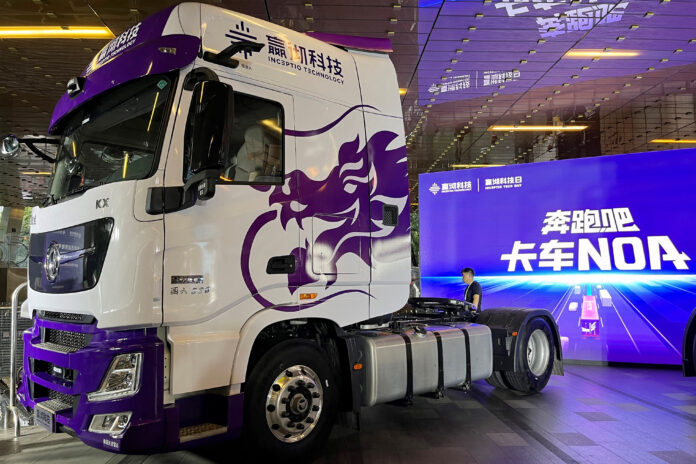
The development of Inceptio Technology illustrates this gradual approach. Founded in 2018, the company positioned itself around the combination of autonomous-driving technology, mass-produced trucks and freight operations. In 2021, it began commercial operations of L3 autonomous trucks, working with major logistics companies and cargo owners. By October 2022, its autonomous trucks had accumulated more than 10 million kilometers in commercial operations, according to the company. Its approach was not to eliminate the driver immediately, but to progressively transfer repetitive and demanding driving tasks from humans to machines.
That distinction is crucial. L3 autonomous driving still requires human supervision and intervention under specified conditions, but it can substantially reduce the physical and cognitive burden placed on drivers during long-distance transportation. The driver becomes less of a conventional full-time operator and increasingly functions as a supervisor of an automated transportation system. In this model, autonomous driving is introduced not as an overnight replacement for human labor, but as a gradual restructuring of the division of labor.
China’s autonomous-driving industry has also found an even more controllable entry point: mines, ports and industrial logistics facilities.
A mining site does not resemble a crowded urban road. Vehicle routes are relatively fixed, operating areas are clearly defined, and loading, transportation and unloading can be coordinated within a controlled system. This makes it possible to deploy higher levels of automation before the technology is ready to handle every unpredictable situation found on public roads.
In Inner Mongolia, for example, large autonomous mining trucks are already being deployed in open-pit coal mines. Some vehicles operate without conventional driver cabins, while autonomous platooning systems can allow one safety operator to supervise several vehicles. These machines can perform loading, driving, obstacle avoidance and unloading with limited or no direct human intervention.
This is where autonomous driving begins to look less like a new automotive feature and more like a new industrial production system.
The convergence of autonomous driving with electrification strengthens this transformation. Electric heavy trucks can reduce energy costs, while autonomous systems can optimize acceleration, braking, following distances and route selection. In controlled industrial environments, electric autonomous trucks can potentially operate continuously according to centrally managed schedules, increasing equipment utilization while reducing dependence on human labor.
China’s industrial structure provides an unusually large number of such application scenarios. The country has enormous ports, mining operations, manufacturing facilities, logistics parks and freight corridors. These environments create a broad range of opportunities for autonomous commercial vehicles to generate economic value before fully autonomous passenger transportation becomes ubiquitous.
Policy has also played an important role in accelerating this process. Chinese authorities have identified intelligent mining and autonomous industrial vehicles as part of broader efforts to improve mine safety and promote industrial digitalization. Policy support, infrastructure investment and local demonstration projects have helped create conditions in which autonomous vehicles can move from technical trials toward commercial operations.
The development of autonomous heavy trucks is therefore increasingly becoming an ecosystem rather than a competition between individual technology companies. Automakers, autonomous-driving developers, battery manufacturers, logistics companies, mining groups and financial institutions are becoming interconnected.
This can be seen in the emerging investment relationships surrounding autonomous trucking. Battery companies have incentives to support electric commercial vehicles, logistics companies need more efficient transportation capacity, mining groups need safer and more automated operations, while autonomous-driving companies need real-world operating environments and large volumes of data. Investment relationships can therefore become a mechanism for integrating supply, technology and demand.
Pony.ai, for instance, has expanded its Robotruck business from long-haul freight into urban distribution. At the 2026 Beijing International Automotive Exhibition, the company presented a fourth-generation L4 autonomous heavy truck based on a battery-electric commercial vehicle platform and announced plans for large-scale deployment. It also introduced an L4 autonomous light truck for urban logistics and announced cooperation with China COSCO Shipping Logistics, reflecting a broader strategy that links long-haul transportation with urban distribution.
The significance of this shift lies in the attempt to build an integrated autonomous freight network rather than simply sell autonomous vehicles. A truck equipped with an autonomous-driving system is still only a vehicle. A commercially viable autonomous freight system requires vehicles, software, cloud-based dispatching, remote assistance, maintenance, insurance, financing, energy infrastructure and logistics customers to work together.
This also explains why China’s autonomous-driving development has followed a relatively gradual path. The transition from L2 driver assistance to L3 conditional automation and eventually to L4 driverless operation is not simply a matter of improving sensors or artificial intelligence. It requires redundant braking and steering systems, reliable computing platforms, functional safety, cybersecurity, remote operations and clearly defined rules for responsibility when something goes wrong.
The gap between a successful demonstration and a scalable business remains significant. Autonomous trucks operating on private industrial roads face a fundamentally different challenge from autonomous vehicles operating freely across cities and provinces. Public-road deployment requires coordination among different jurisdictions, consistent rules for autonomous vehicles, infrastructure compatibility and a legal framework capable of determining responsibility in the event of an accident.
Labor is another issue that cannot be separated from the technological transition. China’s freight industry remains heavily dependent on drivers, many of whom work long hours under physically demanding conditions. Autonomous driving could reduce the most repetitive and exhausting aspects of truck driving, but large-scale automation could also reshape employment across the industry.
The eventual outcome is therefore unlikely to be a simple equation of machines replacing people. A more gradual transformation could see some drivers move into roles involving remote supervision, fleet management, vehicle maintenance, dispatching and operational support. Whether this transition creates sufficient new opportunities, and how workers affected by automation are supported, will be an important test of the social value of the technology.
China’s emphasis on autonomous heavy trucks ultimately reflects a broader industrial calculation. The country has a huge freight market, extensive manufacturing capacity, large-scale mining and port operations, rapidly expanding electric-vehicle supply chains and a growing demand for logistics efficiency. These conditions provide autonomous driving with something every emerging technology needs: a large number of real problems that can be solved for a measurable economic return.
The United States has demonstrated the potential of autonomous passenger transportation through robotaxis, while China is building a different kind of autonomous-driving laboratory on highways, at ports and inside mines. The distinction should not be understood as a simple contest between two national technology strategies. Rather, each approach reflects the economic environments in which autonomous driving is being commercialized.
For China, the heavy truck may prove to be more than another application of artificial intelligence. It could become a bridge between automation, electrification and the restructuring of the logistics industry. As autonomous vehicles move from isolated pilot projects toward larger fleets, the central question will no longer be whether a truck can drive itself. The more consequential question will be whether an entire freight network can operate around autonomous vehicles.
If that transition succeeds, the significance of autonomous trucking will extend well beyond the truck itself. It will represent a shift in how freight is organized, how industrial labor is allocated, how energy is consumed and how transportation assets are managed. China’s autonomous-driving revolution may therefore begin not with the passenger sitting in the back seat of a robotaxi, but with the cargo moving silently through a mine, across a port or along a highway.
Source: xinhuanet, tech gmw, sohu, tech cnr