


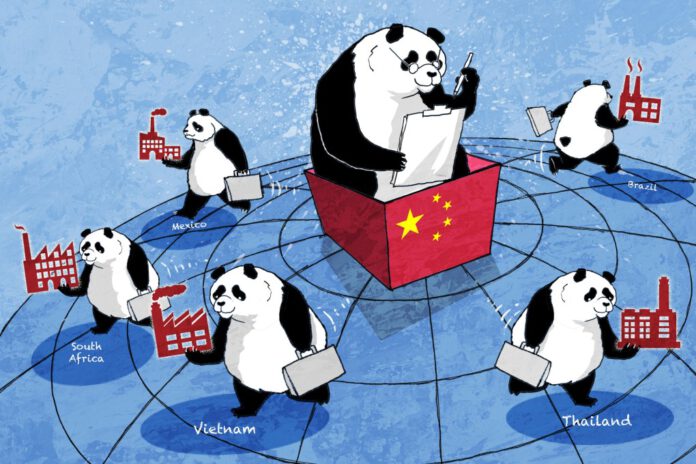
For much of the past decade, Southeast Asia has been the obvious destination whenever Chinese manufacturers talk about going global. Vietnam has absorbed electronics production, Thailand has attracted automotive supply chains, Malaysia has moved further into semiconductors, and Indonesia has leveraged its nickel resources to build a position in electric vehicles and batteries.
But if the horizon is extended from the next two or three years to the next decade, a more important question is emerging: once Southeast Asia becomes the consensus destination, where does Chinese manufacturing go next?
The answer may not be another country offering cheaper labor. The global manufacturing map is being reshaped by forces far more complicated than production costs. Companies are increasingly deciding where to manufacture based on proximity to customers, tariffs, supply-chain resilience, energy, critical minerals, industrial policy and geopolitical risk.
Globalization is not disappearing. Its logic is changing. UNCTAD’s World Investment Report 2026 shows that global foreign direct investment rose 6% in 2025 to around $1.6 trillion, but investment became increasingly concentrated in strategic sectors and destinations. Artificial-intelligence infrastructure, semiconductors, critical minerals and energy-transition industries accounted for a growing share of new investment. The share of global greenfield investment value going into strategic sectors rose from 16% in 2020 to 44% in 2025.
The implication for Chinese manufacturers is profound. The old model was relatively simple: produce in China, export to the world. The emerging model is more distributed: keep R&D, core technologies, critical components and much of the supply chain in China, while establishing production, sales, logistics, service and eventually selected R&D capabilities closer to customers overseas.
China already has the scale to build such a network. Chinese outbound direct investment reached about $192 billion in 2024, while Chinese investors had established more than 52,000 overseas enterprises across 190 countries and regions by the end of that year. In 2025, China’s non-financial outbound direct investment reached roughly $146 billion, with investment in Africa rising 41% and investment in Europe increasing 20.9%.
This means Chinese manufacturing’s next chapter cannot be reduced to a “Southeast Asia story”. It is becoming a global network story. India is perhaps the clearest example of why.
Its importance lies not simply in its population, but in the combination of a huge consumer market, relatively rapid economic growth and increasing manufacturing localization. The World Bank expects India’s economy to grow by around 6.6% in 2026 and 7.2% in 2027. For automakers, electronics companies, appliance manufacturers and industrial-equipment producers, the question is increasingly not whether Indian consumers will buy their products, but whether a market of this scale can be served indefinitely from factories elsewhere.
That makes India different from a conventional “China plus one” destination. Companies are not necessarily going there to reproduce Chinese manufacturing at lower cost. They are going there to build manufacturing capacity for one of the world’s largest future markets.
The opportunity, however, comes with complexity. Infrastructure, supplier depth, land, regulation and differences among Indian states can all affect the economics of an investment. India’s value is therefore enormous, but it is not synonymous with simplicity. Mexico represents a completely different logic.
Its economic growth may be modest, but foreign investment continues to flow in because geography itself has become an industrial asset. Mexico attracted a record $40.87 billion in foreign direct investment in 2025. Its proximity to the United States and integration with North American supply chains make it particularly attractive to automotive, appliance and industrial-equipment companies.
The value of manufacturing in Mexico is therefore not simply lower labor costs. It is shorter supply chains and closer access to customers. But Mexico also demonstrates why geopolitics is becoming part of the manufacturing cost structure. Tariffs, rules of origin and changing trade policies toward Chinese imports can affect the economics of a factory as much as wages or logistics. Building in Mexico no longer automatically guarantees easier access to the US market.
Europe presents another model. Hungary, with fewer than 10 million people, would not normally appear on a list of major consumer markets. Yet it has become an important destination for Chinese investment in Europe, particularly in electric vehicles and batteries. Chinese companies are attracted not by Hungary’s domestic market alone, but by its position inside Europe’s industrial system.
The lesson is important: a country’s value is not necessarily determined by how many consumers it has. It can also depend on how many consumers, suppliers and industrial clusters it connects.
Brazil offers yet another model. Unlike Mexico, whose strategic value is closely tied to North America, Brazil is valuable primarily because of its own market. With more than 200 million people, substantial agricultural and mineral resources and a significant industrial base, Brazil can support long-term localization in sectors ranging from electric vehicles and agricultural machinery to power equipment and consumer goods.
For Chinese companies, Brazil is therefore less a production bridge to another market than a market that must be served locally. That comes with familiar challenges: taxation, bureaucracy, logistics and currency volatility. But companies willing to build for the long term may find a very different proposition from the low-cost manufacturing model of Southeast Asia.
The Middle East adds another dimension. Saudi Arabia is not attractive because of cheap labor. Its proposition is capital, energy, industrial policy and strategic geography. Under Vision 2030, the kingdom is attempting to convert its energy and financial resources into new manufacturing and logistics capabilities. For Chinese companies, opportunities increasingly extend beyond construction and exports into electric vehicles, batteries, power equipment, logistics, data infrastructure and industrial machinery.
Egypt, meanwhile, occupies a different strategic position. Its large population, Suez Canal and location between Europe, Africa and the Middle East give it the potential to become a regional manufacturing hub. Chinese companies are already investing in industrial zones around the canal, suggesting that production in Egypt may increasingly serve not just Egyptian consumers but markets across three regions. Then there is Africa, whose importance is difficult to capture through today’s GDP figures alone.
The continent’s greatest strategic asset may be its future population and consumption growth. Chinese investment in Africa is already accelerating, with non-financial direct investment rising 41% in 2025. The next stage may extend beyond infrastructure projects into industrial parks, local processing, manufacturing and eventually consumer markets.
Africa, however, is not one market. Egypt, Morocco, South Africa, Kenya, Nigeria and Ethiopia represent very different combinations of infrastructure, labor, resources, institutions and market access. The opportunity is long term, but so are the risks.
Taken together, these markets reveal a fundamental shift. Chinese manufacturers are not searching for the “next Vietnam”. They are building different kinds of nodes for a global production network.
India offers market scale. Mexico offers proximity to North America. Hungary offers access to European industrial supply chains. Brazil offers a large domestic market. Saudi Arabia offers capital, energy and state-led industrial development. Egypt offers geographic connectivity. Africa offers long-term demographic potential.
The most difficult part of this transformation, however, is not choosing locations. It is becoming genuinely local. A factory can be built in a few years. A local management team, supplier ecosystem, labor culture and regulatory capability take much longer. Chinese companies operating in the United States, India, Europe, Mexico or Africa face different labor systems, regulations, consumer expectations and social environments. Simply copying a Chinese factory abroad is therefore unlikely to be enough.
The next stage of Chinese globalization will not be about abandoning China. It will be about reorganizing what China has built. Core R&D, engineering capabilities, key components and sophisticated supply chains can remain deeply connected to China, while production and customer-facing functions become increasingly distributed across regional markets.
That is why Southeast Asia is only the first stop. The real destination is not another “world factory”, but a global manufacturing network in which different countries perform different functions.
For Chinese manufacturing, the next decade may therefore be less about moving factories and more about redesigning the architecture of globalization itself. The companies that succeed will not necessarily be those that build the most overseas factories, but those that learn how to connect Chinese technological and manufacturing capabilities with local markets, local institutions and local organizations around the world.
The map of Chinese manufacturing is no longer being redrawn around one country. It is being redrawn around a network.
Source: people cn, scio gov cn, xinhua, weforum, scmp