


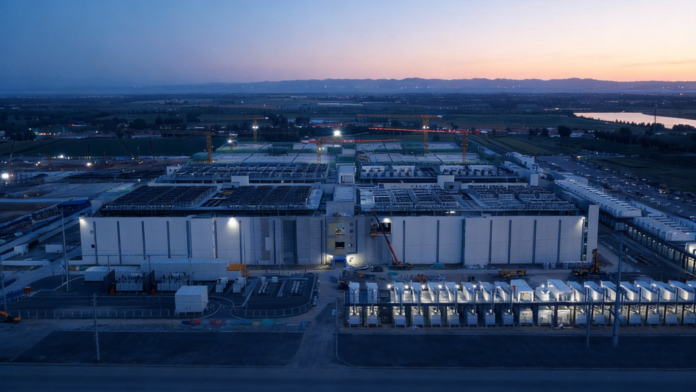
As artificial intelligence enters the era of large-scale models, computing power is emerging as a new form of industrial infrastructure, alongside land, capital and energy. The geography of computing is changing with it. The most important question is no longer simply where data centers can be built, but where abundant electricity, computing capacity, networks, data and industrial demand can converge.
In this transformation, Ulanqab, a city in northern China’s Inner Mongolia Autonomous Region, offers an increasingly important case study.
Once better known for agriculture and animal husbandry, Ulanqab has spent more than a decade building a digital economy from the ground up. By 2026, more than 100 data-center projects had been established across the city, with operational computing capacity reaching 172,000 PetaFLOPS, up 112 percent year on year. More than 95 percent of that capacity is intelligent computing. In the first half of 2026, fixed-asset investment in the computing industry rose 38.1 percent, while electricity consumption surged 89.52 percent.
These numbers point to something larger than a boom in data centers. Ulanqab is attempting to turn its natural resources into a new industrial production system: wind and sunlight into electricity, electricity into computing power, and computing power into the digital products of the AI economy.
The foundation of that transformation is energy. The rise of generative AI has fundamentally changed the economics of data centers. Traditional facilities require reliable electricity, but large AI training and inference clusters demand far greater power density. They also place new requirements on cooling, grid stability, storage and power management. As AI computing expands, electricity is no longer merely an operating cost. It is becoming a strategic advantage.
Ulanqab happens to have an unusual combination of conditions. Its renewable-energy capacity has surpassed 20 million kilowatts, while green electricity accounts for roughly 67 percent of the city’s power supply. Its cool climate reduces cooling requirements, and its proximity to Beijing and the wider Beijing-Tianjin-Hebei region gives it a relatively strong network position for serving eastern China.
More importantly, Ulanqab is experimenting with a deeper integration of electricity and computing. Projects combining renewable generation, grids, energy storage and computing loads are designed to allow power consumption to respond more intelligently to fluctuations in wind and solar generation. The goal is not simply to supply data centers with green electricity, but to make computing infrastructure part of the energy system itself.
The significance of this shift is easy to underestimate. In the traditional data-center model, electricity is an input purchased by the operator. In the emerging AI infrastructure model, the ability to generate, transmit, store and intelligently manage electricity may become part of the computing platform itself.
Ulanqab is therefore trying to build an economic chain that extends well beyond the server rack. Companies including Huawei, Alibaba, ByteDance, Baidu, China Mobile-linked operators and major data-center companies such as GDS and VNET have established a presence in the region. The resulting ecosystem increasingly covers data centers, intelligent computing, cloud services, data processing, AI applications, equipment manufacturing and operations.
Data annotation provides an example of how seemingly peripheral activities can become part of this ecosystem. Raw information must be cleaned, classified and labeled before it can be used effectively to train AI models. Companies such as Wisdom Reach have built data-processing operations in Ulanqab, turning large volumes of unstructured information into machine-readable training material while creating new employment opportunities locally.
The more consequential question, however, is what happens after computing power has been built.
For years, the value of a data center was measured largely in racks, servers, power capacity and computing performance. The rise of large language models introduces another unit of economic activity: the token.
Tokens are the basic units through which many AI models process language and other forms of information. Training and running increasingly powerful models can therefore generate enormous volumes of token-based computation. Ulanqab’s proposed “Token Capital” strategy is an attempt to move beyond the traditional business of renting computing capacity and toward capturing more of the value created by that computing power.
Its development strategy can be summarized as a progression from “Grassland Cloud Valley” to “Intelligent Computing City” and ultimately to “Token Capital.” The first stage established the data-center infrastructure; the second built large-scale intelligent computing capacity; the third seeks to connect that capacity with AI models, applications and digital value creation. In this sense, the idea of a “Token Capital” is less about creating a new physical commodity than about repositioning the city within the AI value chain.
The August 2026 launch of Envision Galaxy Base illustrates how ambitious that transition has become. The facility covers roughly 120,000 square meters and is designed for parallel deployment of up to one million AI accelerators, with computing capacity measured at the million-PetaFLOPS scale. Its broader campus is planned to exceed 2 gigawatts.
The project represents a shift from conventional data-center construction toward what could be described as an AI computing factory: a highly concentrated combination of chips, power, cooling, networking and renewable energy designed specifically for large-scale model training and inference.
Yet the most important story is not the record-setting scale of any individual project. It is the emergence of an integrated regional model. At the top of the chain are wind and solar resources. In the middle are power systems, data centers and intelligent-computing clusters. Further downstream are data processing, cloud services, AI applications, equipment manufacturing, maintenance and recycling. Universities and vocational institutions are also expanding programs in artificial intelligence, cloud computing and data-center operations to supply the workforce required by the new industry.
The result is an ecosystem in which computing is no longer an isolated infrastructure business. It is becoming an industrial platform. But scale alone will not determine whether Ulanqab succeeds.
The city still faces significant challenges: grid capacity, network connectivity, domestic chip supply, cooling technology, investment returns, utilization rates and the availability of highly skilled AI talent. Announced capacity and planned investment are not the same as operational capacity, and the conversion of computing infrastructure into sustainable economic value will depend ultimately on real demand from AI companies and applications.
This distinction will become increasingly important as AI infrastructure investment accelerates. Building more computing capacity is relatively straightforward when capital and land are available. Making every unit of electricity, every accelerator and every unit of computing time generate sufficient economic value is much harder.
For Ulanqab, the next stage is therefore not simply about building larger data centers or accumulating more PetaFLOPS. It is about increasing the value density of every kilowatt-hour, every chip and every token produced. That is what makes Ulanqab significant beyond Inner Mongolia.
For much of the industrial era, factories followed markets, ports and population centers. Digital infrastructure is beginning to reverse that logic. As AI systems become increasingly energy-intensive, some parts of the digital economy may increasingly follow electricity, land, climate and network infrastructure instead.
On the grasslands of northern China, wind turns turbines into electricity. Electricity powers chips. Chips train models. Models generate tokens. Those models are then applied to autonomous driving, computer vision, industrial design, scientific research and thousands of other applications.
A new industrial chain is taking shape. Whether Ulanqab ultimately becomes a genuine “Token Capital” will depend not on how many data centers it builds, but on whether it can convert its natural-resource advantage into technological capability, industrial depth and sustained value creation.
That is the larger question now unfolding on the grasslands of Inner Mongolia, and one that may offer an early glimpse of how the geography of the global AI economy is beginning to change.
Source: stdaily, nmgwx, wulanchabu gov, xinhuanet, tencent