


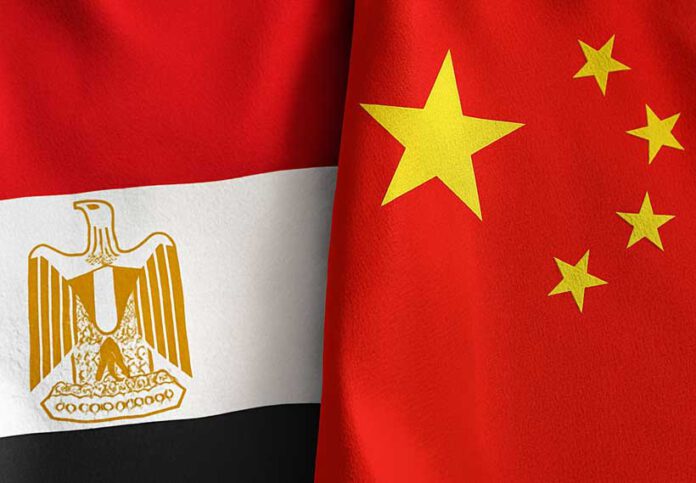
As the first Arab and African country to establish diplomatic relations with the People’s Republic of China, Egypt’s story with China has long gone beyond diplomatic rhetoric. At this important juncture, as the two countries look to build on the past while opening a new chapter, their partnership is gaining new possibilities.
Zhao Jun, Associate Professor at the Institute of Middle East Studies at Shanghai International Studies University, has conducted extensive field research in Egypt and followed China-Egypt relations and China-Arab cooperation for many years. Zhao offers a systematic assessment from his own perspective, providing a grounded and pragmatic lens through which to understand the direction and prospects of China-Egypt relations in the new era.
2026 marks the 70th anniversary of diplomatic relations between China and Egypt, the first Arab and African country to establish diplomatic ties with the People’s Republic of China; how would you characterize the evolution of bilateral relations and their current historical position?
The evolution of China-Egypt relations over the past 70 years can broadly be divided into four stages: political consolidation from 1956 through the 1970s; institutionalized cooperation from the 1980s to the late 1990s; strategic and pragmatic expansion from 2000 to around 2013; and comprehensive strategic partnership since 2014.
Two dates are particularly significant. 1956 established the foundation of political trust, while 2014, when the two countries elevated their relationship to a comprehensive strategic partnership, marked a qualitative transformation. Over the past decade, cooperation has expanded from diplomacy and political support to infrastructure, industrial parks, energy, automobiles, digital economy and artificial intelligence.
The deeper transformation, however, lies in the changing nature of the relationship. It has moved from political solidarity to strategic cooperation and increasingly toward a broader vision of shared development and a community with a shared future. The TEDA Suez Economic and Trade Cooperation Zone and other major projects have translated political trust into industrial and economic cooperation.
Today, China-Egypt relations have acquired significance beyond the bilateral level. Egypt simultaneously belongs to the Arab, African, Middle Eastern, Mediterranean and Red Sea geopolitical spaces, while China is a major developing country and an important member of the Global South. Their cooperation therefore naturally intersects with China-Arab, China-Africa and broader Global South cooperation.
In this sense, the 70th anniversary should not be viewed merely as a commemorative milestone. It marks a transition from historical friendship toward a future-oriented partnership centered on modernization, Global South cooperation and a community with a shared future.
What have been the most significant achievements and structural constraints in the alignment of China’s and Egypt’s development strategies over the past decade?
The most significant achievement has been the transition from strategic convergence to project implementation and increasingly to industrial integration. Since the establishment of the comprehensive strategic partnership in 2014, the Belt and Road Initiative has been closely aligned with Egypt’s Vision 2030, producing projects such as the TEDA zone, the Central Business District in the New Administrative Capital, the Ramadan 10th of Ramadan railway and Egypt’s satellite program.
More importantly, cooperation is moving beyond construction and contracting toward localized manufacturing, supply chains and industrial capacity. Chinese investment in new energy, automobiles, home appliances, building materials and textiles is helping Egypt convert its geographic advantages around the Suez Canal into manufacturing and export capacity.
The experience suggests three important principles: strategic alignment provides long-term stability; industrial parks create clustering effects; and localization determines sustainability. The objective is not simply to transfer Chinese manufacturing capacity to Egypt, but to combine Chinese capital, technology and management with Egypt’s market, geography and resources to create mutually reinforcing industrial ecosystems.
The constraints have also changed. The central question is no longer whether there are projects, but whether those projects can generate sustainable economic returns. Egypt’s macroeconomic pressures, financing costs and foreign-exchange constraints have affected investment expectations. The next phase therefore requires deeper integration of trade, investment, industry, technology and human capital.
Can China’s zero-tariff policy for African countries significantly reshape the long-standing trade imbalance between China and Egypt?
The trade imbalance is a real issue, but it should not be reduced to a simple question of China exporting too much and Egypt exporting too little. The structure of trade matters as much as its aggregate value. A significant share of China’s exports to Egypt consists of intermediate goods that enter Egyptian manufacturing and can subsequently contribute to exports to third markets.
The zero-tariff policy creates an important institutional opportunity for Egypt to expand exports to the Chinese market, and the initial increase in Egyptian exports suggests that the policy is already producing effects. But tariffs are only one component of export competitiveness.
Whether the trade structure changes fundamentally will depend on Egypt’s ability to improve product quality, supply capacity, logistics, branding and knowledge of the Chinese market. Zero tariffs can accelerate export growth, but they cannot by themselves eliminate a structural trade deficit.
Ultimately, trade rebalancing requires industrial rebalancing. The key is to turn improved market access into durable industrial competitiveness.
As artificial intelligence, data centers and other emerging technologies enter the bilateral agenda, how should we understand the growing role of technology competition in China-Egypt relations?
Artificial intelligence is emerging as an important new area of China-Egypt cooperation, but its significance goes beyond individual commercial projects. AI chips, computing infrastructure, cloud services and data centers have strategic implications, placing technological cooperation within a broader environment of US-China technology competition.
It would nevertheless be misleading to portray Egypt simply as a “front line” of that competition. Egypt has traditionally pursued strategic autonomy and diversified external partnerships. Its primary objective is to secure technology, investment and digital capabilities from multiple sources rather than choose exclusively between China and the United States.
Egypt’s strategic significance derives from its population, geographic position and dual role in the Arab and African worlds. If it can use multiple sources of technology to build an open yet increasingly capable digital ecosystem, it could become an important node in the digital transformation of the Global South.
The real significance of China-Egypt AI cooperation therefore lies not in whether a particular data-center project is awarded to one company or another, but in whether the two sides can develop longer-term cooperation in joint research, talent development, industrial applications and digital governance, while addressing data sovereignty, cybersecurity and technological transparency.
How will Egypt’s strategic autonomy and balancing diplomacy affect China-Egypt relations amid intensifying regional polarization and major-power competition?
Egypt’s balancing diplomacy is essentially a form of strategic autonomy centered on national interests and the preservation of policy flexibility among competing powers. Rather than being a source of uncertainty for China-Egypt relations, this autonomy can provide an important foundation for their long-term development.
Egypt maintains relationships with China, the United States, Russia, Europe and the Gulf states. Its strategic value therefore lies not only in its domestic market but also in its ability to connect different regional and international networks.
China does not require an Egypt that is forced to choose sides; it benefits from an Egypt capable of making autonomous decisions and expanding its room for cooperation. As bilateral cooperation moves further into strategic sectors such as AI, digital infrastructure, renewable energy and advanced manufacturing, respecting Egypt’s foreign-policy autonomy will become increasingly important.
The likely trajectory is therefore not formal alignment, but overlapping interests, diversified partnerships and greater strategic coordination.
What does the deepening of China-Egypt military cooperation, including the “Eagles of Civilization” joint air exercises, mean for regional security?
China-Egypt military cooperation should be understood within the context of their long-standing strategic trust and Egypt’s tradition of maintaining diversified defense partnerships, rather than simply as evidence of geopolitical alignment.
The “Eagles of Civilization” exercises have evolved from personnel exchanges toward more systematic and increasingly realistic training, indicating deeper military confidence and operational cooperation. For China, this represents conventional defense cooperation; for Egypt, it provides an additional channel for enhancing military capabilities while preserving strategic flexibility.
Its regional significance lies primarily in the diversification of security cooperation rather than the formation of a new military bloc. Expanding cooperation into counterterrorism, maritime security, search and rescue, peacekeeping and disaster response could further strengthen its contribution to regional public security.
As Egypt increasingly serves as a link between China, the Middle East and Africa, how should its role as a “strategic hub” be distinguished from that of a traditional ally or partner?
I would describe Egypt more precisely as a strategically significant hub partner, rather than an agent or proxy. Egypt connects Africa and Asia and links the Red Sea, Mediterranean and Suez Canal, while simultaneously occupying important positions in both Arab and African affairs. This gives China-Egypt cooperation a naturally broad regional spillover effect.
Over the past decade, China has effectively developed a form of “hub-oriented” engagement with Egypt, extending bilateral cooperation toward China-Arab, China-Africa and third-party markets. This is less about geopolitical control than about using Egypt’s geographic and institutional position to connect different cooperation networks.
A strategic hub differs from an ally in that an alliance emphasizes security commitments and bloc politics; a partnership emphasizes equality and mutual benefit; a hub emphasizes connectivity and network value. Egypt does not need to choose between China and the United States for its position to have strategic significance.
What role does the China-Egypt relationship play in China’s broader engagement with the Arab League, and which elements of the bilateral experience are transferable to other Arab countries?
China-Egypt relations have significance for China-Arab cooperation in three respects: they demonstrate how political trust, development cooperation and cultural exchange can reinforce one another; Egypt provides an important institutional platform for China-Arab engagement; and bilateral strategic alignment offers mechanisms that can inform cooperation with other Arab states.
However, the Egyptian experience cannot simply be replicated. What can be transferred are mechanisms rather than models. Arab countries differ significantly in resource endowments, population size, industrial structures and development stages.
For Gulf states, cooperation may focus more heavily on energy transition, AI and finance; for other Arab countries, infrastructure, manufacturing and energy may be more relevant. The broader principles are therefore straightforward: mutual political respect, strategic alignment of development priorities and country-specific cooperation.
Source: guancha, moderndiplomacy