


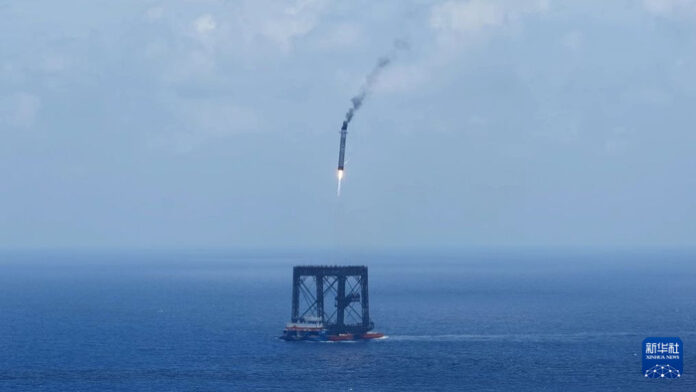
On July 10, 2026, China’s Long March 10B rocket completed a maritime net-based recovery of its first-stage booster at the Hainan Commercial Space Launch Site, marking a major breakthrough in reusable launch technology. As China expands its satellite internet infrastructure and advances reusable rockets, commercial space is moving toward large-scale deployment, creating new opportunities for regions with established aerospace and advanced manufacturing industries.
Northeast China’s Liaoning, Jilin and Heilongjiang provinces have a strong industrial foundation, from aircraft engines and precision components to satellite manufacturing and aerospace research. Their challenge is to turn these established strengths into a competitive commercial space industry.
The three provinces have complementary advantages. Jilin has developed commercial satellite manufacturing and remote-sensing applications; Heilongjiang offers strong research capabilities in spacecraft engineering, control systems and advanced equipment; and Liaoning combines an established aerospace manufacturing base with shipbuilding, marine engineering and port infrastructure. Together, these capabilities could support an integrated regional industry spanning research, manufacturing, launch services and satellite applications.
Jilin is already a significant player in commercial satellite production. Chang Guang Satellite Technology, developer of the Jilin-1 remote-sensing constellation, had completed 30 launch missions and placed 161 satellites in orbit as of July 10, 2026. Its business spans satellite development, manufacturing, in-orbit operations and remote-sensing data services.
The company’s growth reflects a broader shift toward industrialized satellite production, which can reduce manufacturing costs and support larger constellations. Changchun’s optoelectronics industry also provides a foundation for developing suppliers of optical components, electronic systems and related technologies.
The next challenge for Jilin is to connect satellite manufacturing more closely with launch services and downstream demand. Commercial success depends not only on building satellites, but also on deploying them efficiently and converting the resulting data into services for agriculture, forestry, resource monitoring and emergency management.
Heilongjiang’s strengths lie in research and engineering. Harbin Institute of Technology has expertise in spacecraft design, materials, control systems and space communications, while Harbin Engineering University contributes capabilities in shipbuilding and marine engineering.
These capabilities are relevant to the growing demand for launch support systems, tracking and communications equipment, spacecraft testing and maritime operations. The successful launch of the Dongfang Hengyuan, a maritime aerospace launch command and tracking vessel designed and built by Harbin Engineering University, highlights Heilongjiang’s potential contribution to China’s offshore launch infrastructure.
Liaoning, meanwhile, has a long history in aircraft manufacturing and propulsion technology. Shenyang hosts major aerospace enterprises and research institutions, including Shenyang Aircraft Corporation and AECC Shenyang Liming Aero-Engine. The province’s manufacturing expertise can support the production of precision structures, propulsion-related components and other aerospace equipment.
Its shipbuilding and marine engineering industries also create opportunities beyond conventional aircraft manufacturing. These capabilities could be applied to rocket transport vessels, offshore launch platforms and associated support systems, allowing Liaoning to enter commercial space by building on its existing industrial base.
A key development is the proposed commercial offshore rocket launch base in Dandong.
Liaoning’s marine economy development plan for the 15th Five-Year Plan period, released in late June 2026, calls for planning a commercial offshore launch base and developing supporting industries covering rocket assembly, maritime launches, satellite applications, tracking and communications.
Dandong’s government has also identified cooperation with Orienspace as a commercial space priority. Located on Liaoning’s eastern coast, the city has port infrastructure, transportation links and an established equipment manufacturing base. Local companies have experience in specialized inspection technologies, including nondestructive testing services for major aerospace projects.
If approved and built, the launch base could give Dandong a new role in China’s commercial space industry while creating demand for equipment manufacturing, testing, logistics and marine engineering.
However, a launch facility alone cannot guarantee industrial success. Its long-term viability will depend on securing regular launch missions, attracting rocket manufacturers and developing a supply chain that includes assembly, testing, component production and operational support.
Shandong’s Oriental Spaceport in Haiyang offers a useful comparison. By linking port facilities with industrial parks, Haiyang has developed an ecosystem supporting rocket transportation, offshore launches, manufacturing and related services. Its experience shows that a successful launch hub requires close coordination between infrastructure, industrial suppliers and commercial operators.
Dandong has already studied Haiyang’s model and engaged with commercial rocket companies. Yet simply replicating an established launch center would be difficult. The proposed project must still address regulatory approvals, technical assessments, launch safety, maritime coordination and long-term demand.
Rather than attempting to duplicate Haiyang, Dandong could focus on areas where Liaoning has distinct advantages, particularly maritime engineering, launch support and specialized equipment manufacturing.
The broader opportunity lies in connecting Dandong with the industrial capabilities of the other northeastern provinces. Changchun could supply satellites and remote-sensing technologies; Harbin could contribute spacecraft research, testing and tracking systems; and Shenyang could provide precision components and aerospace manufacturing. Dandong could serve as a maritime launch and logistics hub.
Such cooperation would allow the three provinces to build on their existing strengths rather than develop competing industrial clusters independently. It would also help link research and development with manufacturing, launch operations and commercial applications.
Capital and talent remain important constraints. Commercial space requires substantial upfront investment, lengthy product validation and sustained financing. Although Northeast China has strong universities and research institutes, it faces challenges in attracting venture capital and retaining highly skilled personnel.
Cross-provincial investment funds, university-industry partnerships and stronger technology commercialization mechanisms could help address these gaps. Investment should prioritize companies with competitive technologies, identifiable customers and realistic commercial prospects.
Commercial space could also help upgrade the region’s traditional manufacturing industries. Aerospace production demands high precision, reliability and advanced materials, creating opportunities for existing manufacturers to move into higher-value products and services.
For Northeast China, the goal should not be to develop every segment of the commercial space industry independently. Instead, the three provinces need to identify their most competitive roles, coordinate investment and build supply-chain relationships that generate sustained commercial demand.
Jilin’s satellite manufacturing, Heilongjiang’s research capabilities and Liaoning’s aerospace and marine engineering industries provide a foundation for such a strategy. Dandong’s proposed offshore launch base could become a link between them, provided the project progresses beyond infrastructure planning to attract operators, secure launch missions and develop supporting industries.
The region’s success will ultimately depend on whether it can turn its industrial legacy into an integrated commercial space ecosystem—one that connects research, manufacturing, launch services and satellite applications to create a new source of growth for Northeast China.
Source: 21jingji, hlj gov cn, xinhua, shenyang gov cn, sina finance