


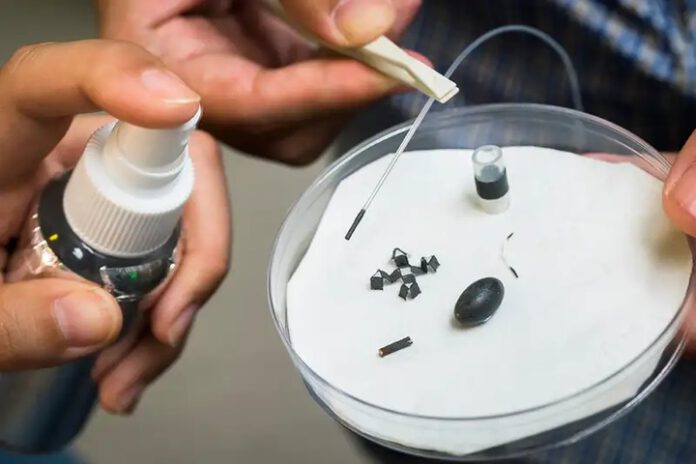
When people think of robots, they usually imagine rigid metal bodies, mechanical joints, precision motors, and sophisticated electronic components. From industrial robotic arms to humanoid machines capable of walking and running, most conventional robots rely on fixed structures to achieve stability, strength, and precise movement.
But a new generation of robots is challenging that traditional image. Instead of having a rigid body, these machines can stretch, flow, deform, and even reconnect after being separated. They resemble sticky slime more than conventional machinery, yet they can navigate narrow gaps, wrap around objects, and move under the influence of an external magnetic field.
Researchers call this unusual creation a magnetic slime robot, a technology that has drawn comparisons to the shape-shifting symbiote Venom from science fiction. Although these robots are still far from possessing the extraordinary abilities depicted in movies, their real-world capabilities are opening up promising new directions in robotics, materials science, and biomedical engineering.
China is playing an increasingly important role in this emerging field. Research teams from institutions including The Chinese University of Hong Kong, Harbin Institute of Technology, and the Shenzhen Institutes of Advanced Technology of the Chinese Academy of Sciences have explored different ways to use magnetic materials and soft robotic systems to address practical engineering and medical challenges.
Their work reflects a broader trend in Chinese scientific research: the rapid development of technologies that combine advanced materials, intelligent control, precision engineering, and biomedical applications.
Traditional robots are designed around a fundamental trade-off between strength, stability, and flexibility. Rigid structures can withstand substantial loads and execute precise movements, but they often struggle when the surrounding environment becomes narrow, irregular, or difficult to navigate. A robot that performs exceptionally well on an open factory floor may become ineffective when required to pass through a tiny opening or move inside a winding tube.
The problem becomes even more pronounced as robots shrink in size. Miniature robots have limited space for batteries, motors, sensors, and control electronics. As a result, reducing a robot’s dimensions often comes at the expense of its operating time and functional capabilities. At the millimeter scale, the power supply itself can occupy a substantial portion of the available space.
Magnetic slime robots approach this problem from a different direction. Rather than relying entirely on onboard motors and batteries, they can be manipulated by magnetic fields generated externally. This arrangement reduces the need to accommodate conventional drive systems inside the robot’s body and allows the material to change shape without relying on rigid mechanical joints.
In 2022, researchers from The Chinese University of Hong Kong and Harbin Institute of Technology jointly developed a magnetic slime robot that demonstrated unusual deformation and movement capabilities. The research offered an alternative approach to robotic design, showing how a soft, magnetically responsive material could perform tasks that would be difficult for a conventional rigid machine.
The material itself is relatively straightforward. Early versions combined polyvinyl alcohol, borax, and magnetic particles. Polyvinyl alcohol forms the polymer matrix, while borax helps create cross-links within the material. These interactions give the resulting substance its characteristic combination of elasticity, viscosity, and deformability. Magnetic particles allow it to respond to external magnetic fields.
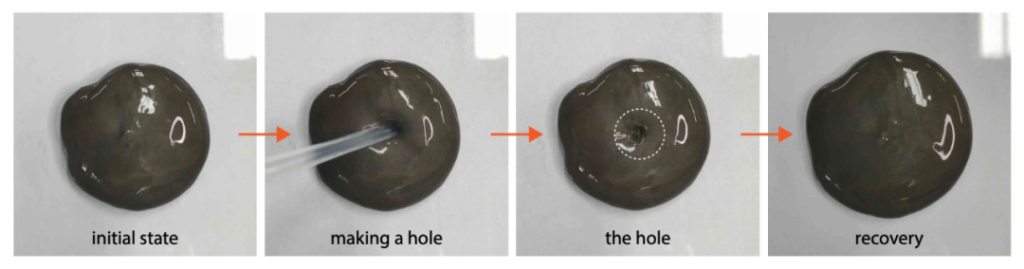
The result is a material that behaves differently from both ordinary liquids and rigid solids. It can stretch and flow under suitable conditions while retaining enough cohesion to maintain its overall structure. Depending on its composition and the forces applied, it can also recover its shape or reconnect after being separated.
Its behavior has similarities to that of certain non-Newtonian and viscoelastic materials, although the precise mechanical properties depend on the formulation and experimental conditions. Not every magnetic slime behaves identically, and its ability to recover or reconnect should not be confused with the unlimited self-healing ability of fictional liquid organisms.
One of its most striking features is its ability to change shape under magnetic control. By adjusting the direction, strength, spatial distribution, and movement of an external magnetic field, researchers can influence the material’s motion and deformation.
The basic principle resembles using a magnet to move an iron object from a distance, but controlling a soft material requires considerably greater precision. The magnetic forces must be coordinated with the material’s viscosity, elasticity, dimensions, and surrounding environment.
In laboratory demonstrations, researchers showed that magnetic slime could pass through gaps approximately 1.5 millimeters wide, navigate curved tubes around 5 millimeters in diameter, and move through mazes and over uneven surfaces. Experiments also demonstrated movement across different materials, including metal, plastic, and glass.
For conventional robots, a narrow passage may require a complete redesign of the machine or the use of specialized folding mechanisms. A magnetic slime robot, by contrast, can exploit its own flexibility to adapt to the available space.
This capability is more than a scientific curiosity. It suggests a different way to approach environments where conventional mechanical structures encounter physical limitations.
The material can also perform wrapping and grasping tasks. Traditional robotic grippers typically rely on mechanical fingers or other rigid components to hold objects. Soft materials can instead change their shape to conform to an object’s contours, potentially allowing them to handle irregular or delicate targets.
Under magnetic guidance, the slime can extend toward an object and curl around it. If the material is sufficiently large, it can even envelop several small objects at once, gathering them together for transport.
Such a strategy could eventually prove useful in precision manufacturing, where fragile components must be moved without excessive pressure, or in confined equipment where conventional tools cannot easily reach the target.
However, the ability to wrap around an object in a laboratory does not automatically mean that a magnetic slime robot is ready for use inside the human body. Medical applications require much more extensive investigation into material safety, precise control, retrieval, tissue damage, and the possibility of leaving particles behind.
Medicine is nevertheless one of the most intriguing potential applications of this technology.
The human body contains numerous narrow and branching structures, including blood vessels, digestive passages, and other confined anatomical spaces. Medical instruments already use flexible endoscopes, catheters, and miniature devices to reach these regions, but their movement remains constrained by the geometry of the surrounding anatomy.
A robotic material that can deform while moving through a confined passage could offer additional flexibility. Researchers are also exploring whether magnetic slime can be divided into smaller portions under controlled conditions, transported through narrow channels, and subsequently brought back together.
Related research involving teams from Harbin Institute of Technology has investigated the separation, transport, and reassembly of magnetic slime under magnetic control. The underlying idea is significant: instead of simply making an entire robot smaller, researchers can potentially alter how its material is distributed and organized to navigate complex spaces.
This approach could eventually contribute to research on targeted drug delivery. If a magnetic soft material could safely carry therapeutic compounds, reach a specific location, release its payload, and then be removed or biodegraded, it might help deliver medication more locally while reducing unnecessary exposure elsewhere in the body.
Potential applications include localized anti-inflammatory treatment and certain forms of targeted therapy. Magnetic control could help guide the material, while its flexibility might allow it to adapt to complex geometries.
Yet blood vessels are far more complicated than laboratory tubes. Blood flow, vessel-wall elasticity, clotting risks, magnetic-field limitations, and biological compatibility all present substantial challenges. Demonstrating that a material can pass through a narrow artificial channel is therefore very different from proving that it can navigate human blood vessels safely.
Another important development has involved the use of magnetic materials in research addressing left atrial appendage closure, a procedure used to reduce stroke risk in certain patients with atrial fibrillation.
In March 2026, a team from the Shenzhen Institutes of Advanced Technology of the Chinese Academy of Sciences reported research exploring magnetic materials for this cardiovascular application. The work illustrates how the shape adaptability of soft materials may be relevant to specific clinical problems, although the exact capabilities and clinical readiness of any such system must be assessed from the original study and its supporting evidence.
Atrial fibrillation can increase the risk of blood clots and ischemic stroke. For selected patients, closing the left atrial appendage can help reduce that risk. Conventional closure devices have predefined shapes and dimensions, but the anatomy of the left atrial appendage varies substantially between individuals. Irregular geometry can make complete sealing challenging.
A material that can adapt its shape may offer a different way to address this problem. Instead of relying exclusively on a fixed structure, a deformable material could potentially conform more closely to the surrounding anatomy and reduce residual gaps.
If such materials can achieve reliable sealing, maintain their mechanical integrity, and demonstrate long-term biocompatibility, they could eventually contribute to new approaches in cardiovascular intervention. Animal studies and other preclinical experiments are important steps in this process, but they do not establish that a technology is ready for routine human use. Clinical trials and regulatory approval remain essential.
Beyond medicine, magnetic slime robots may also find applications in flexible electronics and electrical circuit repair. Potential applications also include athletic training, rehabilitation, posture monitoring, and human-machine interaction. Such sensors could help track finger movements, joint angles, and changes in body position while improving comfort during prolonged use.
The challenge is ensuring that the measurements remain reliable. Temperature, humidity, contact conditions, and repeated stretching can all influence electrical signals. Calibration, signal processing, and durability testing would therefore be essential before these materials could be deployed in dependable commercial products.
The broader significance of magnetic slime robotics lies in a fundamental change in how robots are designed. China’s growing research activity in this area is particularly noteworthy. Work involving universities and research institutes across the country demonstrates how domestic scientific capabilities are expanding at the intersection of materials science, robotics, and biomedical engineering.
Source: ifanr, zhihu, guancha, yahoo