


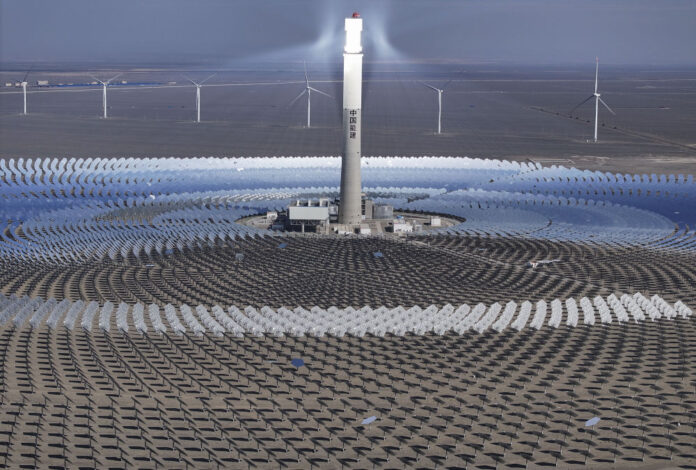
Xinjiang has traditionally relied on agriculture and animal husbandry as the main pillars of its economy. Constrained by geographical conditions, transportation infrastructure and a relatively limited industrial base, the region historically experienced slower economic development. Yet its vast Gobi deserts, abundant sunshine, extensive mountain ranges and powerful winds have also given it exceptional potential for renewable energy.
Xinjiang’s renewable energy development is built not only on its natural resource advantages, but also on decades of industrial exploration. As early as the 1980s, the region began researching, testing and promoting wind power technology. In 1986, Xinjiang introduced its first wind turbine. The first phase of the Dabancheng Wind Farm was completed in 1988, and the facility was connected to the grid in 1989. By 1994, Dabancheng had become home to one of China’s largest commercial wind farms at the time, earning its place as an important birthplace of the country’s wind power industry.
From initially importing turbines from Denmark and other countries, to gradually localizing the production of key components such as towers, blades, gearboxes and control systems, and eventually developing independently designed direct-drive permanent-magnet turbines, Dabancheng has witnessed China’s wind power industry evolve from technology importation and domestic substitution to international competitiveness. This region, once primarily known for farming and animal husbandry, began exploring a new path from traditional resource use to a modern energy industry.
Over the past three decades, wind power development in Xinjiang has continued to advance towards larger-scale projects, greater efficiency and more sophisticated technology. The Dabancheng Wind Farm has been upgrading its older turbines, replacing early-generation equipment with larger and more advanced models to improve the utilization of wind resources.
Technologies such as LiDAR-based wind measurement enable turbines to detect wind speed and direction more accurately, helping increase power generation efficiency and reduce operation and maintenance costs. Meanwhile, the wind power industry chain continues to expand, bringing together turbine manufacturing, engineering construction, equipment maintenance and technological research.
Renewable energy is no longer simply a collection of turbines installed across open landscapes. It has become an important driver of local industrial development, employment and technological progress. In places such as Mulei, wind power equipment manufacturers are expanding their production capacity, providing essential support for the regional renewable energy industry while creating new employment opportunities for local communities.
If wind power represents the historical foundation of Xinjiang’s renewable energy development, the rapid rise of solar power has further unlocked the region’s enormous natural potential. With abundant sunshine and extensive Gobi and desert landscapes, Xinjiang is ideally suited for large-scale photovoltaic power generation.
In recent years, major renewable energy bases in Hami, Zhundong and the southern Xinjiang region surrounding the Tarim Basin have accelerated their development. Solar projects are spreading across deserts and Gobi landscapes, gradually forming large-scale, integrated development zones.
In places such as Ruoqiang, photovoltaic projects with capacities of one million kilowatts and beyond have been built and brought into operation, turning land that was previously unsuitable for conventional agricultural production into space for generating clean electricity. Meanwhile, the Tarim Oilfield has developed large-scale solar power stations in areas including Bazhou and Kashgar. In Luopu County, Hotan, initiatives such as combining photovoltaic power generation with agriculture and desertification control are exploring ways to integrate clean energy production, land utilization and ecological restoration.
The coordinated development of wind and solar power is reshaping Xinjiang’s energy landscape. In recent years, the region’s installed renewable energy capacity has grown rapidly, transforming it from an important traditional energy-producing area into one of China’s major renewable energy development hubs.
By the end of February 2026, Xinjiang’s installed renewable energy capacity had exceeded 173 million kilowatts, accounting for more than 60 percent of its total installed power generation capacity. Several renewable energy bases, each with a capacity of over 10 million kilowatts, have taken shape. In 2025, renewable energy generation in Xinjiang reached 146.7 billion kilowatt-hours, representing a year-on-year increase of 22.3 percent.
The value of renewable energy extends far beyond generating more electricity. Located in northwestern China, Xinjiang has abundant wind and solar resources, but the scale of local electricity consumption does not always match the rapid expansion of energy production. One of the key challenges is therefore how to transmit the green electricity generated across its deserts and Gobi landscapes to wider markets.
In recent years, Xinjiang has continued to strengthen its power grid, developing a transmission network supported by a 750-kilovolt backbone grid. Ultra-high-voltage direct-current transmission projects are connecting energy resources in western China with major electricity-consuming regions in the central and eastern parts of the country.
Since the launch of the Xinjiang electricity transmission in 2010, electricity generated in the region has been delivered to numerous provinces, with renewable energy accounting for an increasingly significant share of the exported power. The Xinjiang-to-Chongqing transmission project, which entered operation in 2025, has further expanded the region’s capacity to deliver clean energy beyond its borders. Wind and solar power generated in the deserts of northwestern China can now travel thousands of kilometres to support industrial production and everyday life in other parts of the country.
Xinjiang’s energy transition is also extending into smaller-scale applications that are more closely connected to everyday life and local infrastructure. In remote desert areas and along major transport routes, renewable energy is increasingly being used to ensure the reliable operation of essential facilities. China Mobile Xinjiang has been developing solar-powered communication base stations in areas such as Aksu, exploring integrated solar and battery storage systems at key border locations in Wushi County, and deploying complementary wind-solar-storage systems in challenging environments along the Duku Highway.
For communication stations located far from urban power grids, where conventional electricity supplies are limited, solar panels, wind turbines and energy storage systems can provide greater energy independence and improve reliability during extreme weather conditions. At the same time, initiatives combining photovoltaic power generation with agriculture and ecological restoration demonstrate that renewable energy development is no longer limited to large centralized power stations. It is gradually becoming part of rural production, infrastructure development and environmental protection.
Xinjiang’s renewable energy journey reflects both the rapid development of China’s wind and solar industries and the transformation of natural resource advantages into new drivers of regional growth. The economic landscape of this region was once defined primarily by farmland, pastures and traditional resource development.
Today, it is increasingly shaped by wind turbines, photovoltaic panels, energy storage facilities and an expanding network of power transmission lines. The winds and sunshine across this vast territory are being transformed into new sources of industrial upgrading, national energy security and low-carbon development. Xinjiang is becoming, in every sense, fertile ground for China’s renewable energy future.
Source: sciencenet, cas, ceec, xjhb gov cn, xinhua, chinanews