


Thousands of kilometers from the ocean, in the vast desert landscapes of northwestern China, oysters, swimming crabs, whiteleg shrimp and groupers are finding an unlikely new home. Once considered unsuitable for conventional agriculture, Xinjiang’s saline-alkali waters are being transformed into productive aquaculture resources through scientific innovation.
At Alar, a city on the northwestern edge of the Taklimakan Desert in the Xinjiang Uygur Autonomous Region, oysters originally brought from Zhejiang Province on China’s eastern coast have successfully adapted to the local saline-alkali environment. After several months of cultivation, they have reached harvest size, with the largest individual weighing as much as 316 grams. Their growth has even surpassed that of some coastal-farmed oysters.
The success of desert oyster farming is more than an agricultural curiosity. It represents a broader effort to rethink how underutilized land and water resources can be developed, while creating new economic opportunities for local communities. Across Xinjiang, a new model of inland aquaculture is gradually taking shape, turning saline-alkali waters into what local observers increasingly describe as a “blue granary.”
The idea of raising seafood in the desert may seem improbable. Xinjiang has no coastline, and much of its land is characterized by arid conditions and high soil salinity. Yet these very characteristics provide the foundation for an unconventional approach to aquaculture.
Millions of years ago, the region surrounding the Taklimakan Desert was covered by an ancient sea. Geological changes and evaporation gradually left large quantities of salt in the soil. Today, saline-alkali land is widespread across the region. Agricultural irrigation has further contributed to the formation of saline drainage water, as water from the Tarim River dissolves salts in the soil and carries them into drainage systems.
For traditional farming, excessive salinity is a serious obstacle. For aquaculture specialists, however, saline water represents a potentially valuable resource. The challenge lies in making it suitable for aquatic species that traditionally depend on marine environments.
This requires far more than simply adding salt to freshwater. Different aquatic species have specific requirements for water chemistry, including ionic composition, calcium and magnesium concentrations, hardness and microbial balance. The chemical characteristics of inland saline water differ considerably from those of seawater, meaning that conventional coastal farming techniques cannot simply be transferred to the desert.
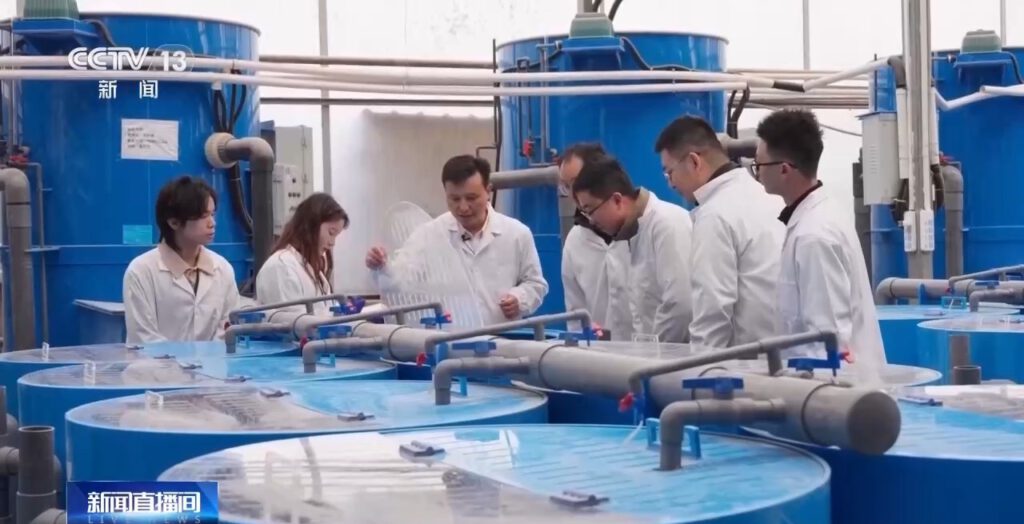
In 2023, with support from the Ningbo assistance program for Xinjiang, a research team led by Dr. Wang Huan of Ningbo University began working in Alar to address these challenges. The team developed a systematic approach covering seedling acclimatization, water-quality regulation, microbial and algal management, and transportation.
One important breakthrough involved understanding the effects of eight major ions in saline-alkali water on aquatic organisms. Rather than attempting to reproduce seawater exactly, the researchers adjusted water hardness and calcium-magnesium concentrations according to the needs of individual species. They also introduced microbial and algal nutrient-management techniques to stabilize the aquatic environment.
The region’s climate created another challenge. During summer, prolonged sunshine and high temperatures can cause dramatic fluctuations in water pH. Measurements showed that pH levels could rise from approximately 8.3 in the morning to 9.3 around midday, increasing the risk of algal blooms and water-quality instability.
Transportation was equally problematic. In 2024, some shipments of aquatic seedlings suffered mortality rates approaching 100 percent when direct and indirect losses were combined. By strengthening seedling nutrition before transportation and optimizing stocking density and size according to transport distance, the team significantly improved survival rates.
Xinjiang’s natural environment, meanwhile, offers several unexpected advantages. Long summer daylight hours encourage the growth of algae, which provide natural food for filter-feeding oysters. Compared with coastal farming areas, desert locations are less exposed to typhoons and tidal fluctuations. Limited rainfall also helps maintain relatively stable salinity levels in aquaculture ponds.
These conditions have enabled researchers and local producers to experiment with a growing range of species. In Alar, the research team established a polyculture system combining swimming crabs, whiteleg shrimp, razor clams and mullet. By integrating species occupying different ecological niches, the system improves resource utilization and creates opportunities for more efficient production. Demonstration projects have reported average economic returns exceeding 20,000 yuan per mu, compared with only several thousand yuan under conventional farming practices.
The transformation is not the work of a single research team. Since 2018, Professor Wei Jie and his colleagues at Tarim University have conducted field research on saline-alkali aquaculture in Alar. Their work has focused on salt-tolerant species, specialized feeds and practical farming techniques. They have successfully cultivated tilapia, whiteleg shrimp, sea bass and largemouth bass, while providing technical guidance to more than 50 farming households and supporting aquaculture development across more than 30,000 mu of water surface.
Another important initiative involves Professor Chen Sheng’ao and his research team at Tarim University. As part of China’s national Blue Granary Science and Technology Innovation program, they have conducted ecological aquaculture experiments at Swan Lake in Alar, a saline inland water body formed by agricultural drainage. By introducing species such as tilapia, largemouth bass and grouper, the researchers have been examining not only fish growth and nutritional quality but also the interactions between aquaculture, aquatic microorganisms and surrounding saline-alkali land.
Meanwhile, private enterprises are helping turn scientific discoveries into commercial production. Xinjiang Shishixian Aquaculture, established by entrepreneurs with decades of seafood farming experience in Guangxi, has developed saline-water aquaculture bases in several parts of southern Xinjiang. By adding carefully selected trace elements and beneficial microorganisms, the company has created artificial seawater suitable for species including groupers, oysters and other high-value seafood. It has also obtained eight patents related to its production technologies.
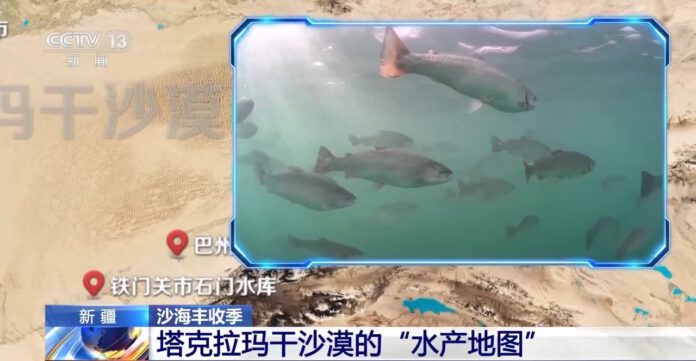
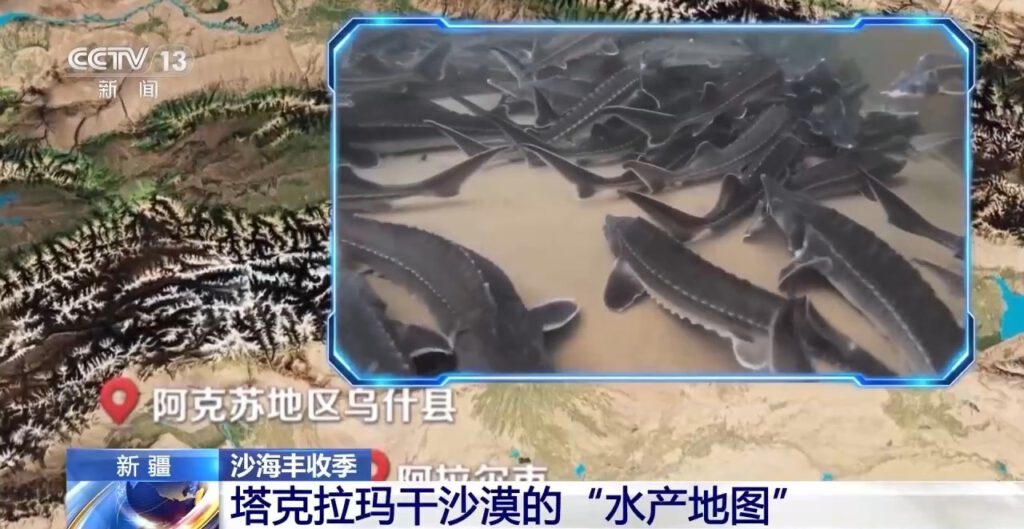
The industrial landscape extends well beyond Alar. In Qiemo County, Bazhou, saline water supports the farming of grey mullet and grouper. In Tiemenguan, cold water originating from the Kunlun Mountains provides suitable conditions for salmon farming. In Hotan County, Chinese mitten crab seedlings are raised in reconstructed saline-alkali ponds. Marki County in Kashgar has explored Australian freshwater crayfish production, while Wushi County in Aksu has developed sturgeon farming using cold spring water.
Together, these projects demonstrate that there is no single model for desert aquaculture. Each location must identify suitable species and adapt its techniques to local water quality, temperature and ecological conditions. More importantly, the value of saline-alkali aquaculture extends beyond seafood production. It offers a way to make better use of agricultural drainage water, reduce the waste of underutilized water resources and create additional income for rural communities.
In Wolonggang Village, in the Midong District of Urumqi, residents have developed a substantial aquaculture industry by taking advantage of the village’s saline-alkali land and abundant water surfaces. The village now has 51 aquaculture households operating more than 3,000 mu of fish ponds. As some areas of land have gradually improved, residents have also begun leasing them for the cultivation of commercial crops. The village is exploring intelligent aquaculture systems and water recycling to improve production efficiency and environmental performance.
Across the Taklimakan Desert region, this approach to resource development is accompanied by other efforts to build sustainable industries. In Pishan County, for example, large-scale cultivation of snake gourd has demonstrated the potential of sandy soils for specialized agricultural production. In Shaya County, cistanche is cultivated alongside desert shrubs such as Haloxylon ammodendron, combining desert vegetation restoration with medicinal plant production and processing.
When an oyster from China’s eastern coast grows to maturity beside the Taklimakan Desert, it represents more than the successful adaptation of a marine species to an unfamiliar environment. It reflects the power of science to redefine the value of natural resources and create new possibilities for regional development.
Source: xj china news, paper people, news cctv