


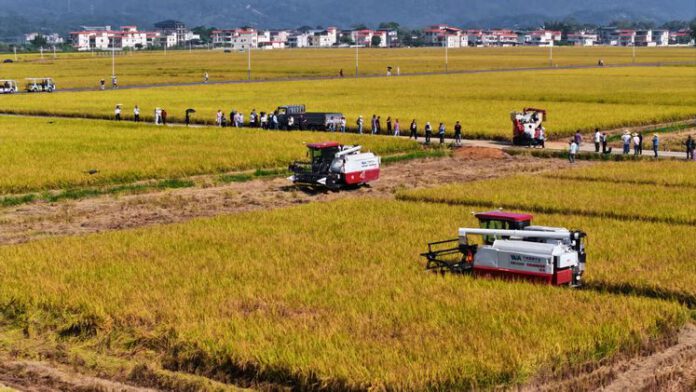
In October, the Guangdong Wanlyu Smart Agricultural Farm in Dongyuan County, Heyuan, Guangdong Province, enters its harvest season. This harvest reflects a new technological foundation for agriculture.
Covering approximately 5,300 mu, the farm includes around 2,000 mu dedicated to breeding and seed production and 3,300 mu for rice cultivation. With technological support from Luo Xiwen, an academician of the Chinese Academy of Engineering and professor at South China Agricultural University, and his research team, the farm has developed into a large-scale smart agriculture demonstration base.
It has achieved intelligent and autonomous operations throughout the entire production process, from soil preparation and planting to crop management and harvesting, with operational efficiency reportedly 50 times higher than that of traditional farming methods. What is being harvested here is not merely rice, but also the results of integrating China’s space-breeding research, modern agricultural technology and practical farming.
China’s space-breeding research began in August 1987, when seeds of rice, green peppers and other crops were carried aboard the country’s ninth recoverable satellite, marking the beginning of its exploration into space-induced mutation breeding. China subsequently conducted a series of crop seed spaceflight experiments.
In 2006, China launched Shijian-8, the world’s first recoverable satellite specifically dedicated to space-breeding research. Over more than three decades, these experiments have generated an increasingly extensive body of research. Rice has become one of the most extensively studied crops in China’s space-breeding programme, with the earliest research efforts, the largest number of spaceflight materials and some of the most significant scientific achievements.
Why can the space environment create new opportunities for rice breeding? The answer lies in its distinctive mutagenic factors. Space radiation originates mainly from galactic cosmic rays, high-energy solar particles and energetic particles trapped by Earth’s magnetic field. Among them, high-energy heavy ions possess strong penetrating and ionising capabilities, enabling them to affect the genetic material of seeds and induce DNA damage and genomic mutations. Using molecular markers and genome sequencing, researchers have identified various types of genetic variation associated with space-induced mutation, including single-nucleotide changes, insertions and deletions, and structural variations. These changes provide new genetic resources for rice improvement.
However, mutation does not automatically mean improvement. Changes induced by the space environment are random. Only a proportion of them are beneficial, while many may have no breeding value or may even result in undesirable traits. The real challenge is not simply to induce mutations, but to identify valuable genes that meet agricultural production needs from among a vast pool of genetic variations and ensure that these genes can be stably inherited by subsequent generations.
The competitiveness of space breeding does not depend simply on how many seeds can be sent into space. It depends on the ability to establish a complete technological system encompassing mutation induction, identification, screening and variety development. Spaceflight experiments create the initial genetic variation; ground-based research determines whether that variation can become a valuable breeding resource; and sustained breeding innovation determines whether those resources can ultimately be translated into agricultural productivity.
Huahang Xiangyinzhen was developed by the National Engineering Research Center for Plant Space Breeding at South China Agricultural University. It is an aromatic conventional Simiao rice variety that received variety approval in 2022. Its development did not involve simply planting seeds that had travelled into space and obtaining a new variety directly. Instead, researchers screened large populations of space-induced mutant materials to identify promising genetic variants, then used cross-breeding and multi-generation selection to combine high yield, superior quality and disease resistance within a single variety.
In terms of agricultural performance, Huahang Xiangyinzhen demonstrates a strong combination of desirable traits. Its average yield in a 100-mu demonstration area reached 723.5 kilograms per mu, while its eating-quality score reached 94.86. Its amylose content ranges from approximately 15.0% to 15.3%, contributing to a soft, pleasantly chewy texture when cooked. The variety also demonstrates good resistance to rice blast and lodging. It is the only conventional Simiao rice super variety from Guangdong Province to have been selected for this recognition.
Importantly, the significance of this variety extends beyond its high yield. It demonstrates progress in addressing a long-standing challenge in rice breeding: achieving high productivity without compromising grain quality. Modern rice production can no longer focus exclusively on yield per unit of land.
Consumers increasingly value taste and nutritional quality; farmers prioritise disease resistance, production costs and profitability; and agricultural systems must also consider compatibility with mechanisation, resource efficiency and environmental sustainability. A successful commercial variety must strike a balance among these competing demands. The development of Huahang Xiangyinzhen illustrates the shift from improving individual traits towards the coordinated improvement of multiple characteristics.
Today, space-bred rice is cultivated across approximately 50,000 mu in Heyuan. A range of space-bred Simiao rice products has also been developed. The local cultivation of varieties such as Huahang Xiangyinzhen has helped move space-breeding achievements beyond experimental research plots and into farmers’ fields. The Guangdong Wanlyu Smart Agricultural Farm has become an important platform for translating these scientific advances into practical agricultural production.
Here, breeding, cultivation, agricultural machinery, crop protection, harvesting and grain transportation are no longer isolated operations. Instead, they form part of an integrated smart agriculture system. Autonomous rotary tillers, seeders, harvesters and grain transport vehicles work in coordination, while agricultural drones and high-clearance sprayers handle crop protection and field management. Drones are also used for straw collection and the transportation of agricultural materials. By combining intelligent machinery with agricultural production data, the farm has achieved autonomous operations throughout the entire process, from soil preparation and planting to crop protection and harvesting, keeping mechanical harvesting losses below 1.8%.
The development of the Guangdong Wanlyu Smart Agricultural Farm also reflects a broader shift from single-season harvesting towards year-round land utilisation. After the rice harvest, the farm promptly plants wheat, Chinese milk vetch and rapeseed. The use of green manure crops helps improve soil conditions and reduce dependence on chemical fertilisers.
The research team has also made breakthroughs in green manure breeding, developing new space-bred Chinese milk vetch lines such as Hangzi No. 1 and Hangzi No. 5, marking progress in the application of space-breeding technology to green manure crops in China. Through large-scale cultivation of Chinese milk vetch, with yields exceeding 6,500 kilograms per mu in some high-yield fields, the farm is building an integrated soil improvement system that combines space-derived genetic resources, intelligent agricultural machinery and ecological restoration.
According to relevant figures, green manure cultivation combined with supporting management practices can reduce chemical fertilizer use in rice fields by 25% to 30%, while generating more than 300 yuan in combined cost savings and additional income per mu. Rice production is therefore becoming more than the harvesting of a single crop. It is evolving into a circular agricultural system that integrates variety improvement, soil fertility enhancement, straw utilisation and farmland ecological protection.
Ultimately, technological progress must benefit industries and farmers. The Guangdong Wanlyu Smart Agricultural Farm currently produces more than 4,500 tonnes of rice and over 500 tonnes of high-quality rice seeds annually. Its average rice yield remains above 550 kilograms per mu, with the highest reaching 600 kilograms per mu, while its annual output value exceeds 20 million yuan.
The farm has independently developed 15 categories comprising 23 individual products in its space-bred agricultural product range. In 2025, sales exceeded 1,300 tonnes, generating revenue of more than €2.69 million. Through land transfers, industrial development and local employment, the farm directly provides jobs for more than 300 villagers, while over 2,700 rural households receive approximately €524,000 in annual land rental income. The farm has also established a training and flight-testing base for unmanned agricultural machinery, providing agricultural drone and other technical training to cultivate a new generation of skilled farmers.
The value of space-bred rice is also beginning to extend beyond China’s borders. In recent years, as global food security has attracted growing attention, China’s space-breeding technology has drawn increasing interest from countries around the world. In 2025, Wanlyu Smart Agricultural Technology reported that its space-bred rice varieties had been introduced for trial cultivation in several Asian and African countries. Trials in six countries, including Pakistan, the Democratic Republic of the Congo, Nigeria and Ghana, had shown promising results. According to the company, average yields could reach three times those of locally grown traditional rice varieties.
In Nigeria, the company has worked with several local regions to trial approximately 260 mu of Chinese space-bred rice varieties, reporting encouraging yield performance. Young Nigerian agricultural entrepreneurs have expressed interest in expanding cultivation and deepening cooperation. Meanwhile, agricultural authorities in several other African countries have also extended invitations to Chinese enterprises, seeking to introduce space-bred rice varieties into their domestic agricultural systems.
This trend is driven by practical needs. Some African countries face challenges including insufficient food supplies, relatively low agricultural productivity and traditional farming systems that struggle to keep pace with population growth. For these countries, the appeal of China’s space-bred rice lies not in its technologically impressive name, but in whether its high-yield potential and disease resistance can adapt to local climates, soils and farming systems, and whether it can genuinely increase food production per unit of land.
For a country with a large population and substantial food demand, food security has never been simply a matter of increasing output. It is a systemic challenge involving resources, science and technology, industry and the environment. Against the backdrop of limited arable land, climate change, pest and disease risks, and uncertainty in global food supplies, the continued development of rice varieties that combine high yield, superior quality, resilience and suitability for mechanised production remains a major priority for agricultural innovation.
Source: scau edu cn, farmer, zxbq, cnsa gov cn