


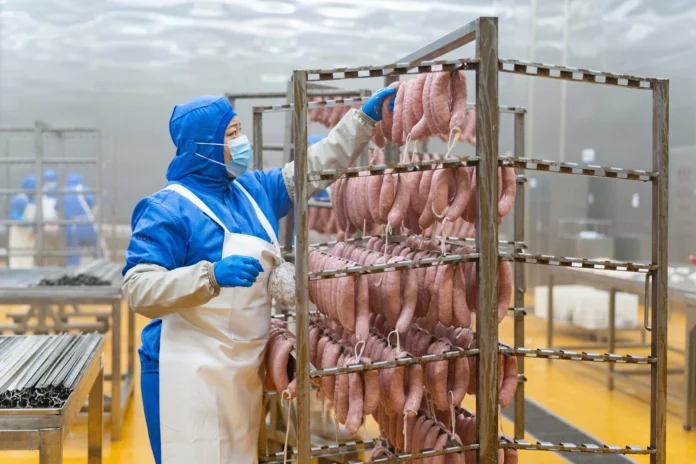
In Qinggang County, Heilongjiang Province, a pig is undergoing a transformation from a conventional agricultural product into the centerpiece of a modern food industry.
From corn cultivation and feed production to breeding, hog farming, slaughtering, food processing, cold-chain logistics and retail, Qinggang is bringing together what were once separate stages of the pork supply chain within a single county. The county now aims to develop the sector into a roughly $1.4 billion industry within three to five years.
The ambition is not built on a blank slate. Qinggang is a major grain-producing and hog-producing county. Annual grain output is about 1.15 billion kilograms, while the county’s hog inventory has traditionally remained above one million head. Its abundant corn production provides a natural foundation for feed manufacturing and livestock farming. The more decisive change, however, has come from the county’s long-term partnership with Sichuan-based agricultural and food company Tieqili Group.
Tieqili entered Qinggang in 2017. The following year, the company and the county government signed a strategic cooperation agreement covering a million-head hog industry. Qinggang subsequently invested about $90 million, to build a parent-stock breeding farm, a grandparent breeding facility and a series of finishing farms. Together, these facilities have established a more standardized and industrialized breeding system. The group has also developed feed production in the county. A modern feed plant launched in 2021 has a designed annual capacity of 200,000 tons, while the group’s total feed capacity in Northeast China has reached 400,000 tons.
The other major pillar of the chain is Heilongjiang Maple Ranch Food Co., Ltd. The company invested about $34 million, in its Qinggang operation, which began production in 2023. Its modern slaughtering facility has an annual capacity of two million hogs. Inspection, testing, carcass processing, cooling and aging are integrated into a standardized production system, with food-safety data incorporated into a traceability platform. Feed batches, farms and processing information can be traced through the production chain.
The biggest economic shift, however, comes after slaughtering. In the past, a hog leaving the farm generally meant that much of its potential added value was created elsewhere. Qinggang is now trying to capture that value locally by turning pork into sausages, cured meats, cooked products and other processed foods. The county has developed an annual processed-food capacity of about 30,000 tons, with more than 100 product varieties. In 2025, Maple Ranch slaughtered 406,400 hogs and processed 51,300 tons of fresh and prepared meat products, generating revenue of $108 million.
The result is more than a conventional hog-farming operation. It is an integrated industrial chain in which grain provides the raw material, feed connects crop production with livestock, breeding and farming form the agricultural core, slaughtering and processing create additional value, and logistics and retail extend the chain to consumers. The longer the chain remains within the county, the greater the potential for local output, employment, tax revenue and supporting services.
A distinctive feature of the Qinggang model is how the economic benefits of the industrial chain are distributed. Under its government-business cooperation framework, agricultural assets financed by the county government are operated by Tieqili. The projects generate guaranteed annual returns of more than $4.2 million. These returns are incorporated into village-level collective income programs, with priority given to households with no labor capacity and formerly impoverished residents.
The approach forms part of Qinggang’s broader “2+N” mechanism for linking industry with rural incomes, centered on two major county industries, hog farming and photovoltaic power. The county has invested approximately $2.7 billion, in related support assets and programs. In 2025, operating assets generated around $11.8 million, in income, benefiting more than 31,000 people.
The underlying idea is not to transfer farming and market risks to individual households, but to use industrial assets, employment and collective income mechanisms to allow rural communities to share in the returns generated by industrial development.
Yet an integrated supply chain does not automatically translate into a highly competitive industrial cluster. Qinggang’s next challenge is to move from a complete industrial chain to a higher-value industrial chain.
The first challenge lies in farming. Large-scale standardized farms have improved production efficiency and biosecurity, but smaller producers still need stronger organization, technology and risk-management capabilities. Hog prices are inherently cyclical, and reliance on farming margins alone leaves producers vulnerable to market downturns. Expanding contract farming, strengthening agricultural insurance and improving price-risk management will therefore be critical to the sector’s resilience.
The second challenge is value creation. Slaughtering capacity by itself does not determine the competitiveness of a food industry. The greater value lies in brands, research and development, product innovation and distribution. Qinggang has moved beyond fresh pork into sausages, cured meats and cooked foods, but building nationally recognized brands, developing higher-margin products, making fuller use of slaughter by-products and establishing stronger e-commerce and retail channels remain important tasks.
This is where the planned Qinggang International Youfood Valley comes into play. Covering approximately 524 mu, or about 35 hectares, the industrial park involves planned investment of $63 million. Its infrastructure, standardized factory buildings and cold-storage facilities are being developed to attract food-processing, logistics, research and related businesses.
The objective is not simply to add factories, but to create an industrial ecosystem in which companies can share raw materials, technology, logistics, research capabilities and market channels. Qinggang plans to attract more than 10 large-scale enterprises within three to five years and turn the park into a food-processing cluster with annual output of $1.4 billion, while creating more than 3,000 jobs.
The county’s hog industry generated $261 million, in output in 2025, with Maple Ranch contributing $114.6 million. Reaching the $1.49 billion target would therefore require a substantial expansion beyond primary farming and slaughtering, particularly in processed foods, branding, logistics and the broader food-manufacturing ecosystem.
The significance of Qinggang’s experiment ultimately extends beyond whether it reaches a particular output target. For an agricultural county, the fundamental challenge is how to convert grain production into food manufacturing, livestock production into processing value, and corporate investment into lasting employment and local economic activity.
Qinggang’s answer is to treat the pig not as the end product, but as the starting point of an industrial chain. When corn enters a feed mill, piglets enter standardized farms, hogs move into modern slaughtering facilities and pork emerges as sausages, cured meats and other branded foods, a traditional agricultural activity begins to function as a broader county-level industrial system.
Whether Qinggang can ultimately build a nationally competitive billion-dollar food cluster will depend on its ability to develop brands, attract complementary businesses, strengthen research and development, and expand its markets. But the county has already made a fundamental shift: turning a pig from a single agricultural commodity into the foundation of a much broader industrial economy.
Source: molihua, 21jingji, hlj gov cn, cfsn, sohu