


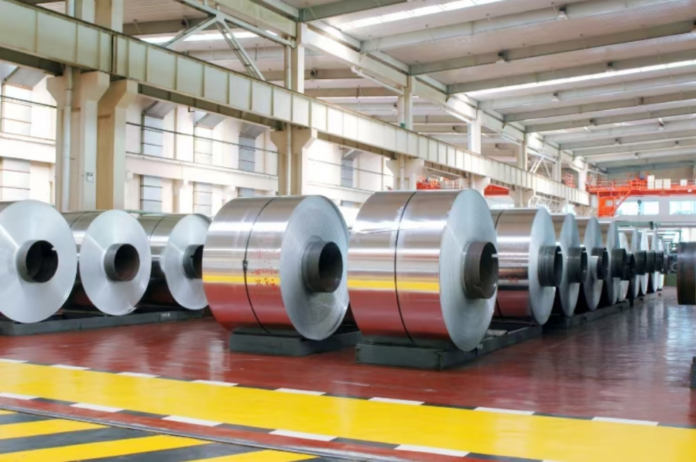
In the race to build ever more powerful artificial intelligence infrastructure, some of the most important components are far removed from the headlines. They are not GPUs, servers or data centers, but materials measured in fractions of a millimeter. Among them is aluminum foil, in some applications as thin as 0.02 millimeters.
As AI servers become increasingly powerful, their power density is rising rapidly, placing greater demands on power management, heat dissipation and system reliability. Aluminum foil sits at the heart of several of these systems. It is used in thermal-management applications, while high-end electronic aluminum foil is also a critical raw material for the electrode foils used in aluminum electrolytic capacitors, which help stabilize power systems.
The expansion of AI computing is therefore beginning to reshape demand deep inside the materials supply chain. According to a research report by BOC International Securities, the global market for electrode foil used in aluminum electrolytic capacitors for AI servers is expected to reach RMB 2.59 billion in 2026 and RMB 5.02 billion in 2027, potentially exceeding RMB 10 billion by 2029.
The numbers point to a broader shift. The competition for AI computing power is no longer confined to chips and servers. Increasingly, it is also a competition over materials, energy, manufacturing processes and supply-chain resilience. At the upstream end of that chain, a mountainous county in southern China is emerging as an unlikely industrial hub.
Ruyuan Yao Autonomous County, in China’s Guangdong Province’s Shaoguan City, does not produce aluminum. Yet after more than two decades of industrial development, it has built one of the world’s largest clusters for electronic aluminum foil and related products. In 2025, the county’s aluminum-foil industry generated RMB 12.132 billion in output. Its electronic aluminum foil and medium- and high-voltage corrosion foil products have established leading positions in global markets, with core products accounting for more than 22 percent of global market share.
At the center of this industrial ecosystem is Dongyangguang, an aluminum and advanced-materials group that has gradually built a vertically integrated chain spanning electronic foil, corrosion foil, formed foil and aluminum electrolytic capacitors.
The story of Ruyuan’s aluminum-foil industry did not begin with aluminum. It began with a decision to locate a technologically demanding manufacturing business in a place that, on the surface, appeared to have few natural advantages for it.
In 1997, entrepreneur Zhang Zhongneng, originally from Dongyang in Zhejiang Province, began investing in Ruyuan. The following year, Dongyangguang established its first formed-foil plant there.
The choice was less unusual than it initially appeared. Formed foil is a core material for aluminum electrolytic capacitors, whose major customers were concentrated in the Pearl River Delta. Ruyuan was relatively close to this enormous manufacturing market. At the same time, the county had abundant hydropower resources, an important advantage for an electricity-intensive manufacturing process.
Ruyuan therefore offered something more valuable than access to aluminum itself: a combination of energy, cost and proximity to customers.
But these advantages alone could not have created a global industrial cluster. Technology was the decisive factor.
When Dongyangguang entered the field, key technologies for electronic foil production were dominated by Japanese companies. Working with universities and research institutions, the company developed new corrosion processes and eventually raised material yields to above 98 percent, helping to replace imported products and establish a domestic manufacturing base.
That breakthrough became the starting point for a much broader industrial strategy.
Rather than remaining focused on one product, Dongyangguang expanded along adjacent links of the value chain. It moved from formed foil into corrosion foil, then upstream into electronic bright foil, while also extending downstream into aluminum electrolytic capacitors. Over time, the company developed an integrated chain covering electronic bright foil, corrosion foil, formed foil and capacitors.
The logic was not simply vertical integration for its own sake. Each new business was connected to an existing technological capability, customer relationship or manufacturing process. This “chain-based” model also drove Dongyangguang beyond the capacitor-materials business. The company expanded into air-conditioning foil, automotive thermal-management materials and aluminum foil for new-energy batteries.
In 2010, Dongyangguang established a joint venture in Ruyuan focused on high-performance aluminum foil. As the automotive industry pursued lighter vehicles without sacrificing thermal performance, the company developed high-performance air-conditioning foil and brazing foil. Its MB fin technology, for example, was designed to reduce the weight of automotive heat exchangers while maintaining heat-transfer performance.
The rise of electric vehicles created another opportunity. Aluminum foil is used as a current collector in lithium-ion batteries, providing a conductive framework inside the cell. Dongyangguang subsequently entered the battery-foil market, and its Ruyuan facility now has an annual battery aluminum-foil capacity of around 12,000 tonnes. The company’s industrial expansion did not stop at aluminum.
The corrosion and forming processes used in electronic foil manufacturing require significant quantities of chemical inputs. To secure its raw-material supply, Dongyangguang built chlor-alkali production facilities and subsequently expanded into chloromethanes, fluorochemicals and PVDF, a high-performance polymer widely used in lithium batteries and photovoltaic applications.
The result is a broader industrial ecosystem in which aluminum materials, chemicals, energy and electronic components reinforce one another. This is what distinguishes Ruyuan from a conventional manufacturing base. Its competitive advantage is no longer a single factory or a single product, but an interconnected industrial system.
Over more than two decades, Dongyangguang has invested more than RMB 20 billion in Ruyuan. Other companies have gradually been attracted to the area, filling gaps around the anchor enterprise. The county has developed a supply chain stretching from aluminum ingots and electronic bright foil to corrosion foil, formed foil and capacitors, while also branching into chemical and new-energy materials.
Local government has played a supporting role by targeting investment around the leading enterprise and focusing on filling specific gaps in the supply chain. The objective is to transform an individual corporate success into a broader industrial cluster.
That industrial architecture is now encountering a new source of demand: AI computing.
The most visible components of an AI server are processors and accelerators. But keeping those processors running reliably requires a complex power and thermal-management infrastructure. As server power density increases, capacitors must deliver higher capacitance and voltage performance while occupying less space and maintaining high reliability.
That shift directly benefits high-end electronic aluminum foil and electrode-foil manufacturers. Dongyangguang’s recent results illustrate the change. In the first half of 2026, its high-end aluminum-foil business generated RMB 3.673 billion in revenue, up 26.35 percent year on year. Revenue from its electronic components and materials business reached RMB 1.902 billion.
The company’s AI-related business is growing from a much smaller base but at a much faster rate. In the first half of 2026, AI-related revenue reached RMB 289 million, an increase of more than elevenfold year on year. The company’s AI portfolio includes computing services as well as components and technologies linked to power and thermal management.
The more important development, however, may be occurring inside the materials business itself.
Dongyangguang is pushing into higher-performance products with greater capacitance, higher voltage tolerance and improved reliability. Its laminated-foil technology, developed through long-term cooperation with Japanese partner Toyo Aluminium, uses an additive forming process rather than conventional chemical corrosion. According to the company, the technology can increase capacitance per unit area by 20 to 40 percent compared with conventional corrosion foil, potentially allowing capacitors to become 20 to 30 percent smaller at the same capacitance.
For AI servers, such improvements are more than incremental material upgrades. They address one of the central engineering challenges of modern computing infrastructure: delivering more electrical performance within increasingly constrained physical space.
Market demand is already pushing manufacturers to upgrade their production lines. High-end medium- and high-voltage corrosion foil has seen particularly strong orders, while Dongyangguang has accelerated both production-line upgrades and new capacity construction in Ruyuan.
The significance of this expansion lies not simply in producing more aluminum foil. The competitive frontier is shifting from capacity to high-end capacity. That distinction will determine whether Ruyuan can sustain its position in the next stage of industrial development. The first phase of the county’s growth was about moving from zero to one: establishing a manufacturing base, mastering core technologies and building a complete supply chain. The next phase is likely to be about moving from scale to sophistication.
High-end electronic aluminum foil is an industry with substantial technical and certification barriers. Increasing output alone does not guarantee competitiveness. Manufacturers must control aluminum purity, grain structure, corrosion behavior, forming processes, product consistency and yield rates at increasingly demanding levels.
Ruyuan’s investment in research and digital manufacturing is therefore becoming as important as its physical production capacity. Cluster companies reportedly allocate more than 3 percent of revenue to research and development, while Dongyangguang has established postdoctoral and engineering research platforms. Its manufacturing operations have also adopted digital systems such as MES and ERP to monitor production processes and improve consistency.
Sustainability is emerging as another competitive variable.Aluminum processing and chemical manufacturing are energy- and resource-intensive businesses. Ruyuan’s historic advantage in hydropower can increasingly be viewed through a different lens: as a foundation for lower-carbon manufacturing. As data-center operators and technology companies place greater emphasis on renewable energy and supply-chain emissions, the environmental profile of materials may become an increasingly important part of their competitiveness.
Ruyuan also benefits from something beyond its own industrial capabilities: its location within Shaoguan’s emerging computing infrastructure. In 2022, Shaoguan was designated as the location of the Guangdong-Hong Kong-Macao Greater Bay Area national hub node’s data-center cluster under China’s national integrated computing-power network. The policy was intended in part to develop computing infrastructure outside the core cities of the Greater Bay Area while providing large-scale computing capacity to markets such as Guangzhou and Shenzhen.
This creates a potentially important connection between Ruyuan’s manufacturing economy and the regional computing economy. The opportunity is not simply to supply one material to one server. A more ambitious model would connect advanced materials with data centers, power equipment, liquid cooling, energy storage and electronic components, creating a broader regional ecosystem around computing infrastructure.
For Ruyuan, this distinction matters. The real question is not whether aluminum foil can “catch the AI wave.” Demand cycles come and go, and individual applications can change rapidly. The more fundamental question is whether AI can become a catalyst for upgrading an already established manufacturing ecosystem.
The conditions are increasingly visible. Ruyuan has accumulated manufacturing expertise, technological capabilities, a mature supply chain and an anchor enterprise with global customers. Shaoguan provides a growing computing-infrastructure market. AI, meanwhile, is raising the technical requirements for power electronics and thermal management.
Together, these forces could push the county’s industrial cluster into a new phase. The transformation also illustrates a broader possibility for China’s county-level manufacturing economy. A region does not necessarily need mines, oil fields or other natural-resource endowments to become globally competitive in advanced materials. What matters can be the ability to combine energy, infrastructure, technology, customers and industrial organization over a sufficiently long period.
More than two decades ago, Ruyuan attracted an aluminum-foil manufacturer because it offered cheap and reliable electricity and access to the Pearl River Delta market. Technology then turned that initial advantage into a foothold in a highly specialized industry. Supply-chain integration transformed the foothold into an industrial cluster. And now, the expansion of AI computing is creating a new layer of demand.
A sheet of aluminum foil may be only 0.02 millimeters thick, but the industrial system behind it is anything but thin. In Ruyuan, the next stage of competition will not be determined by how much aluminum foil can be produced. It will be determined by how far the cluster can move up the value chain, from volume to precision, from manufacturing to innovation, and from supplying individual components to becoming an indispensable part of the global computing infrastructure.
Source: nfnews, 21jingji, sina finance, the paper, gdhte