


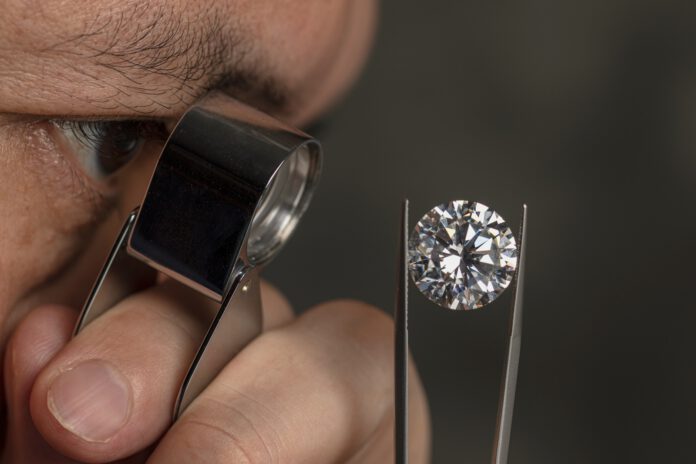
A one-carat lab-grown diamond displayed on a US retail website may have originated in Zhecheng, Henan Province, China, been cut and polished in Surat, India, and eventually entered an American retailer’s inventory. Along this global supply chain, the price of the same material changes dramatically. China has built substantial production capacity, yet it has not secured a corresponding share of the value created downstream.
In the first half of 2026, China’s average export price for rough lab-grown diamonds was approximately $8.94 per carat. After cutting and polishing in India, the average export price of finished loose stones rose to around $74 per carat. At US retailer Brilliant Earth, the median listed price for a one-carat round diamond with E color, VS1 clarity, Excellent cut, and an IGI certificate reached $796.
These figures are not directly comparable measures of profit: cutting reduces weight, while grading, certification, logistics, marketing, and retailing all add costs. The specifications and commercial terms may also differ. Nevertheless, the price gap highlights a fundamental weakness in China’s position: the country can manufacture diamonds at scale but has limited influence over how they are processed, marketed, and priced for end consumers.
China’s competitive advantage rests on its manufacturing base. Both high-pressure, high-temperature (HPHT) and chemical vapor deposition (CVD) technologies have developed alongside a mature industrial ecosystem. Henan, in particular, has established a cluster spanning equipment manufacturing, crystal growth, testing, and processing. China’s rough lab-grown diamond production capacity reached approximately 25.2 million carats in 2025, accounting for around 63% of the global total.
Yet production capacity does not automatically translate into pricing power. According to She Dingshun, general manager of the Henan Lab-Grown Diamond Trading Center, India accounts for approximately 95% of global diamond cutting and polishing. China supplies the rough stones; India controls much of the processing and trading infrastructure; and Western markets capture value through branding, distribution, and retail. Chinese producers are concentrated in the most capital-intensive part of the chain, where cash flow is critical and bargaining power is weak.
The roots of this imbalance lie in the industrial nature of lab-grown diamonds. Unlike natural diamonds, whose supply depends on mineral deposits and lengthy mining cycles, lab-grown diamonds can be produced by adding equipment, improving growth processes, and increasing yields. Around 2021, some manufacturers achieved gross margins of 70%–80%, attracting investment and accelerating capacity expansion. Prices for premium rough stones subsequently fell from $150–160 per carat to around $30 in 2023 and approximately $10–15 in 2024.
Falling production costs should ordinarily reflect manufacturing progress. But when products are difficult to differentiate and sales channels are concentrated among a limited number of buyers, efficiency gains can translate into lower prices rather than higher profits. Chinese manufacturers, eager to secure orders and recover working capital, face pressure to undercut one another. Once one company lowers its price, competitors may follow to protect their market share. The result is a cycle in which greater capacity and better technology fuel further price declines.
The damage is already visible. Some factories in Henan suspended production when prices hit bottom in 2024. In the first half of 2025, the gross margin of lab-grown diamonds at China’s Power Diamond reportedly fell to 12.60%. The lesson is clear: expanding production alone can no longer guarantee sustainable growth.
India’s advantage lies in controlling the commercial links between production and consumers. Its established cutting and polishing workforce, trading networks, and customer relationships give buyers greater flexibility in choosing suppliers and negotiating prices. More concerning for China, India is also moving upstream.
During fiscal 2024, India produced approximately 16 million carats of lab-grown diamonds. Indian company Kira announced plans to expand its CVD reactor fleet and extend its operations into cutting, polishing, and jewelry manufacturing. Government-backed research has also supported the development of domestic growth technologies and equipment. China’s manufacturing lead is therefore not guaranteed to last.
The strategic challenge is not simply to bring every processing step back to China. It is to gain greater control over how the entire value chain is organized. A proposed division of labor known as “Henan–Xinjiang–Shanghai” would combine crystal growth and rough-stone production in Henan, cutting and polishing in Shache County, Xinjiang, and trading, design, branding, and overseas market access in Shanghai. Shache County and Zhongzuan Network signed an industrial cooperation agreement in June 2026, with an initial group of approximately 60 trainees entering the training process.
Meanwhile, the Henan Lab-Grown Diamond Trading Center is developing shared inventory, trading events, and price indexes to improve transparency around quality, availability, and delivery schedules. These initiatives could help producers compete on consistent supply and product differentiation rather than price alone. Their real value, however, will depend on whether they attract sufficient buyers, generate credible transaction data, and secure repeat orders.
Moving downstream is not automatically profitable. Cutting and polishing require skilled labor, equipment investment, and a reliable order pipeline. Trading platforms need active participation from both buyers and sellers. Independent brands must shoulder the costs of design, marketing, distribution, and inventory. Vertical integration creates value only when the additional revenue exceeds the costs and risks of operating these new businesses.
A second opportunity lies beyond jewelry. Diamond, valued as a gemstone for its appearance and emotional significance, can also function as an advanced industrial material. Its exceptional thermal conductivity makes it a potential solution to one of the most pressing challenges in AI infrastructure: removing heat from high-power chips.
In February 2026, US company Akash Systems announced the delivery of NVIDIA H200 GPU servers incorporating its diamond-based cooling technology to Indian cloud provider NxtGen. The application is no longer merely theoretical, although commercial adoption still depends on performance, reliability, cost, and manufacturing consistency.
Chinese companies are also pursuing this market. Huifeng Diamond, based in Zhecheng, is expanding from diamond micropowders into high-thermal-conductivity materials, including diamond-copper composites and CVD diamond heat spreaders. The company has reported sample validation with major customers and initial small-scale production.
Huanghe Whirlwind has developed polycrystalline diamond heat spreaders but has stated that these products have not yet had a material impact on its business. China National Machine Tool Corporation’s Guoji Jinggong has secured small-batch orders for diamond heat spreaders, primarily for defense applications, while its products for civilian thermal management remain under customer validation.
Industrial materials offer a different route to value creation. Customers care less about carat weight, color, and clarity than about thermal performance, reliability, service life, and consistency at scale. Qualifying for advanced supply chains requires extensive testing and customer validation, so technological breakthroughs alone are insufficient. But successful commercialization could give Chinese producers a more defensible competitive position than competing solely on the price of rough stones.
The central issue facing China’s lab-grown diamond industry is therefore not whether it can produce more diamonds, but whether it can capture more value from them. The supply chain from Henan to Surat to the United States reveals a gap between manufacturing strength and market power. Moving into trading, design, and branding could improve control over consumer-facing value, while advanced industrial applications could create new technological barriers to entry.
Neither path offers a shortcut. China’s next phase of growth will depend on converting production advantages into products customers recognize, technologies they trust, and orders that generate sustainable profits. Only then can the country move beyond leading in output to competing across the value chain.
Source: guancha, scmp, cw, the paper