


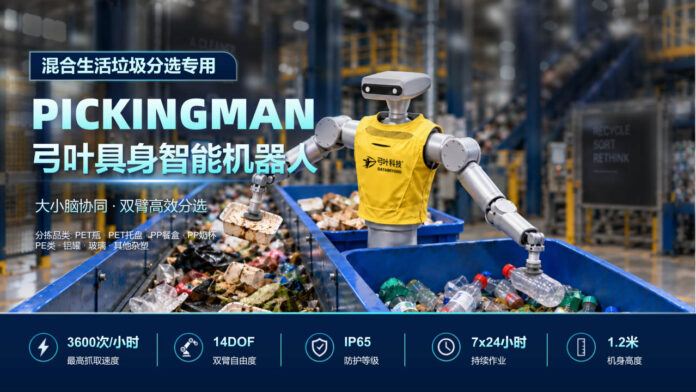
China is turning to artificial intelligence to solve one of the most difficult challenges in modern waste management: how to separate mountains of mixed waste efficiently and recover as many valuable materials as possible. By combining AI-powered recognition, hyperspectral imaging, robotics and automated sorting systems, Chinese companies are moving waste recycling beyond traditional manual sorting and toward a more precise, intelligent and industrialised process.
The scale of the challenge is enormous. According to China’s National Bureau of Statistics, the country’s urban areas collected and transported approximately 262 million tonnes of household waste in 2023. Much of this waste contains a complex mixture of plastics, metals, textiles, paper and organic materials. When these materials are mixed together, identifying and separating them becomes difficult, particularly when items are dirty, damaged or partially concealed. Valuable recyclable materials can consequently end up being incinerated or sent to landfill instead of being recovered.
Traditional sorting relies heavily on manual labour and mechanical equipment. Workers can identify obvious materials, while magnets and screens separate certain metals and objects by size. However, these methods struggle with complex waste streams, especially lightweight plastic films, multilayer packaging and mixed textiles. AI offers a new approach by enabling machines to recognise materials based on their visual characteristics and other measurable properties, making automated sorting more accurate and adaptable.
In Guangzhou, AI-assisted waste sorting has been tested at household waste transfer stations. The project has reportedly processed approximately 26,000 tonnes of untreated household waste. By identifying recyclable materials before the remaining waste moves to its next treatment stage, the system helps recover resources that might otherwise be lost. The project also demonstrates how AI sorting can be integrated into existing municipal waste infrastructure rather than requiring every part of the waste management system to be rebuilt from scratch.
In Dongguan, Guangdong Province, intelligent sorting technology is being applied to mixed waste at a larger industrial scale. AI-powered equipment identifies different objects moving along conveyor belts, allowing robotic systems or automated mechanisms to separate selected materials. Compared with conventional sorting, this approach can improve consistency, reduce reliance on manual labour and help facilities process complicated waste streams. Its value is particularly clear when dealing with materials that are difficult to distinguish by shape alone.
The technology behind these systems involves several layers. Computer vision first analyses images of waste items, identifying features such as shape, colour, texture and surface patterns. Deep-learning models are trained on large datasets containing examples of different waste categories, enabling them to recognise objects under changing conditions. Once an item has been identified, the system calculates its position and communicates with sorting equipment, which can use robotic arms, air jets or mechanical diverters to separate it from the waste stream.
However, recognising an object is not the same as identifying what it is made of. Two plastic items may look almost identical but consist of different polymers, which require different recycling processes. A dark plastic container, a dirty packaging film or a textile made from blended fibres can be particularly difficult to classify using ordinary cameras.
To address this problem, some advanced systems combine AI with hyperspectral imaging. Unlike conventional cameras, which capture a limited range of visible colours, hyperspectral cameras measure reflected light across many wavelengths. Different materials produce distinctive spectral signatures, allowing the system to distinguish certain plastics, fibres and other substances that look similar to the human eye. When these measurements are combined with machine-learning algorithms, sorting equipment can make more informed decisions about material composition.
This technology is also being explored in textile recycling. In Zhangjiagang, Jiangsu Province, specialised sorting equipment has been developed to identify and separate discarded textiles according to their material characteristics. This is important because clothing often contains mixtures of cotton, polyester, nylon and other fibres. Such mixtures can be difficult to recycle into high-quality new materials. More precise identification can improve the purity of sorted textiles and provide better-quality feedstock for downstream recycling processes.
Despite these advances, major technical challenges remain. Waste arriving at a sorting facility is rarely clean or uniform. Items overlap on conveyor belts, materials become contaminated with food or liquid, and flexible packaging can fold, tear or stick to other objects. AI models trained on carefully prepared images may perform less reliably in these unpredictable real-world conditions. Meanwhile, hyperspectral imaging and robotic sorting equipment must operate at high speeds without making the overall process prohibitively expensive.
Another challenge is that successful sorting does not automatically guarantee successful recycling. Recovered materials must meet the quality requirements of downstream processors, and the cost of cleaning, transporting and reprocessing them must be economically viable. A system may identify a material correctly but still fail to create a commercially valuable recycling stream if the material is too contaminated or difficult to process.
Chinese researchers and companies are therefore working to improve the entire process, from material recognition to physical separation and recovery. More diverse training datasets can help AI systems handle variations in waste composition. Improved sensors can provide more reliable material identification, while better robotic coordination can increase sorting speed and reduce missed or incorrectly classified items. Integrating these technologies with existing transfer stations and recycling plants also helps move intelligent sorting from isolated demonstrations toward practical, large-scale deployment.
The ultimate goal is not simply to make waste sorting faster. It is to recover materials that were previously too difficult or costly to separate, reduce the amount of waste requiring final disposal and return more resources to industrial production. Plastics may be directed toward mechanical recycling or, where appropriate, chemical recycling. Metals can re-enter manufacturing supply chains, while suitable textile fibres can become raw materials for new products. The actual outcome depends on the quality of the recovered material and the availability of suitable recycling facilities.
From Guangzhou’s household waste transfer stations to Dongguan’s intelligent mixed-waste sorting lines and Zhangjiagang’s textile-sorting equipment, China is pushing AI-powered recycling toward greater precision and efficiency. The most significant breakthrough is the ability to move beyond simply recognising rubbish and begin identifying the materials within it, determining their potential uses and directing them back into productive supply chains.
In the past, waste management focused primarily on collection, incineration and safe disposal. Today, the combination of AI, hyperspectral imaging and robotics is helping recover more valuable materials before they are lost in the final treatment process. The progress is not yet complete, and fully circular recycling remains difficult for many mixed and contaminated materials. But China is steadily tackling some of the hardest problems in industrial waste sorting.
When machines can identify different materials in tonnes of mixed waste and return them to the production chain, rubbish is no longer merely a burden to be disposed of. It becomes a resource waiting to be recovered. China’s ambition is to bring waste recycling to an unprecedented level of precision and efficiency, turning artificial intelligence into a practical force for extracting more value from every tonne of waste.
Source: databeyond, sthjj gz gov, china science communication, sina