


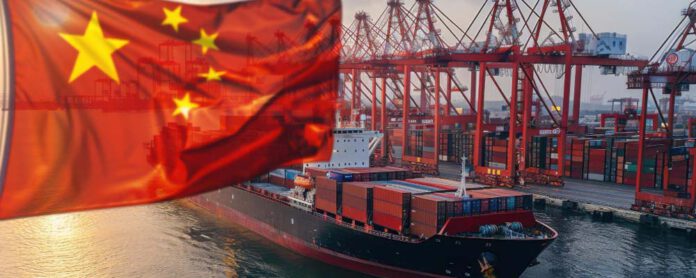
The scale of world trade is changing, and China is increasingly important not only as a supplier to global markets, but also as one of the world’s most consequential sources of demand.
At a time when global growth remains under pressure, trade barriers are rising and supply chains are being reconfigured, China’s foreign trade offers a revealing measure of how the global economy is evolving. The key question is no longer simply how much China sells to the world, but also how much China is buying from it.
In the first half of 2026, China’s total goods trade surpassed $ 3.73 trillion for the first time, increasing 16.9 percent year on year. Imports reached $ 1.6 trillion, up 22.1 percent, significantly faster than exports. The scale of imports exceeded $ 1.49 trillion in the first half of a year for the first time in China’s history.
Behind that figure lies a development with implications well beyond China itself: while many economies continue to struggle with weak demand, the Chinese market is absorbing an enormous volume of goods, raw materials, machinery, equipment and consumer products from around the world.
For many years, discussions of China’s role in global trade focused primarily on its exports. China became synonymous with manufacturing goods for international markets, from household appliances and furniture to electronics and industrial equipment.
But that picture is increasingly incomplete. China has remained the world’s second-largest import market for 17 consecutive years, and “selling to China” has become an increasingly important internationalization strategy for companies of very different sizes and origins.
The attraction begins with scale. China’s enormous consumer base and comprehensive industrial system generate demand across a broad range of sectors, from agricultural products and energy to industrial components, advanced equipment and consumer goods. Yet market size alone does not explain the growing interest. More significant is the transformation of Chinese demand itself.
As Chinese manufacturing moves toward greater technological sophistication, digitalization and lower-carbon production, demand is expanding for high-precision machine tools, industrial robots, sensors, industrial software, automated systems and energy-saving technologies. German companies offer a useful illustration.
For some manufacturers, exporting a machine to China is no longer a one-off transaction. A machine may be accompanied by software, technical adaptation, maintenance, training, energy-efficiency solutions and long-term services. A single piece of equipment can therefore become the starting point for a much broader commercial relationship.
A similar transformation is taking place in consumer markets. British folding-bicycle maker Brompton has found China to be its largest market, accounting for about 30 percent of global sales in its 2025-26 financial year. Thai conglomerate CP Group has expanded its offerings in China from fresh durian to frozen durian, durian ice cream and other processed products. Ethiopian coffee exporters are increasing production and processing capacity as demand from China grows.
These cases point to a broader phenomenon. The significance of the Chinese market is not simply that particular foreign products sell well there. Rather, the scale and diversity of Chinese demand are encouraging overseas companies to adapt products, develop new channels and upgrade their production capabilities.
Imports are therefore not merely a matter of consumption. They are also part of China’s industrial transformation. Machinery, industrial components and advanced technologies can support domestic upgrading, while agricultural products, consumer goods and services respond to changing household demand. In the first seven months of 2026, China’s imports of mechanical and electrical products reached $791.6 billion, an increase of 29.7 percent. Such growth links China’s import demand directly to technological upgrading and industrial investment.
The export side of China’s trade is changing just as rapidly. The country’s traditional export strengths in clothing, furniture and household appliances have increasingly been joined by electric vehicles, lithium batteries, solar products, industrial robots, artificial-intelligence equipment and other high-value-added products.
In the first half of 2026, China’s industrial robot exports rose 18.6 percent year on year, reaching markets in 141 countries and regions. This shift matters because it reflects a change in the basis of China’s competitiveness. Scale and cost remain important, but they are increasingly complemented by technological capability, dense industrial supply chains and the ability to respond quickly to changing global demand.
China’s export model is becoming less about simply producing more goods and more about producing increasingly sophisticated goods within an integrated manufacturing ecosystem.
Behind both imports and exports lies another critical asset: infrastructure. Around 95 percent of China’s international trade in goods is transported by sea, making major ports such as Ningbo-Zhoushan, Shanghai, Shenzhen and Qingdao essential nodes in global supply chains. At the same time, the China-Europe Railway Express has opened an increasingly important land corridor across Eurasia. More than 130,000 train services have been operated cumulatively, carrying goods across 53 major categories to hundreds of cities in Europe.
The diversification of China’s trading partners is equally significant. ASEAN has become China’s largest trading partner, while trade with countries participating in the Belt and Road Initiative accounts for more than half of China’s total foreign trade. Trade with Europe, Latin America and Africa has also continued to expand. On the import side, China recorded growth in imports from more than 150 countries and regions during the first half of 2026.
For developing economies, the significance of this expanding market can be particularly substantial. China’s decision to eliminate tariffs on imports from 53 African countries with which it maintains diplomatic relations is one example of how trade policy can influence market access. For Ethiopian coffee producers, for instance, growing demand from China is encouraging investment not only in exports but also in processing, packaging and supply networks. The result is potentially more than higher export volumes: it can create incentives for producers to move further up the value chain.
This is why China’s trade figures should not be viewed simply as an indicator of the country’s own economic performance. Exports represent China’s supply to the world, while imports represent China’s demand for the world. The same country can therefore function simultaneously as a major global supplier and a major global customer.
That dual role has become increasingly important at a time when the world economy is struggling with weak demand and greater uncertainty. Global trade ultimately depends on both sides of the equation: production and consumption, supply and demand, exporters and importers.
A large and increasingly open Chinese market can provide demand for products from Germany, Britain, Thailand, Ethiopia and many other economies, while Chinese manufacturers continue to supply goods to consumers and businesses around the world.
The deeper story behind China’s more than 25 trillion yuan of trade is therefore not simply that China is exporting more.
It is that the country is becoming more deeply embedded in both sides of global commerce. The question for the coming years will not only be how much China can sell abroad, but how much of the world’s products, technologies and services the Chinese market can absorb, and how effectively China’s manufacturing capabilities can continue to supply global demand.
In that sense, China’s trade is moving beyond the old distinction between an export powerhouse and an import market. It is becoming part of a more interconnected system in which markets, supply chains, technology and consumption increasingly reinforce one another.
The significance of China’s trade scale lies precisely in this two-way relationship: China is not simply a place from which the world buys. It is also a market to which the world increasingly sells, and through which global businesses are finding new ways to grow.
Source: yidaiyilu, bjd, cgtn, pangea logistics network